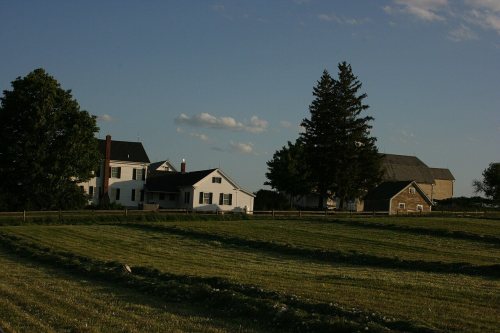
Founding year: Wikidata. First post office: 1802.The full story ↓
History grade
What drives New Haven’s History grade
On its age, its old homes and the National Register, New Haven is more historic than 91% of U.S. towns. All 3 inputs are above most U.S. towns; its age ranks highest and its National Register listings lowest.
A
HistoryA character grade: shown, never part of New Haven’s overall grade.
Vermont towns list more on the Register than most of the country (a typical Vermont town has 147 per 10,000 residents, the U.S. 2.4), so New Haven’s 50.2 sits near the middle of its state (48% of Vermont towns have fewer) while its 9 historic buildings outnumber those of 75% of U.S. towns.
NoteThe founding year comes from Wikidata alone; no second source gives 1761.
How sure. Graded on any two of the three inputs instead, the letter would range from A− to A+. The pre-1940 share is a Census survey estimate (±5.7 points).
Founding year: Wikidata (other dates in Quick answers). Homes: Census ACS 2020–24. National Register: National Park Service, May 2026 list; each listing counted once (boundary changes and added documentation belong to their listing), and a historic district counts its contributing buildings. How TownRatings grades history →
What stands out about New Haven’s past
Read from the archive, the National Register and the record. The page puts what stands out first.
In July 1830, New Haven was heavily affected by the Great Freshet of 1830. Floodwaters along the New Haven River destroyed bridges, mills, and homes, and fourteen residents were reported killed.
Passages that mention New Haven, cut from the printed page as they were published.
History of Addison county Vermont, with illustrations and biographical sketches of some of its prominent men and pioneers1886 · page 528Read the page →
Read the text
mentioned law in the United States Court. After protracted litigation the matter was decided in favor of the church. The suit, which was to test the validity of the church's title throughout the State, was brought against the town of New Haven. The share in New Haven for the first settled minister, after an attempt made by the Universalists to obtain it, was, by a vote of the town, appropriated to the use of common schools.
Text read by machine from the scan; it may contain errors.
History of Addison county Vermont, with illustrations and biographical sketches of some of its prominent men and pioneers1886Read the page →
Read the text
year, in Weybridge one year, and in Starksboro five years, where he conducted a rake factory and wheelwright shop, after which he went to New Haven for three years, working at the carpenter and joiner's trade. In the spring of 1875 he came to Weybridge and worked at his trade until May, 1880, when he took charge of the Weybridge grist-mill, which he has since conducted. He was married March 20, 1805, to Miss Marcia L. Evans, of Randolph, Vt. They have had three sons born to them — Albert E., who died December 2, 1885, aged nineteen; Merle B., now a student at Beeman Academy, New Haven, and Claude M. Mr. Sneden haa always taken a deep interest in the issues of the day, and for many years has been an earnest
Text read by machine from the scan; it may contain errors.
New Haven, a rural historical town of Vermont1887 · page 21Read the page →
Read the text
Between 40 and 50 years ago. New Haven was a very dull place. We had decided in school house debates that this town never would invite a railroad near, oats and horses would be worthless, taverns closed, and in the language of Judge Bottom, a flock of black birds flying over would be of equal value.
Text read by machine from the scan; it may contain errors.
Scans and text from the Internet Archive. Books published in 1930 or earlier, which are in the public domain.
By decade
New Haven, decade by decade
2 decades in the archive, from the 1830s to the 1940s. Scroll each row; tap a photo for its story.
Nothing in the archives for these yearsWeddings on Main Street, storms, parades, school pictures, the old store. If it’s in your family album, it belongs here.
In 1761, according to Wikidata. New Haven’s post office opened in 1802, and the first U.S. census counted 723 people here in 1790.
How does New Haven rank for history?
New Haven is more historic than 91% of U.S. towns. The History grade combines the town’s founding era, the share of homes built before 1940 and its National Register listings. It’s a character grade, so it isn’t part of the overall grade. How it works.
What is on the National Register in New Haven?
5 listings: 4 buildings, among them the New Haven Junction Depot (listed 1978, the first), and 1 structure. 9 historic buildings in all.
How old are the homes in New Haven?
24% of New Haven’s homes were built before 1940 (Census estimate, ±5.7 points), against a typical 22% for a Vermont town; the median home was built in 1981.
Founding dates: Wikidata, Wikipedia, the U.S. post office records of Blevins & Helbock (CC0) and the Census. Homes by year built: Census ACS 2020–24. National Register of Historic Places: National Park Service (list of May 22, 2026). Old photos, postcards and papers: Wikimedia Commons, the Library of Congress and other public archives, credited on each item’s page. Maps: U.S. Geological Survey historical topographic maps (via Esri) and Sanborn fire-insurance maps (Library of Congress). History text and census tables: Wikipedia (CC BY-SA 4.0). Places that used to be: USGS Geographic Names Information System (2021).
From Wikimedia Commons (11), the Library of Congress (1), the National Register of Historic Places (5), Wikipedia, Wikidata and Wikipedia for famous people, U.S. Geological Survey historical maps, U.S. Census counts (via Wikipedia), the US Post Offices dataset (Blevins & Helbock), the USGS Geographic Names Information System and old county and town histories (Internet Archive). Archive images are copied here with their credits and licenses, shown on each photo’s page. Refreshed monthly.


 1832–1833
 2014
 2014
 2014
 2012
 2012
 2012
 2011
 2007
 2004