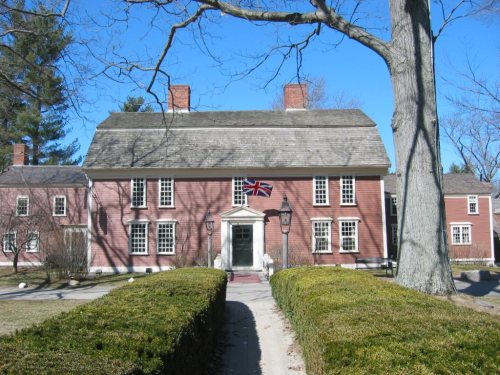
Sudbury dates to 1638, and 5 of its places are on the National Register
More historic than 78% of U.S. towns · #232 of 283 in Massachusetts. What drives it
Most of Sudbury was built recently: 6% of its homes predate 1940 and the median home dates from 1977. 5 places in town are on the National Register, among them two historic districts with 86 buildings between them. Below: 11 old photos and papers, maps from 1886 on, and the census since 1790.
Founding year: Wikidata. First post office: 1819.The full story ↓
History grade
What drives Sudbury’s History grade
On its age, its old homes and the National Register, Sudbury is more historic than 78% of U.S. towns, #232 of 283 in Massachusetts. Its age holds the grade up; its share of homes from before 1940 pulls it down.
A−
HistoryA character grade: shown, never part of Sudbury’s overall grade.
Massachusetts towns list more on the Register than most of the country (a typical Massachusetts town has 46.0 per 10,000 residents, the U.S. 2.4), so Sudbury’s 57.5 sits near the middle of its state (52% of Massachusetts towns have fewer) while its 111 historic buildings outnumber those of 90% of U.S. towns.
NoteThe founding year comes from Wikidata alone; no second source gives 1638.
How sure. Graded on any two of the three inputs instead, the letter would range from B− to A. The pre-1940 share (±2.3 points) is firm at this size.
Founding year: Wikidata (other dates in Quick answers). Homes: Census ACS 2020–24. National Register: National Park Service, May 2026 list; each listing counted once (boundary changes and added documentation belong to their listing), and a historic district counts its contributing buildings. How TownRatings grades history →
What stands out about Sudbury’s past
Read from the archive, the National Register and the record. The page puts what stands out first.
Incorporated in 1639, the boundaries of Sudbury included (by 1653) what is now Wayland (which split off in 1780, initially as East Sudbury), and parts of present day Framingham, Marlborough, Stow and Maynard (the latter town splitting off in 1871). Nipmuc Indians lived in what is now Sudbury, including Tantamous, a medicine man, and his son Peter Jethro, who deeded a large parcel of land to Sudbury for settlement in 1684.
Passages that mention Sudbury, cut from the printed page as they were published.
A history of Framingham, Massachusetts, including the Plantation, from 1640 to the present time, with an appendix, containing a notice of Sudbury and its first proprietors1847 · page 10Read the page →
Read the text
Crowne, in the year 1662, at a place near the Cold Spring, near unto the road which leadeth from Sudbury unto Connecticut, on the S. side of a branch of Sudbury river, being about nine miles from the town of Sudbury, at a place called by the Indians, Maynaguncok hill ; beginning at the S. side of the said hill, and from thence a line upon a N.N.
Text read by machine from the scan; it may contain errors.
A history of Framingham, Massachusetts, including the Plantation, from 1640 to the present time, with an appendix, containing a notice of Sudbury and its first proprietors1847 · page 24Read the page →
Read the text
A few weeks after that event, occurred the incident we are now to relate.* Thomas Eames, who a few years before had leased the " Pelham Farm," at Sudbury, settled, near 1670, within the bounds of the Plantation of Framingham. He built his house on the southern slope of Mount Wayte, between the Sudbury river and Farm pond, at a distance of about seven miles S.W. from the ancient town of Sudbury, and about three miles E.
Text read by machine from the scan; it may contain errors.
Newton genealogy, genealogical, biographical, historical1915 · page 804Read the page →
Read the text
6970. JOSEPH NEWTOX^ of Htill, England, was from a family of Newtons that lived in Hull, Yorkshire, England, for several generations and hefore that came from the adjoining County of Lincolnshire. Since our Richard Newton of Sudbury, Mass., probably originated in or near the home town of Sudbury, England, it is not impossible that these two clans may have been nearly related.
Text read by machine from the scan; it may contain errors.
Newton genealogy, genealogical, biographical, historical1915 · page 34Read the page →
Read the text
probably a smelter, or a blomary, or a foundry; something more than a blacksmith's shop. They did things in a small way in those days, but got the results they desired. Wliat leads me to think the ironworks at Southborough was of the kind above mentioned is that it is said by the historian of Sudbury that witliin the present [1800] century, iron ore dug in the town was laden on boats at Old Town Bridge and taken down Sudbury river to Chelmsford.
Text read by machine from the scan; it may contain errors.
Scans and text from the Internet Archive. Books published in 1930 or earlier, which are in the public domain.
By decade
Sudbury, decade by decade
2 decades in the archive, from the 1890s to the 1900s. Scroll each row; tap a photo for its story.
Nothing in the archives for these yearsWeddings on Main Street, storms, parades, school pictures, the old store. If it’s in your family album, it belongs here.
In 1638, according to Wikidata. Sudbury’s post office opened in 1819, and the first U.S. census counted 1,290 people here in 1790.
How does Sudbury rank for history?
Sudbury is more historic than 78% of U.S. towns, #232 of 283 in Massachusetts. The History grade combines the town’s founding era, the share of homes built before 1940 and its National Register listings. It’s a character grade, so it isn’t part of the overall grade. How it works.
What is on the National Register in Sudbury?
5 listings: 3 buildings and 2 historic districts, the Wayside Inn Historic District and the Sudbury Center Historic District, with 86 contributing buildings. 111 historic buildings in all.
How old are the homes in Sudbury?
6% of Sudbury’s homes were built before 1940 (Census estimate, ±2.3 points), against a typical 21% for a Massachusetts town; the median home was built in 1977.
Founding dates: Wikidata, Wikipedia, the U.S. post office records of Blevins & Helbock (CC0) and the Census. Homes by year built: Census ACS 2020–24. National Register of Historic Places: National Park Service (list of May 22, 2026). Old photos, postcards and papers: Wikimedia Commons, the Library of Congress and other public archives, credited on each item’s page. Maps: U.S. Geological Survey historical topographic maps (via Esri) and Sanborn fire-insurance maps (Library of Congress). History text and census tables: Wikipedia (CC BY-SA 4.0). Places that used to be: USGS Geographic Names Information System (2021).
From Wikimedia Commons (6), the Library of Congress (5), Wikidata (4), the National Register of Historic Places (5), Wikipedia, Wikidata and Wikipedia for famous people, U.S. Geological Survey historical maps, U.S. Census counts (via Wikipedia), the US Post Offices dataset (Blevins & Helbock), the USGS Geographic Names Information System and old county and town histories (Internet Archive). Archive images are copied here with their credits and licenses, shown on each photo’s page. Refreshed monthly.






 1890
 1890
 1898
 1898
 1898
 1898
 1898
 1898
 1900