Marlborough dates to 1657, and 21% of its homes were built before 1940
More historic than 90% of U.S. towns · #141 of 283 in Massachusetts. What drives it
16 places in town are on the National Register, among them three historic districts with 126 buildings between them. Below: 7 old photos and papers, maps from 1885 on, and the census since 1790.
Founding year: Wikidata. First post office: 1799.The full story ↓
History grade
What drives Marlborough’s History grade
On its age, its old homes and the National Register, Marlborough is more historic than 90% of U.S. towns, #141 of 283 in Massachusetts. All 3 inputs are above most U.S. towns; its age ranks highest and its National Register listings lowest.
A
HistoryA character grade: shown, never part of Marlborough’s overall grade.
Massachusetts towns list more on the Register than most of the country (a typical Massachusetts town has 46.0 per 10,000 residents, the U.S. 2.4), so Marlborough’s 31.7 sits near the middle of its state (40% of Massachusetts towns have fewer) while its 132 historic buildings outnumber those of 91% of U.S. towns.
How sure. Graded on any two of the three inputs instead, the letter would range from A− to A. The pre-1940 share (±2.9 points) is firm at this size. Two sources give 1657.
Founding year: Wikidata (other dates in Quick answers). Homes: Census ACS 2020–24. National Register: National Park Service, May 2026 list; each listing counted once (boundary changes and added documentation belong to their listing), and a historic district counts its contributing buildings. How TownRatings grades history →
What stands out about Marlborough’s past
Read from the archive, the National Register and the record. The page puts what stands out first.
In 1656, several families from Sudbury, Massachusetts, led by Edmund Rice, John Howe, John Ruddock, and John Bent, petitioned the Massachusetts General Court to create a new town. The proposed town would be located southwest of Sudbury at the intersection of two trails used by local Native American tribes, known as the Nashua Trail and Connecticut path. Its name would be Marlborough, after the market town in Wiltshire, England of the same name.
Passages that mention Marlborough, cut from the printed page as they were published.
History of the town of Marlborough, Middlesex county, Massachusetts, from its first settlement in 1657 to 18611862 · page 116Read the page →
Read the text
Bat the old town of Marlborough was destined to a further dismemberment. The people of " Stony Brook," as the south part of Marlborough was familiarly called, applied to the town to be set off as a distinct municipality. After some delay, the town agreed upon a line, and joined in a petition " with the Stony Brook men for a confirmation of said township." The territory thus set off was incorporated in 1121, by the name of Southborough — a name suggested by its geographical position
Text read by machine from the scan; it may contain errors.
Topographical and historical sketches of the town of Northborough, with the early history of Marlborough, in the commonwealth of Massachusetts, furnished for the Worcester magazine1826 · page 23Read the page →
Read the text
Plantation of Marlborough, was completely broken up and soon passed into other hands. On the 15th of July 1684, a fevv weeks subsequent to the date of the Indian deed of the English Plantation, the Indian lands were formally transferred by deed to John Brigham ot Marlborough and his fellow purchasers ;* and in October, 1686, the aforesaid John Brigh;im who was a note<l surveyor and speculator in lands, was appointed " to lay out 30 acres to each of the proprietors in some of the best of the land lying as convenient
Text read by machine from the scan; it may contain errors.
Historical reminiscences of the early times in Marlborough, Massachusetts1910 · page 388Read the page →
Read the text
In 1909. Marlborough expended about $4,000 for the public library; police department appropriation for 1909 was $11,500; in 1909 Marlborough appropriated for the poor $9500; $1,000 was appropriated to Marlborough hospital in 1909 ; in 1909 Marlborough expended about $23,500 for highways; in 1909 Marlborough expended about $11,000 for the fire department ; in 1909 between five and six thousand dollars was spent for gypsy moth destruction; in 1909 Marlborough expended for electric lights $10,350.
Text read by machine from the scan; it may contain errors.
Historical reminiscences of the early times in Marlborough, Massachusetts1910 · page 122Read the page →
Read the text
Arnold's daughters, remained on the home place. Before the town of Marlborough was settled by the English the Indians cultivated the apple, and Gookin, in describing the Indian planting field, speaks of the apple orchards whose fruit in every period of Marlborough history has been conspicuous. As early as KwC) the Indians showed their appreciation for this fruit, and never failed to injure the orchards belonging to their enemies. In 17r)2 Henry I^arnes, Esc[., the loyalist, set up a distillery in the center of the town for the manufacture of cider brandy which he ex-
Text read by machine from the scan; it may contain errors.
Scans and text from the Internet Archive. Books published in 1930 or earlier, which are in the public domain.
By decade
Marlborough, decade by decade
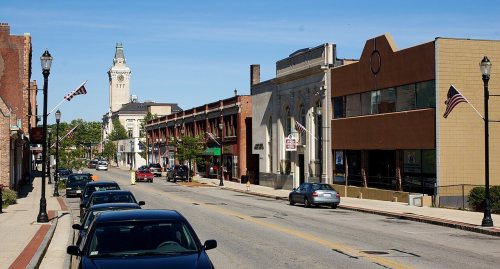
One decade in the archive so far: the 1890s. Scroll each row; tap a photo for its story.
Nothing in the archives for these yearsWeddings on Main Street, storms, parades, school pictures, the old store. If it’s in your family album, it belongs here.
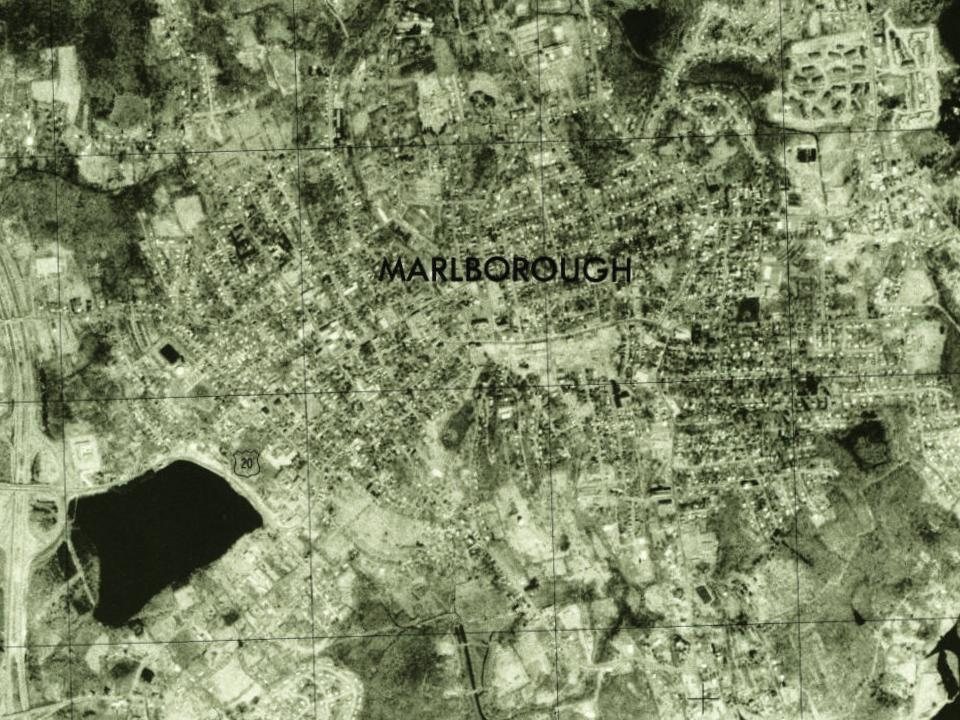
Fire insurance maps drew every building, what it was made of and what it was used for, so insurers could price the risk of fire. Pick a year, then a sheet.
In 1657, according to Wikidata. Marlborough’s post office opened in 1799, and the first U.S. census counted 1,554 people here in 1790.
How does Marlborough rank for history?
Marlborough is more historic than 90% of U.S. towns, #141 of 283 in Massachusetts. The History grade combines the town’s founding era, the share of homes built before 1940 and its National Register listings. It’s a character grade, so it isn’t part of the overall grade. How it works.
What is on the National Register in Marlborough?
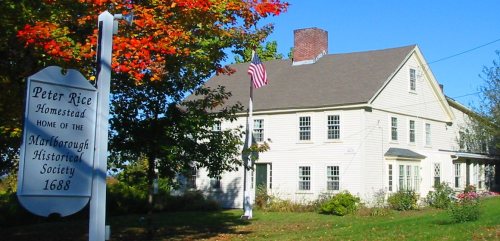
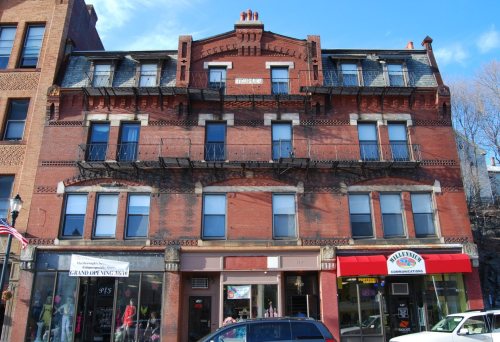
16 listings: 5 buildings, among them the Capt. Peter Rice House (listed 1980, the first), 3 historic districts, the Marlborough Center Historic District, the Pleasant Street Historic District and the West Main Street Historic District, with 126 contributing buildings, 7 sites, and 1 structure. 132 historic buildings in all.
How old are the homes in Marlborough?
21% of Marlborough’s homes were built before 1940 (Census estimate, ±2.9 points), against a typical 21% for a Massachusetts town; the median home was built in 1974.
Founding dates: Wikidata, Wikipedia, the U.S. post office records of Blevins & Helbock (CC0) and the Census. Homes by year built: Census ACS 2020–24. National Register of Historic Places: National Park Service (list of May 22, 2026). Old photos, postcards and papers: Wikimedia Commons, the Library of Congress and other public archives, credited on each item’s page. Maps: U.S. Geological Survey historical topographic maps (via Esri) and Sanborn fire-insurance maps (Library of Congress). History text and census tables: Wikipedia (CC BY-SA 4.0). Places that used to be: USGS Geographic Names Information System (2021).
From Wikimedia Commons (7), Wikidata (10), the National Register of Historic Places (16), Wikipedia, Wikidata and Wikipedia for famous people, U.S. Geological Survey historical maps, U.S. Census counts (via Wikipedia), the US Post Offices dataset (Blevins & Helbock), the USGS Geographic Names Information System, Sanborn fire insurance maps (Library of Congress) and old county and town histories (Internet Archive). Archive images are copied here with their credits and licenses, shown on each photo’s page. Refreshed monthly.









 1896
 1896
 1896
 1896
 1896
 1896

