Founding year: Wikipedia. First post office: 1821.The full story ↓
History grade
What drives Ellington’s History grade
On its age, its old homes and the National Register, Ellington is more historic than 62% of U.S. towns, #133 of 155 in Connecticut. Its National Register listings hold the grade up; its share of homes from before 1940 pulls it down.
B
HistoryA character grade: shown, never part of Ellington’s overall grade.
Connecticut towns list more on the Register than most of the country (a typical Connecticut town has 73.3 per 10,000 residents, the U.S. 2.4), so Ellington’s 63.2 sits near the middle of its state (44% of Connecticut towns have fewer) while its 104 historic buildings outnumber those of 90% of U.S. towns.
NoteThe founding year comes from Wikipedia alone; no second source gives 1733.
How sure. Graded on two of the three inputs, so a change in either one moves the letter more than it would with three. The pre-1940 share is a Census survey estimate (±3.2 points).
Founding year: Wikipedia (other dates in Quick answers). Homes: Census ACS 2020–24. National Register: National Park Service, May 2026 list; each listing counted once (boundary changes and added documentation belong to their listing), and a historic district counts its contributing buildings. How TownRatings grades history →
What stands out about Ellington’s past
Read from the archive, the National Register and the record. The page puts what stands out first.
The land that became Ellington was named by the natives as “Weexskashuck” which translates to “Great Marsh”. The earliest settlers called the area Great Marsh or Goshen. In 1671, the town of Windsor, purchased the land of East Windsor and Ellington from the Native Americans to recover land loss from the Connecticut-Massachusetts border dispute. Though no one attempted to settle the fertile lands for another 50 years. Samuel Pinney was the first settler in today's Ellington (Pinney Road bears his name in town). In 1733, Ellington was established as a Parish of the town of Windsor. East Windsor then split off from Windsor and held land in what is today's East Windsor, South Windsor and Ellington in May 1768. Ellington split off twenty years later and incorporated itself in May 1786. Mostly known as an agricultural community, the Crystal Lake section of town was for a while a popular summe…
Passages that mention Ellington, cut from the printed page as they were published.
History of ancient Windsor, Connecticut, including East Windsor, South Windsor, and Ellington, prior to 1768, the date of their separation from the old town1859 · page 274Read the page →
Read the text
assemblj' postponed it until October, then until May, 1168, when that part of Windsor east of the Connecticut River, was made the town of East Windsor. With this improvement of their circumstances, the Ellington people seem to have been content until llie obvious claims of the parish to a distinct organization, resulted in their incorporation in 1186, as the town of Ellington' Tho relations of the town with East Windsor, were always amicable; the neighborly connection between them is not yet
Text read by machine from the scan; it may contain errors.
History of ancient Windsor, Connecticut, including East Windsor, South Windsor, and Ellington, prior to 1768, the date of their separation from the old town1859 · page 113Read the page →
Read the text
This extensive purchase, covering the greatest part of Enfield; two thirds of East Windsor; east of Scantic; and all of Ellington, was obtained by the Bissells for the town of Windsor, to whom it was afterwards transferred. The Bissells received 200 acres (in the present town of Ellington) for their share in the transaction.
Text read by machine from the scan; it may contain errors.
Scans and text from the Internet Archive. Books published in 1930 or earlier, which are in the public domain.
Timeline
Ellington, 1733 to 1917
Woven from the archive, old maps, post office records, the National Register and the people born here.
In 1733, according to Wikipedia’s history of the town. Ellington’s post office opened in 1821, and the census of 1820 counted 1,196 people here.
How does Ellington rank for history?
Ellington is more historic than 62% of U.S. towns, #133 of 155 in Connecticut. The History grade combines the town’s founding era, the share of homes built before 1940 and its National Register listings. It’s a character grade, so it isn’t part of the overall grade. How it works.
What is on the National Register in Ellington?
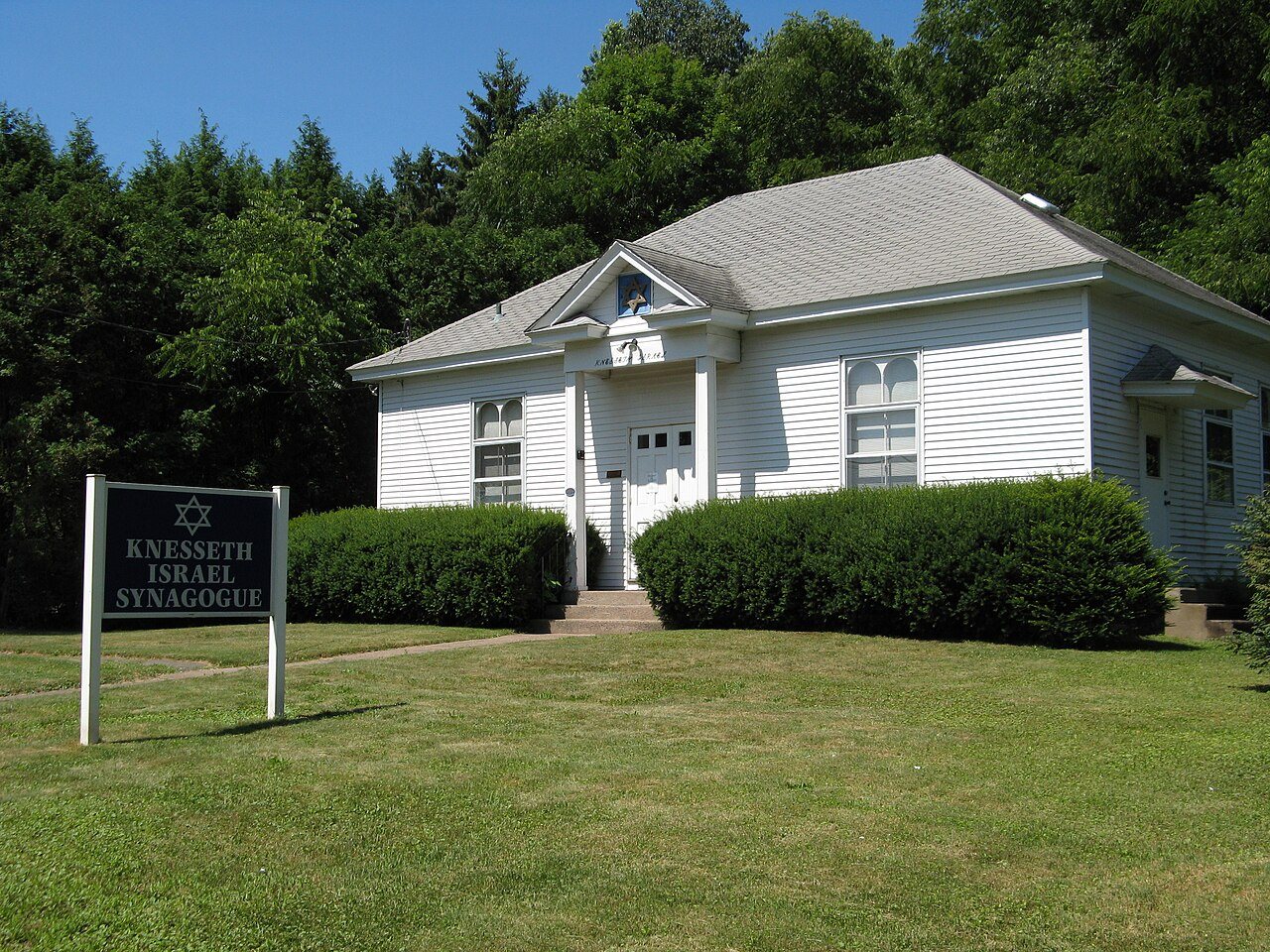
Two places: the Ellington Center Historic District (listed 1990) and the Knesseth Israel Synagogue (1995).
How old are the homes in Ellington?
10% of Ellington’s homes were built before 1940 (Census estimate, ±3.2 points), against a typical 15% for a Connecticut town; the median home was built in 1982.
Founding dates: Wikidata, Wikipedia, the U.S. post office records of Blevins & Helbock (CC0) and the Census. Homes by year built: Census ACS 2020–24. National Register of Historic Places: National Park Service (list of May 22, 2026). Old photos, postcards and papers: Wikimedia Commons, the Library of Congress and other public archives, credited on each item’s page. Maps: U.S. Geological Survey historical topographic maps (via Esri) and Sanborn fire-insurance maps (Library of Congress). History text and census tables: Wikipedia (CC BY-SA 4.0). Places that used to be: USGS Geographic Names Information System (2021).
From Wikimedia Commons (6), the National Register of Historic Places (2), Wikipedia, Wikidata and Wikipedia for famous people, U.S. Geological Survey historical maps, U.S. Census counts (via Wikipedia), the US Post Offices dataset (Blevins & Helbock), the USGS Geographic Names Information System and old county and town histories (Internet Archive). Archive images are copied here with their credits and licenses, shown on each photo’s page. Refreshed monthly.





 2010
 2009
 2007
 2007
 2007
 2006