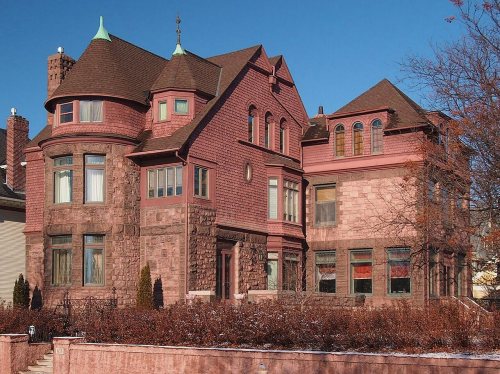
St. Paul’s weakest is safety — its police reported 1,505 violent crimes reported to the FBI in 2025, a higher rate per resident than just over nine in ten U.S. towns. Schools are weaker too — its schools rank behind nearly four fifths of the state's. Walkability is its strong suit: it is more walkable than 98% of U.S. towns. Homes run about $291K for a typical one, 2.9 times the Minneapolis metro’s $100K median household income. Health is a strength too — residents are healthier than just over two thirds of U.S. towns on CDC estimates. The overall grade comes out at C, better than 27% of U.S. towns. In the ranking it comes 259th of 271 in Minnesota. History is its standout character grade: an A+, better than 98% of U.S. towns, with 119 places on the National Register.
Figures: health, CDC PLACES · FBI crime data, 2025 · schools, state test and graduation results · home values, Zillow · incomes, Census ACS, 2020–24.
Fort Snelling · National Register of Historic Places
St. Paul’s story
180 years in pictures
Fort Snelling is one of 4 National Historic Landmarks here, the National Register’s top tier. Its founding year, 1846, comes before those of 98% of the Minnesota towns we grade with a known year.
Census counts: 1,112 in 1850, 311,527 in 2020. The archive holds 6 old photos and papers going back to 1843 and 6 maps from 1896 on.
119 places on the National Register of Historic Places.
Its grades run from A+ for walkability (better than 98% of comparable towns) to D for safety (better than 9%), so the C overall blends very different results.
St. Paul has homes that are cheap against local pay and gets more snow than most of the country, though not than most of Minnesota; it also reports violent crime at about twice the Minnesota rate.
The biggest place to walk is Pig's Eye Regional Park, 1,752 acres with 3.2 miles of trail. Count the trails in 136 parks and preserves and they come to 91 miles. St. Paul’s trail density stands at 1.6 miles per square mile, above both the Minnesota town median (0.5) and the median of U.S. towns (0.4).
Each of its 6 graded neighbors has a higher School Grade than its C−, West St. Paul highest at B.
The Saint Paul Public Schools runs its public schools. Of its 180 schools, three are listed below, each with the reason. Public school enrollment in St. Paul: 5,010 students across 6 schools.
Violent crime runs at 4.9 per 1,000 residents, about twice the Minnesota rate; the Safety Grade counts each violent crime four times, so this weighs most on its D. Reported crimes fell from 11,156 to 10,063 over the last three FBI years, a drop beyond ordinary year-to-year swings.
For St. Paul, the property offense rate is 27.8 per 1,000 residents. This Minnesota town reports more crime per resident than most U.S. towns we grade: about 91% report less.
St. Paul’s natural-hazard score from FEMA stands at 25 of 100, against 40 of 100 in Minnesota’s towns and 44 of 100 across U.S. towns. Federal aid has come to St. Paul households in 6 declared disasters; the latest was in 2019. FEMA puts nearly a third of the town’s expected hazard losses down to inland flooding, and 26% to cold waves.
Within Minnesota it is less healthy than 60% of the 271 graded towns: Minnesota sets a high bar.
Among adults in St. Paul, 28% have high blood pressure. CDC measures, 32 in all: St. Paul beats Minnesota on 4 and trails on 13. Of the 271 Minnesota towns we compare, none has a higher share of adults who feel lonely than St. Paul. 73% of adults in the town had a checkup this year; 19% worry about having enough food.
68%healthier than U.S. townsB+Health Grade
St. Paul
Minnesota towns
U.S. towns
Feel lonely (CDC PLACES)
39%
30%
33%
Yearly checkup (CDC PLACES)
73%
75%
79%
Food insecurity (CDC PLACES)
19%
11%
14%
High blood pressure (CDC PLACES)
28%
31%
35%
32 measures vs. Minnesota
4 better15 too close to call13 worse
What stands out
St. Paul
MN
Fewer adults who have had cancer
6.2%
8.5%
Fewer adults with arthritis
18.3%
22.3%
More adults facing food insecurity
19.4%
11.4%
Allina United Hospital
0.5 mi away · emergency room
3 of 3
care shortages: primary care, dental, mental health
The U Of Mn St Paul weather station, 5 miles away, records that 40 inches of snow fall in a normal winter: more than most of the country, but less than 83% of Minnesota places with climate records. July afternoons average 82.5°: cooler than most of the country, but hotter than 90% of Minnesota places with climate records; January nights average 6.9°.
The typical July afternoon high for St. Paul comes to 83°F. St. Paul’s January low is 7°F.
St. Paul: 44% of adults 25 and older hold a bachelor’s degree or more. Adults 18 to 34 are 29% of residents (22% statewide); people 65 and older are 12% of residents (17% statewide).
33.7median age · MN 38.8
St. Paul
Minnesota towns
U.S. towns
Median age
33.7 years
39.9 years
40.5 years
Aged 65 or older
12%
18%
18%
Bachelor’s degree or more, 25+
44%
33%
29%
Under 18
24%
23%
22%
St. PaulMinnesotaUnited States
Ages · share of residents
18%
<1010–1718–2425–3435–4445–5455–6465–7475+
Education · adults 25 and older
No diploma11%
High school21%
Some college18%
Associate’s8%
Bachelor’s25%
Graduate19%
Women and men · all residents
50.9% women, 49.1% men
WomenMNU.S.Men
About 96 men for every 100 women. Across Minnesota, 49.9% of residents are women. Median age: women 33.8, men 33.6.
Jobs in St. Paul fell by 10,637 from 2013 to 2023, to 165,704. One in 4 of the town’s working residents works locally. The share of residents in St. Paul who live below the poverty line: 16%. The median commute is under 7 miles.
28%work in town
St. Paul
Minnesota towns
U.S. towns
Working residents who work in town
28%
9.7%
8%
Work from home
20%
14%
11%
Below the poverty line
16%
7%
9.6%
Average trip to work
21 minutes
23 minutes
25 minutes
Where working residents work
In St. Paul28%
Minneapolis20%
Bloomington4%
Edina3%
Roseville3%
7 mi
median commute distance
165,704
jobs based in St. Paul
Balanced
jobs vs. working residents
A+
Walkability grade: more walkable than 98% of U.S. towns
At 2.9 years of the Minneapolis metro’s $100K median household income, the typical home (about $291K) costs less against local pay than in 90% of Minnesota towns; that ratio is one input to that grade.
For households in St. Paul, the share who are owner-occupiers is 53%. The typical home value locally is about $291,000, up 0.8% in a year, 17% below the Minnesota typical home. A home in St. Paul typically sold within 21 days of listing.
Saint Paul (often abbreviated to St. Paul) is the capital city of the U.S. state of Minnesota and the county seat of Ramsey County. As of the 2020 census, the city had a population of 311,527, making it Minnesota's second-most populous city and the 69th-most populous in the United States. Saint Paul and neighboring Minneapolis form the core of the Twin Cities metropolitan area, the third most populous in the Midwest with around 3.7 million residents. The Minnesota State Capitol and the state government offices sit on a hill next to downtown Saint Paul overlooking a bend in the Mississippi River. Local cultural offerings include the Science Museum of Minnesota, the Ordway Center for the Perf…
Falcon Heights reports no FBI crime data of its own. Lilydale isn’t graded (fewer than 1,000 residents, or not enough data). Compare St. Paul with a neighbor →
Questions about St. Paul
Short answers, built from the data on this page.
Is St. Paul, MN a good place to live?
St. Paul grades C overall, better than 27% of U.S. towns and #259 of 271 in Minnesota. It grades B+ for health, D for safety and C− for schools. Safety is its weak spot, with a D.
Is St. Paul, MN expensive?
Cost of living, which also weighs rents, property taxes and how many households pay 30% or more of their income for housing, grades C+.
What is St. Paul, MN known for?
32 notable people were born here, including F. Scott Fitzgerald and Melvin Calvin.



 in town
 6 mi
 in town
 9 mi
 in town