Tulsa dates to 1828, and 99 of its places are on the National Register
More historic than 84% of U.S. towns · #1 of 131 in Oklahoma. What drives it
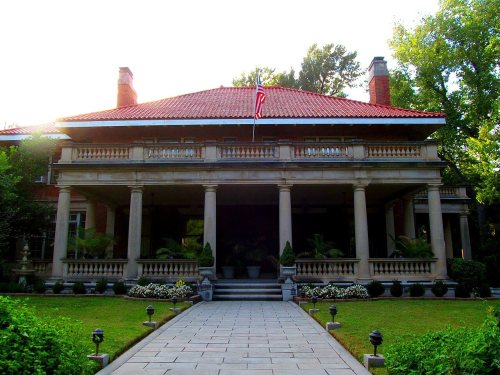
Most of Tulsa was built recently: 9% of its homes predate 1940 and the median home dates from 1973. 99 places in town are on the National Register, among them the Boston Avenue Methodist Episcopal Church, a National Historic Landmark, and ten historic districts with 3,357 buildings between them. Below: 14 old photos and papers, maps from 1894 on, and the census since 1900.
Founding year: Wikipedia. First post office: 1879.The full story ↓
History grade
What drives Tulsa’s History grade
On its age, its old homes and the National Register, Tulsa is more historic than 84% of U.S. towns, #1 of 131 in Oklahoma. Its National Register listings hold the grade up; its share of homes from before 1940 pulls it down.
A−
HistoryA character grade: shown, never part of Tulsa’s overall grade.
Among the 400 U.S. cities of 100,000 or more, Tulsa ranks #101 on History.
Oklahoma towns list more on the Register than most of the country (a typical Oklahoma town has 5.9 per 10,000 residents, the U.S. 2.4), so Tulsa’s 83.3 sits above most of its state (93% of Oklahoma towns have fewer) while its 3,447 historic buildings outnumber those of 100% of U.S. towns.
How sure. Graded on any two of the three inputs instead, the letter would range from B to A+. The pre-1940 share (±0.3 points) is firm at this size. Two sources give 1828.
Founding year: Wikipedia (other dates in Quick answers). Homes: Census ACS 2020–24. National Register: National Park Service, May 2026 list; each listing counted once (boundary changes and added documentation belong to their listing), and a historic district counts its contributing buildings. How TownRatings grades history →
What stands out about Tulsa’s past
Read from the archive, the National Register and the record. The page puts what stands out first.
The country’s official list of buildings and places worth saving. One is a National Historic Landmark, the highest tier. Boundary changes and added documentation are counted with their listing.
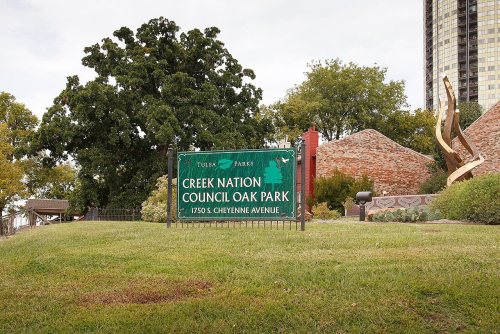
The area where Tulsa now exists is considered Indian Territory, on the land of the Kiikaapoi (Kickapoo), Wahzhazhe Ma zha (Osage), Muscogee (Creek/Muskogee), and Caddo tribes, among others. It was initially named after a Muscogee settlement in the southeastern United States called Tvlahasse with the short form Tallasi in the Muscogee language, which became Tullahassee or Tallise in Spanish. Etvlwv ahassee means "old town" in the Muscogean language. In 1540, Hernando de Soto became the first European to visit and document the original Tulsa in the southeast. Tvlahasse was a member of the Creek Confederacy and had a strong relationship with the town of Locvpokv and members of the two towns largely settled together after Indian Removal and the Trail of Tears in modern-day Tulsa.
Passages that mention Tulsa, cut from the printed page as they were published.
The history of Tulsa, Oklahoma1921 · page 595Read the page →
Read the text
kansas, where he engaged in banking, becoming president of the Bank of Sulphur Springs and so continuing for two years. In 19 13 he returned to Oklahoma, where he has engaged in the real estate and oil business. For a time he was at Sallisaw, Oklahoma, and in 191 5 came to Tulsa, where he has since made his home. He acted as highway commissioner for the Chamber of Commerce until 1918, when he resigned to accept the position of secretary of the Auto Club of Tulsa, so continuing until July, 1920, when he resigned the latter position and became state distributor of the United States Compression Inner
Text read by machine from the scan; it may contain errors.
The history of Tulsa, Oklahoma1921 · page 734Read the page →
Read the text
more gracious associations and memories of his military career by his active affiliation with the Grand Army of the Republic, in which he served several years as adjutant. Mr. Norvell continued his residence in Missouri until 1903, when he came to Tulsa, Oklahoma, acquired extensive land holdings in this section of the state and was successful and influential as a pioneer exponent of the real estate business at Tulsa. A man of fine personality and distinctive ability, he was the friend and confidant of many of the influential men of the city and county, his circle of friends being coextensive with that of his acquaintances, and his personal
Text read by machine from the scan; it may contain errors.
Scans and text from the Internet Archive. Books published in 1930 or earlier, which are in the public domain.
Timeline
Tulsa, 1828 to 1954
Woven from the archive, old maps, post office records, the National Register and the people born here.
Nothing in the archives for these yearsWeddings on Main Street, storms, parades, school pictures, the old store. If it’s in your family album, it belongs here.
Every edition of the U.S. Geological Survey’s map of Tulsa. Tap a year, or press play to watch the town change.
1954Tulsa sheet · 1:24,000
U.S. Geological Survey historical topographic maps (public domain), via Esri’s collection of the scans. The red ring marks the center of Tulsa.
Every building
Tulsa, building by building, 1894–1915
Fire insurance maps drew every building, what it was made of and what it was used for, so insurers could price the risk of fire. Pick a year, then a sheet.
1894Sheet 1 of 1
Edition
Sheets
BrickWoodStone
Sanborn Map Company, via the Library of Congress. Editions published in 1930 or earlier, which are in the public domain.
Then & now
Stand where they stood
No then-and-now pairs yet. Take a photo from the same spot as an old one and they appear here side by side.
Retake this view1940 Census Enumeration District Maps - Oklahoma - Tulsa County - Tulsa - ED 79-1 - ED 79-121C, 1880
Find the spot, match the angle, and add your photo. It becomes the first then-and-now pair on Tulsa’s page.
In 1828, according to Wikipedia’s history of the town. Tulsa’s post office opened in 1879, and the census of 1900 counted 1,390 people here.
How does Tulsa rank for history?
Tulsa is more historic than 84% of U.S. towns, #1 of 131 in Oklahoma. The History grade combines the town’s founding era, the share of homes built before 1940 and its National Register listings. It’s a character grade, so it isn’t part of the overall grade. How it works.
What is on the National Register in Tulsa?
99 listings: 69 buildings, among them the Boston Avenue Methodist Episcopal Church (a National Historic Landmark since 1999) and the Westhope (listed 1975, the first), 28 historic districts with 3,357 contributing buildings, 1 site, and 1 structure. 3,447 historic buildings in all.
How old are the homes in Tulsa?
9% of Tulsa’s homes were built before 1940 (Census estimate), against a typical 7.0% for an Oklahoma town; the median home was built in 1973.
Founding dates: Wikidata, Wikipedia, the U.S. post office records of Blevins & Helbock (CC0) and the Census. Homes by year built: Census ACS 2020–24. National Register of Historic Places: National Park Service (list of May 22, 2026). Old photos, postcards and papers: Wikimedia Commons, the Library of Congress and other public archives, credited on each item’s page. Maps: U.S. Geological Survey historical topographic maps (via Esri) and Sanborn fire-insurance maps (Library of Congress). History text and census tables: Wikipedia (CC BY-SA 4.0). Places that used to be: USGS Geographic Names Information System (2021).
From Wikimedia Commons (12), the Library of Congress (2), Wikidata (4), the National Register of Historic Places (99), Wikipedia, Wikidata and Wikipedia for famous people, U.S. Geological Survey historical maps, U.S. Census counts (via Wikipedia), the US Post Offices dataset (Blevins & Helbock), the USGS Geographic Names Information System, Sanborn fire insurance maps (Library of Congress) and old county and town histories (Internet Archive). Archive images are copied here with their credits and licenses, shown on each photo’s page. Refreshed monthly.


 ★ Landmark






 1896
 1906
 1908
 1909
 1909
 1910
 1910
 1910
 1910
 1912


