Stanford dates to 1750, and 22% of its homes were built before 1940
More historic than 95% of U.S. towns · #155 of 758 in New York. What drives it
6 places in town are on the National Register, among them two historic districts with 29 buildings between them. Below: 2 old photos and papers, maps from 1899 on, and the census since 1820.
Founding year: Wikipedia. First post office: 1814.The full story ↓
History grade
What drives Stanford’s History grade
On its age, its old homes and the National Register, Stanford is more historic than 95% of U.S. towns, #155 of 758 in New York. All 3 inputs are above most U.S. towns; its age ranks highest and its share of homes from before 1940 lowest.
A
HistoryA character grade: shown, never part of Stanford’s overall grade.
New York towns list more on the Register than most of the country (a typical New York town has 12.3 per 10,000 residents, the U.S. 2.4), so Stanford’s 97.5 sits above most of its state (76% of New York towns have fewer) while its 36 historic buildings outnumber those of 83% of U.S. towns.
NoteThe founding year comes from Wikipedia alone; no second source gives 1750.
How sure. Graded on any two of the three inputs instead, the letter would range from A to A+. The pre-1940 share is a Census survey estimate (±6.5 points).
Founding year: Wikipedia (other dates in Quick answers). Homes: Census ACS 2020–24. National Register: National Park Service, May 2026 list; each listing counted once (boundary changes and added documentation belong to their listing), and a historic district counts its contributing buildings. How TownRatings grades history →
What stands out about Stanford’s past
Read from the archive, the National Register and the record. The page puts what stands out first.
Bangall Baptist Cemetery Number 2Bangall Baptist Church Cemetery Number 1CarpenterSaint Mary'sStanfordvilleStanfordville FriendsSutherland - Bear MarketThompson Family
US Post Offices dataset (Blevins & Helbock, CC0). Places and cemeteries from the USGS Geographic Names Information System (2021).
Help out
Start Stanford’s collection
The first neighbors to add old photos shape how Stanford’s history is told.
Decades since 1900 with photos
00s10s20s30s40s50s60s70s80s90s
0 of 10 decades. The empty ones are waiting for someone’s album.
Stanford was first settled circa 1750. The town was part of the Great Nine Partners Patent of 1697. The town of Stanford was formed in 1793 from the town of Washington.
Passages that mention Stanford, cut from the printed page as they were published.
The history of Dutchess County, New York1909 · page 657Read the page →
Read the text
Stanford Monthly Meeting was set off from Creek about 1800, with the Preparative Meetings of Stanford, in the present village of Stanfordville, established in 1795, and Little Nine Partners established 1800, in the town of Washington. Northeast Preparative Meeting, in the town of Northeast, was established by Stanford Monthly Meeting in 1810, having been a meeting for worship since 1803.
Text read by machine from the scan; it may contain errors.
The history of Dutchess County, New York1909 · page 790Read the page →
Read the text
i CHARLES W. WRIGHT, Supervisor of the town of Clinton, Dutchess county, N. Y., was bom in the town of Stanford, March 1, 1866. He acquired his education at the public schools of his native place, and at Sackett's private school. He then accepted a clerkship in the store of Mr. Knickerbocker of Bangall, with whom he remained four years, and was afterwards engaged for a time in the butter and egg businesss in New York City. In the spring of 1892 he established a general mercantile store at Clinton Comers, N. Y. Politically Mr. Wright is a Democrat, and
Text read by machine from the scan; it may contain errors.
Historical sketch of the First Stanford (Baptist) church at Bangall, Dutchess County, N. Y.1910Read the page →
Read the text
Bro. P. Z. Snckett, in behalf of the following members, viz: P. X. Sackett, I. I. 'bright, Chepel Bobinson and others asked for letters to form another Baptist Church in the town of Stanford, whereupon the church appointed a special meeting two weeks from that date, to consider the request, which being refused Bro. P. K. Saokett said that they would withdraw from the church. TThile these events were transpiring Bro.
Text read by machine from the scan; it may contain errors.
Scans and text from the Internet Archive. Books published in 1930 or earlier, which are in the public domain.
Timeline
Stanford, 1750 to 2010
Woven from the archive, old maps, post office records, the National Register and the people born here.
Nothing in the archives for these yearsWeddings on Main Street, storms, parades, school pictures, the old store. If it’s in your family album, it belongs here.
In 1750, according to Wikipedia’s history of the town. Stanford’s post office opened in 1814, and the census of 1820 counted 2,518 people here.
How does Stanford rank for history?
Stanford is more historic than 95% of U.S. towns, #155 of 758 in New York. The History grade combines the town’s founding era, the share of homes built before 1940 and its National Register listings. It’s a character grade, so it isn’t part of the overall grade. How it works.
What is on the National Register in Stanford?
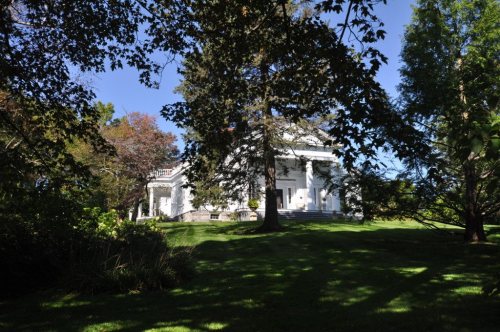
6 listings: 4 buildings, among them the Dr. Cornelius Nase Campbell House (listed 2007, the first), and 2 historic districts, the Walter Beckwith House and the Wethersfield, with 29 contributing buildings. 36 historic buildings in all.
How old are the homes in Stanford?
22% of Stanford’s homes were built before 1940 (Census estimate, ±6.5 points), against a typical 27% for a New York town; the median home was built in 1971.
Founding dates: Wikidata, Wikipedia, the U.S. post office records of Blevins & Helbock (CC0) and the Census. Homes by year built: Census ACS 2020–24. National Register of Historic Places: National Park Service (list of May 22, 2026). Old photos, postcards and papers: Wikimedia Commons, the Library of Congress and other public archives, credited on each item’s page. Maps: U.S. Geological Survey historical topographic maps (via Esri) and Sanborn fire-insurance maps (Library of Congress). History text and census tables: Wikipedia (CC BY-SA 4.0). Places that used to be: USGS Geographic Names Information System (2021).
From Wikimedia Commons (8), Wikidata (2), the National Register of Historic Places (6), Wikipedia, Wikidata and Wikipedia for famous people, U.S. Geological Survey historical maps, U.S. Census counts (via Wikipedia), the US Post Offices dataset (Blevins & Helbock), the USGS Geographic Names Information System and old county and town histories (Internet Archive). Archive images are copied here with their credits and licenses, shown on each photo’s page. Refreshed monthly.




 2025
 2025
 2019
 2019
 2016
 2016


