Founding year: Wikidata; Wikipedia’s history section gives the same year. First post office: 1827.
History grade
What drives Cornwall’s History grade
On its age, its old homes and the National Register, Cornwall is more historic than 93% of U.S. towns. All 3 inputs are above most U.S. towns; its age ranks highest and its National Register listings lowest.
A
HistoryA character grade: shown, never part of Cornwall’s overall grade.
Vermont towns list more on the Register than most of the country (a typical Vermont town has 147 per 10,000 residents, the U.S. 2.4), so Cornwall’s 91.1 sits near the middle of its state (55% of Vermont towns have fewer) while its 11 historic buildings outnumber those of 76% of U.S. towns.
How sure. Graded on any two of the three inputs instead, the letter would range from A− to A+. The pre-1940 share is a Census survey estimate (±10.9 points). Two sources give 1761.
Founding year: Wikidata (other dates in Quick answers). Homes: Census ACS 2020–24. National Register: National Park Service, May 2026 list; each listing counted once (boundary changes and added documentation belong to their listing), and a historic district counts its contributing buildings. How TownRatings grades history →
What stands out about Cornwall’s past
Read from the archive, the National Register and the record. The page puts what stands out first.
Wikipedia doesn’t have a history of Cornwall yet. The photos, dates and memories neighbors add here are how it gets written.
Cornwall is a town in Addison County, Vermont, United States. It was founded November 3, 1761. The population was 1,207 at the 2020 census.
Cornwall was established in 1761. Its population held steady between the last two censuses: 1,185 in 2010, 1,207 in 2020.
Intro from Wikipedia. Population: U.S. Census Bureau.
From the old history books
What they wrote about Cornwall, 1862–1886
Passages that mention Cornwall, cut from the printed page as they were published.
History of Addison county Vermont, with illustrations and biographical sketches of some of its prominent men and pioneers1886 · page 271Read the page →
Read the text
After Daniel Foot discovered the defect in his title under the Weybridge charter, he purchased the right of pitching under the Cornwall charter and laid out one hundred acres, which included the whole of the falls on the Cornwall side and extended some forty rods south of them to " the old Weybridge corner." In the same year (1784) he erected a large building for a saw and a gristmill; the first was put in operation in July, and the other in November, 1785.
Text read by machine from the scan; it may contain errors.
History of Addison county Vermont, with illustrations and biographical sketches of some of its prominent men and pioneers1886 · page 246Read the page →
Read the text
As a considerable tract of territory now included in the town of Middlebury was formerly in the town of Cornwall and its settlement made under the jurisdiction of that town, it becomes essential to trace those settlements in order to complete the history of Middlebury.
Text read by machine from the scan; it may contain errors.
It is hereby enacted by the General Assembly of the State of Vermont, that the north-eiiscorly part of the town of Cornwall, in the County of Addison, hereinafter described, be, and the same 13 anne.xed to the town of Middlebury, in said County, bounded as follows, viz : Beginning at the south-west corner of said Mid llebury, then running west so far that a north line will strike the west end of the long causeway, so called, then on a straight line to the southcast corner of Ethan Andrus's farm, on which he now lives, thence
Text read by machine from the scan; it may contain errors.
Scans and text from the Internet Archive. Books published in 1930 or earlier, which are in the public domain.
By decade
Cornwall, decade by decade
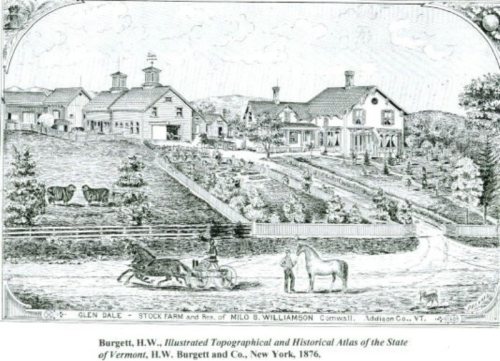
One decade in the archive so far: the 1870s. Scroll each row; tap a photo for its story.
In 1761, according to Wikidata and Wikipedia’s history of the town. Cornwall’s post office opened in 1827, and the first U.S. census counted 826 people here in 1790.
How does Cornwall rank for history?
Cornwall is more historic than 93% of U.S. towns. The History grade combines the town’s founding era, the share of homes built before 1940 and its National Register listings. It’s a character grade, so it isn’t part of the overall grade. How it works.
What is on the National Register in Cornwall?
6 listings: 5 buildings and 1 structure. 11 historic buildings in all.
How old are the homes in Cornwall?
27% of Cornwall’s homes were built before 1940 (Census estimate, ±10.9 points), against a typical 22% for a Vermont town; the median home was built in 1976.
Founding dates: Wikidata, Wikipedia, the U.S. post office records of Blevins & Helbock (CC0) and the Census. Homes by year built: Census ACS 2020–24. National Register of Historic Places: National Park Service (list of May 22, 2026). Old photos, postcards and papers: Wikimedia Commons, the Library of Congress and other public archives, credited on each item’s page. Maps: U.S. Geological Survey historical topographic maps (via Esri) and Sanborn fire-insurance maps (Library of Congress). History text and census tables: Wikipedia (CC BY-SA 4.0). Places that used to be: USGS Geographic Names Information System (2021).
From Wikimedia Commons (16), Wikidata (1), the National Register of Historic Places (6), Wikidata and Wikipedia for famous people, U.S. Geological Survey historical maps, U.S. Census counts (via Wikipedia), the US Post Offices dataset (Blevins & Helbock), the USGS Geographic Names Information System and old county and town histories (Internet Archive). Archive images are copied here with their credits and licenses, shown on each photo’s page. Refreshed monthly.


 2016
 2016
 2014
 2014
 2012
 2012
 2010
 2010
 2010
 2010
 2010
 2010
 2010
 2010
 2004