 I
Church · listed 1953Shrewsbury AbbeyOn the list as Abbey Church of the Holy CrossPhoto: Diliff · CC BY-SA 3.0
 Abbey Church of the Holy Cross · Photo: Diliff · CC BY-SA 3.0
A−History Grade
History of Shrewsbury · Historic England
764 listed buildings, 15 of them Grade I
Historic England counts them inside Shrewsbury’s built-up area, 101 for every 10,000 residents. It also has 9 scheduled monuments. We have photos of 71 of its listed buildings and 8 old views of the town. 15% of its homes were built before 1919. Shrewsbury grades A− for history: #7 of 19 in Shropshire.
Listed buildings
764
101 per 10,000 residents
Grade I
15
exceptional interest
Grade II*
65
more than special interest
Scheduled monuments
9
1 registered park or garden
Homes built before 1919
15%
typical UK town 15%
In pictures
Shrewsbury in 82 photos and old views
Nearly every Grade I and II* building, photographed, and the town before 1950. Tap a photo to step through them full screen.
 Shrewsbury CastleGrade I listed
 Shrewsbury Flaxmill Maltings: Spinning MillGrade I listed
 The Lord Hill HotelGrade II listed
 Former Her Majesty's Prison ShrewsburyGrade II listed
 Statue of Viscount Hill in English Bridge GardensGrade II listed+77See all photos
Photos from Wikimedia Commons and Geograph, copied to our own server, each credited to its photographer with its licence; names open the building’s page or its official list entry.
Through time
Shrewsbury from 1796 to 1914
An old map and 8 old photos and postcards, in date order. All public domain, made before 1950.
 c. 1796
 c. 1890
 c. 1890
 c. 1890
 c. 1890
 1897
 1903
 1903
 c. 1914
Public domain, from Wikimedia Commons, copied to our own server. Each credit opens the image’s page with its full description and history.
The map
Where Shrewsbury’s history is
Every Grade I and II* building, monument and historic park, over the age of each neighbourhood’s homes.
Grade IGrade II*Scheduled monumentPark or garden400 m from St Mary's Church
Homes built before 1919, by neighbourhoodunder 10%10–25%25–50%50%+
9 of 15Grade I buildings stand within 400 m of St Mary's Church, a five-minute walk. So do 371 of the 764 listed buildings.
3 of 48neighbourhoods have mostly pre-1919 homes; in the oldest, 59% were built before 1919.
Hover a dot for its name; tap one with a photo to open it.
764 listed buildings by grade
15 Grade I65 Grade II*684 Grade II
Historic England lists buildings in three grades: Grade I for buildings of exceptional interest (about 2.5% of all listed buildings), Grade II* for particularly important buildings of more than special interest (about 5.8%), and Grade II for buildings of special interest (about 91.7%). Listing protects the whole building, inside and out.
Every entry on the National Heritage List for England whose point lies inside the ONS 2022 built-up-area boundary. One list entry can cover a terrace or a group of buildings. Neighbourhood dots: the population-weighted centre of each Census 2021 output area, coloured by its neighbourhood’s (LSOA’s) share of homes built before 1919 (Valuation Office Agency, March 2025).
Grade I
The 15 Grade I listed buildings in Shrewsbury
Buildings of exceptional interest, about 2.5% of all listed buildings; 9 of these stand within 400 m of St Mary's Church. 13 are photographed. Each opens its own page, with the official list entry.
 I
Public · listed 1953Shrewsbury CastlePhoto: Rev Dan Catt · CC BY-SA 2.0
 I
Inns & shops · listed 1953Ditherington Flax MillOn the list as Shrewsbury Flaxmill Maltings: Spinning MillPhoto: Tk420 · CC BY-SA 4.0
 I
Church · listed 1953St Chad's ChurchOn the list as Church of St ChadPhoto: Necrothesp · CC BY-SA 3.0
 I
Church · listed 1953St Mary's ChurchOn the list as Church of St MaryPhoto: David Dixon · CC BY-SA 2.0
 I
Walls & gates · listed 1953Council House Gatehouse and GatewayPhoto: Humphrey Bolton · CC BY-SA 2.0
 I
Public · listed 1953Shrewsbury LibraryOn the list as LibraryPhoto: Elliott Brown from Birmingham, United Kingdom · CC BY-SA 2.0
 I
Public · listed 1953Old Market HallPhoto: Tony Hisgett from Birmingham, UK · CC BY 2.0
 I
Church · listed 1953Refectory Pulpit of Shrewsbury AbbeyOn the list as Refectory Pulpit Approximately 40 Metres South of Abbey HousePhoto: Taliesin Edwards ( Mouchoir le Souris ) · CC BY-SA 3.0
 I
House · listed 1953The Abbot's HousePhoto: Roy Hughes · CC BY-SA 2.0
 I
Inns & shops · listed 1953The Lion HotelPhoto: Mr M Evison · CC BY-SA 2.0
 I
House · listed 1972The Trotting Horse BuildingPhoto: Richard Law · CC BY-SA 2.0
 I
House · listed 195371, 72 and 73, Wyle CopPhoto: Richard Symonds · CC BY-SA 3.0
Memorials · listed 1987Ditherington Flax Mill: Cross BuildingOn the list as Shrewsbury Flaxmill Maltings: Cross Building
Inns & shops · listed 1995Ditherington Flax Mill: Flax WarehouseOn the list as Shrewsbury Flaxmill Maltings: Flax Warehouse
Grade II*
The 65 Grade II* listed buildings in Shrewsbury
Particularly important buildings of more than special interest. 55 are photographed.
 II*
Church · listed 1969Remains of Abbey Guest HouseOn the list as Abbey Guest House, RemainsPhoto: Richard Symonds · CC BY-SA 3.0
 II*
Church · listed 1969Abbey HousePhoto: Andrew W Kerr · CC BY-SA 4.0
 II*
Street furniture · listed 1953Attached RailingsPhoto: Stephen Richards · CC BY-SA 2.0
 II*
House · listed 1953Belmont HousePhoto: Stephen Richards · CC BY-SA 2.0
 II*
Walls & gates · listed 1953Castle Gates HousePhoto: Dave.Dunford · CC BY-SA 4.0
 II*
Church · listed 1953Church of St AlkmundPhoto: Richard Symonds · CC BY-SA 3.0
 II*
Church · listed 1953Church of St GilesPhoto: Tony Hisgett from Birmingham, England · CC BY 2.0
 II*
Church · listed 1953Church of St JulianPhoto: Richard Symonds · CC BY-SA 3.0
 II*
House · listed 1953Clive House and Adjacent DwellingPhoto: Richard Law · CC BY-SA 2.0
 II*
House · listed 1953Council House CottagePhoto: Richard Law · CC BY-SA 2.0
 II*
Public · listed 1953Drapers' HallOn the list as Drapers Hall and Attached Raised Pavement and RailingsPhoto: Richard Symonds · CC BY-SA 3.0
 II*
Church · listed 1969Former Church of St JohnPhoto: John H Darch · CC BY-SA 2.0
Show the other 53
 II*
House · listed 1953Hardwick HousePhoto: Richard Symonds · CC BY-SA 3.0
 II*
House · listed 1953Irelands Mansion, High StreetOn the list as Ireland's MansionPhoto: Richard Symonds · CC BY-SA 3.0
 II*
House · listed 1953Lord Hill's ColumnPhoto: Keith Havercroft · CC BY-SA 2.0
 II*
Church · listed 1969Meole Brace Church of Holy TrinityPhoto: Daveyonthemove · CC BY-SA 3.0
 II*
Public · listed 1953Old Post Office InnPhoto: Jaggery · CC BY-SA 2.0
 II*
House · listed 1953Owen's MansionPhoto: Simon Burchell · CC BY-SA 4.0
 II*
House · listed 1953Perches HousePhoto: Simon Cobb · CC0
 II*
Inns & shops · listed 1953Prince Rupert HotelPhoto: Richard Symonds · CC BY-SA 3.0
 II*
Church · listed 1953Old Church of St ChadOn the list as Remains of the Old Church of St ChadPhoto: Tom McCallister · CC BY-SA 2.0
 II*
House · listed 1953Shrewsbury CathedralOn the list as Roman Catholic Cathedral of Our Lady Help of Christians and St PeterPhoto: Fountain Posters · CC BY-SA 3.0
 II*
House · listed 1953Rowley's House and Rowley's MansionPhoto: Beep boop beep · CC BY-SA 4.0
 II*
Inns & shops · listed 1987Apprentice House Of Former Ditherington Flax MillOn the list as Shrewsbury Flaxmill Maltings: Apprentice HousePhoto: Richard Law · CC BY-SA 2.0
 II*
Public · listed 1969Swan Hill Court HousePhoto: Richard Law · CC BY-SA 2.0
 II*
Memorials · listed 1953Golden CrossOn the list as The Golden Cross Public HousePhoto: Chris Whippet · CC BY-SA 2.0
 II*
Public · listed 1953Newport HouseOn the list as The GuildhallPhoto: Stephen Richards · CC BY-SA 2.0
 II*
House · listed 1953The Judge's LodgingPhoto: Richard Law · CC BY-SA 2.0
 II*
Inns & shops · listed 1953The King's Head Public HousePhoto: Simon Burchell · CC BY-SA 4.0
 II*
House · listed 1953The MountPhoto: Unknown photographer · Public domain
 II*
House · listed 1953The Old HousePhoto: Ian Taylor · CC BY-SA 2.0
 II*
House · listed 1953The Old MansionPhoto: Richard Law · CC BY-SA 2.0
 II*
House · listed 1953The Old Porch HousePhoto: Jwslubbock · CC BY-SA 4.0
 II*
House · listed 1953The Old Tudor Steak HouseOn the list as The Old Tudor Steak House, Butcher Row and 35 Pride HillPhoto: Richard Symonds · CC BY-SA 3.0
 II*
Walls & gates · listed 1995Shrewsbury town wallsOn the list as Town WallsPhoto: Humphrey Bolton · CC BY-SA 2.0
 II*
Walls & gates · listed 1953Watch Tower and Adjoining WallPhoto: Beep boop beep · CC BY-SA 4.0
 II*
House · listed 1969WhitehallPhoto: Mark Evison · CC BY-SA 2.0
 II*
Walls & gates · listed 1969Whitehall GatehousePhoto: Jaggery · CC BY-SA 2.0
 II*
House · listed 1953Windsor HousePhoto: Jaggery · CC BY-SA 2.0
 II*
House · listed 1980Windsor LodgePhoto: Richard Law · CC BY-SA 2.0
 II*
House · listed 19531 and 2, Council House CourtyardPhoto: Richard Law · CC BY-SA 2.0
 II*
House · listed 195310, BelmontPhoto: Richard Law · CC BY-SA 2.0
 II*
House · listed 1953126 and 127, FrankwellPhoto: Richard Law · CC BY-SA 2.0
 II*
House · listed 196914 and 15, BelmontPhoto: Richard Symonds · CC BY-SA 3.0
 II*
House · listed 195315 and 16, High StreetPhoto: Simon Burchell · CC BY-SA 4.0
 II*
House · listed 195315 and 16, MardolPhoto: Simon Burchell · CC BY-SA 4.0
 II*
House · listed 195319-23, St John's HillPhoto: Richard Symonds · CC BY-SA 3.0
 II*
House · listed 195322, High StreetPhoto: Stephen Richards · CC BY-SA 2.0
 II*
House · listed 195325, High StreetPhoto: Secretary2006 · CC BY-SA 4.0
 II*
House · listed 195329A and 30, Princess StreetPhoto: Richard Symonds · CC BY-SA 3.0
 II*
House · listed 19534, 5 and 6, FrankwellPhoto: Stephen Richards · CC BY-SA 2.0
 II*
House · listed 195365-69, Wyle CopPhoto: Richard Symonds · CC BY-SA 3.0
 II*
House · listed 19537 The SquarePhoto: Richard Symonds · CC BY-SA 3.0
 II*
House · listed 19538 and 9 The SquarePhoto: Richard Symonds · CC BY-SA 3.0
 II*
House · listed 19538-15, St Alkmond's PlacePhoto: Richard Symonds · CC BY-SA 3.0
House · listed 1953Sandford HouseOn the list as Darwin's Townhouse
Inns & shops · listed 1953Park Social ClubOn the list as Park Hotel Park Social Club
Walls & gates · listed 1969Railings and Gates to Abbey House
Inns & shops · listed 1987Stove House And Dye House At Former Ditherington Flax MillOn the list as Shrewsbury Flaxmill Maltings: Dyehouse and Stove House
Public · listed 1969The Hall of the Former Vaughan's Mansion (Part of the Music Hall)
House · listed 1953The Old Council House
House · listed 19531-8 Claremont Bank and Attached Railings
House · listed 1953113 and 114, Frankwell
House · listed 197214, St Mary's Street
House · listed 195317, High Street
Historic streets
Wyle Cop has the most listed buildings
Streets by the listed entries with an address on them. One entry can be a whole terrace, so long rows count once.
Wyle Cop38 listed · 1 Grade I · 1 II*

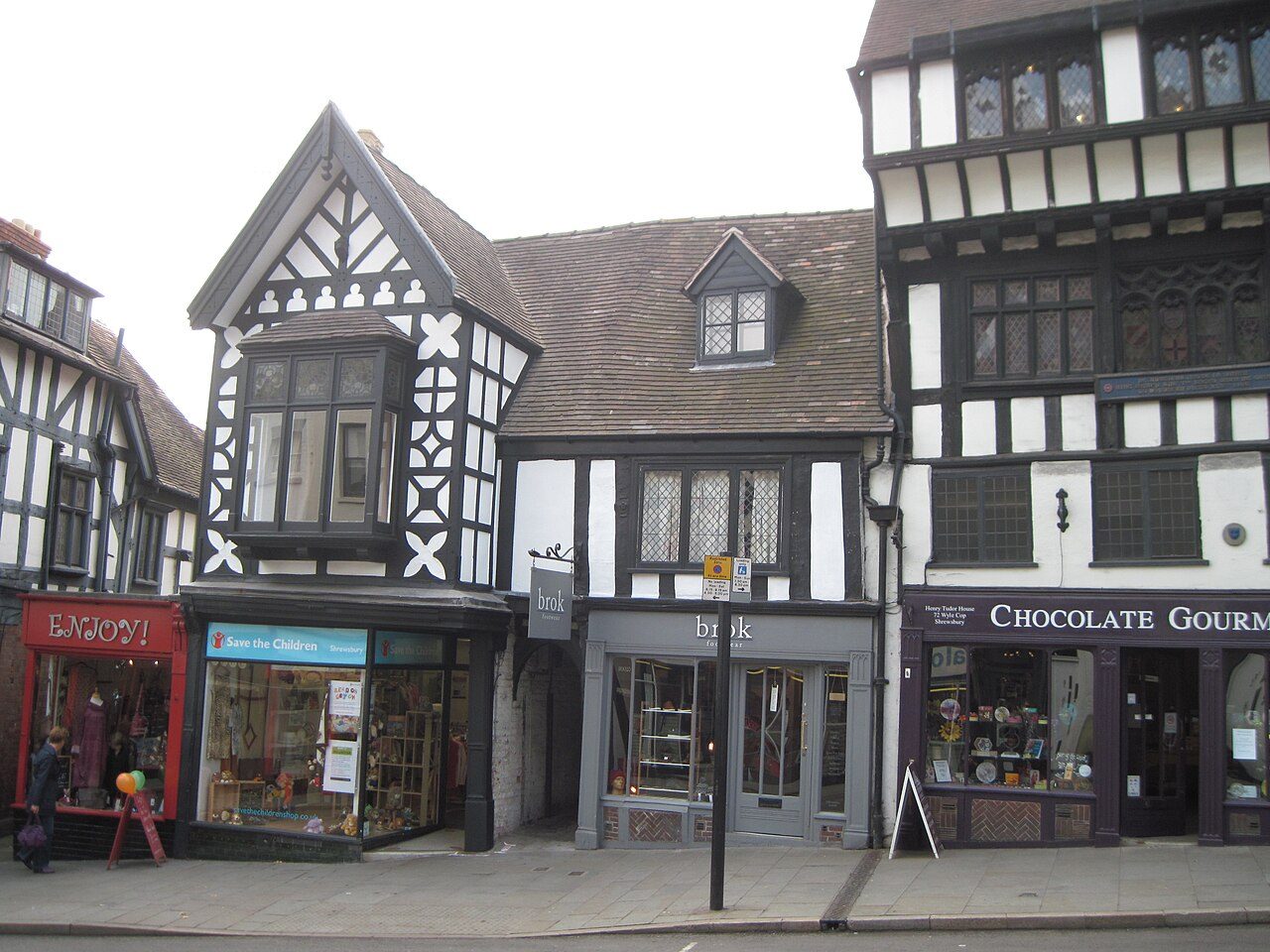
Abbey Foregate36 listed
Mardol32 listed · 1 II*

Frankwell29 listed · 3 II*


High Street19 listed · 4 II*


St John's Hill19 listed · 1 II*

College Hill18 listed
Claremont Hill17 listed
Belmont16 listed · 2 II*


Swan Hill14 listed
Dogpole13 listed
Pride Hill12 listed
Of the 764 entries, 430 are named by a street address; the rest are named buildings such as churches, halls and bridges.
What’s protected
Most of Shrewsbury’s listed buildings are homes
Every listed building sorted by what its list name says it is.
Houses, terraces & villas564
Public & civic buildings55
Inns, shops & warehouses49
Walls, gates & bridges45
Churches, chapels & priories29
Street furniture17
Memorials, crosses & tombs5
564 entries (74%) are houses, terraces and villas. 29 are churches, chapels and priories, including 4 of the 15 Grade I buildings.
Buildings are sorted by words in each entry’s name (church, gate, inn, memorial…): the list’s open data has no building type. An entry named only by its address counts as a house.
Grade II
684 Grade II listed buildings
Most listed buildings are in this grade, which covers buildings of special interest. Open any building to read its official list entry.
The first 150 of 684 Grade II listed buildings, A to Z
Adjoining Stable and Coach HouseAdmiral Benbow Public HouseApothecaries HouseArched Folly in the Garden of the LimesAttached Area RailingsAttached Garden WallAttached RailingsAttached RailingsAttached RailingsAttached Stable BlockBank Farm CottagesBank Farmhouse and St Mary's GrangeBarker's ChambersBarn at Sj 477 110 to South of Bank Farm CottagesBelmont Bank HouseBoundary Wall and Gate Piers at MonklandsBoundary Wall to WhitehallBoundary Wall to the GuildhallBrierly HouseBrooklandsBuck's Head Public House (Part)Building Adjacent to the Old School HouseBuilding to Rear of Nag's Head Public HouseBuilding to the Rear of Number 1ABuildings to rear of 53 MardolCadogan House and StableCanal Tavern Public House and Attached Outbuilding RangeCaradoc HouseCarmel HouseCedar HouseChaddeslode HouseChapel at Shelton HospitalChest Tomb in Churchyard of Old Church of St ChadChrist ChurchChurch of All SaintsChurch of St GeorgeChurch of St MichaelClaremont Buildings (Terrace) and Attached Railings and StepsClaremont HouseClerk to the Justices BuildingCoach House and Boundary Wall to Number 6Coleham Pumping StationCorner FarmhouseCoton HurstCrescent PlaceCrewe Junction Signal Box at Sj 4936 1306Cromwell's HotelDogpole HouseDovecote to Rear of WhitehallEagle House (formerly the Eagle Star Building)Entrance to Victorian ArcadeEye, Ear and Throat HospitalFellmonger's Hall (Darwin Centre)Forecourt, Railings and Gates to Number 6Forecourt, Wall and Railings to Number 7Former Bowdler's SchoolFormer Brewery Trouncer and Company BreweryFormer Church of St NicholasFormer Coach House and Garden Wall to North of St Chad's CottageFormer Elephant and Castle Public HouseFormer First Church of Christ Scientist and Attached RailingsFormer Her Majesty's Prison ShrewsburyFormer Magazine in Garden of Number 5 the ArmouryFormer Monkmoor SchoolFormer Nurses' HomeFormer Punishment Block at the ArmouryFormer Stable Buildings to Numbers 9 and 10Former Stable at Swan Hill Court HouseFormer Swan InnFormer WarehouseFormer Warehouse, Now Part of Number 60 Wyle CopFormer White Hart Public HouseFormer school to south of and attached to 12 St Alkmond's SquareGala Bingo ClubGarage, Formerly Coach House, To Number 12Garage, Formerly Coach House. to Number 13Garden Wall and Gates to Swan HillGarden Wall to Number 13Garden Walls to North West of Clive HouseGate Piers to Swan Hill Court HouseGatehouse and perimeter wall to former HMP ShrewsburyGates and Gate Piers to the QuarryGates to the QuarryGranville HouseHolywell TerraceHospital of the Holy Cross, boundary wall and gate piersHouse of Grain and Cornhouse ApartmentsHouse, Now Part of Eye, Ear and Throat HospitalIce House at Sj 491 138, Coton Hill FarmIncluding Cobbled Area in FrontIvy HouseK6 Telephone Kiosk Adjacent to AbbeyK6 Telephone Kiosk Adjacent to Numbers 54-59 K6 Telephone Kiosk Opposite SafewayKenneth House and Kenneth LodgeKingsland BankKingsland GrangeKingsland GroveKingsland HouseKingsland HouseKinnersley HouseLane End HouseLaura's TowerLaurel CottageLead Water Tank in Garden of Clive HouseLength of Wall with Gate Adjoining Roman Catholic CathedralLibrary, Former Blower's RepositoryLimetree CottageLodge to the QuarryLoggerheads Public HouseLong Meadow Pear Tree CottageMasonic Hall (Part of the Music Hall)Melville House and Wheatlea HouseMemorial Drinking FountainMeole Brace Broome Cottage and Garden WallsMeole Brace HallMeole CottageMile Post at Junction with Bell LaneMile Post on Roundabout at Junction with Abbey Foregate at Sj 5063 1205Milestone at SJ 4834 1303, to north of 35, The MountMillington's Hospital and Wall to ForecourtMonklandsMorfe HouseMurivance House and Allatt HouseMytton VillaNag's Head Public HouseNational Westminster BankNew Park FarmhouseNo. 45, HIGH STREETNos. 25 and 26 Castle Street and Attached RailingsNos. 46 and 47, HIGH STREETNos. 60, 61 and 62, Abbey Foregate and Attached RailingsNumber 14, The Bull's Head Public House and Number 15Number 18, Lucroft Hotel and Number 19Number 21 and Attached WallNumber 26 and Attached Walls and RailingsNumber 5, The ArmouryNumber 6, The Armoury and Armoury MewsNumbers 1-4, The ArmouryNumbers 22-24 and Number 25 (The Crescent) and Adjoining RailingsOld Crow FlatsOld Post Office Public HouseOld School House and Prudence CottageOutbuildings to North East of WhitehallPark CottagePengwern Boat House at Sj 4852 1220Pengwern HousePillar Box Approximately 50 Metres West of Abbey ChurchPillar Box opposite 7, The SquarePremises Occupied by Aspinall'sPremises Occupied by the Good Life
Conservation areas
4 conservation areas cover 16% of Shrewsbury
Areas the council protects as a whole: demolition and changes to how buildings look need consent, and trees are protected.
Shrewsbury 1970300 ha
Belle Vue 199242 ha
Meole Brace 197216 ha
Harlescott 19934 ha
361 hain conservation areas, of 2,312 ha inside the built-up area.
The first, Shrewsbury, was designated in 1970; the newest, Harlescott, in 1993. 731 of the 764 listed buildings stand in one.
Historic England’s conservation areas layer, supplied by councils (incomplete in places, so a page fact, never graded). Hectares are the part of each area inside the built-up area.
How the list grew
304 of Shrewsbury’s 764 listed buildings were added in 1972
The year each building now on the list was first listed.
1972 · 3041953 · 2691995 · 81
19501960197019801990200020102020
The first 269 entries were listed in 1953, 12 of the 15 Grade I buildings among them. 304 came in 1972, in the national resurvey of the 1970s and 80s. Only 4 have been added in the last 15 years.
Monuments & landscapes
Monuments, parks and gardens
Designations that overlap the town by a tenth of their area or half a hectare.
9 scheduled monuments
Nationally important archaeological sites and monuments, protected by law; work on them needs consent from the Secretary of State, advised by Historic England.


1 registered park or garden

1 registered battlefield
History Grade
Shrewsbury grades A− for history
Protected heritage and the age of the town’s homes, against all UK towns.
Protected heritage, for its size and in all (880 points, 116 per 10,000 residents)More than 87% of UK towns
Homes built before 1919 (15%)More than 44% of UK towns
Two measures, each ranked against every UK town of 1,000 or more, with protected heritage counting twice as much as the age of homes. Protected heritage counts each listed building by its grade (Grade I three points, II* two, II one), each scheduled monument and battlefield two, and each registered park or garden by its grade; it is ranked both per 10,000 residents and as a total, so a village with one fine church doesn’t outrank a historic city. The second measure is the share of homes built before 1919, from the Valuation Office Agency’s council tax records. History is a character grade: it describes the town and isn’t part of the overall grade.
Born here
54 notable people born in Shrewsbury before 1900
The 20 best known on one timeline, earliest first.
Richard of Shrewsbury, 1st Duke of York
John Benbow
John Weaver
John Taylor
William Adams
Charles Burney
Edward Waring
Charles Darwin
Arthur Purves Phayre
Elizabeth Prout
William How
Henry Hiles
John Hawley Edwards
Henry Wace
John Wylie
Thomas Henry Poole
Owen Seaman
William Oakley
Billy George
Sam Cookson
1500165018001950

Charles Darwin1809–1882 · English naturalist and biologist (1809–1882)

Edward Waring1736–1798 · English mathematician

Richard of Shrewsbury, 1st Duke of York1473– · Second son of King Edward IV of England, younger of the princes in th…

Charles Burney1726–1814 · English music historian (1726-1814)

John Benbow1653–1702 · Royal Navy Admiral (1653-1702)

Arthur Purves Phayre1812–1885 · British Indian Army officer and colonial administrator (1812-1885)

William How1823–1897 · English bishop (1823-1897)
BG
Billy George1874–1933 · English footballer (1874-1933)
Everyone born in Shrewsbury → Birthplaces from Wikidata; portraits from Wikimedia Commons.
Towns its size
Shrewsbury has the 12th most Grade I buildings of 152 towns its size
Places of 46,000–122,000 people outside London, by Grade I listed buildings.
Shrewsbury15
#6 of 152for listed buildings per resident (101 per 10,000). Bath, Canterbury and Salisbury lead.
11 have more. The typical town its size has 2.
Neighbours
Listed buildings in the places around Shrewsbury
| Town | People | Listed | Grade I | History |
|---|---|---|---|---|
| Shrewsbury | 76,013 | 764 | 15 | A− |
| Bayston Hill | 5,221 | 1 | 0 | D |
| Hanwood | 1,257 | 7 | 0 | C |
| Bomere Heath | 1,364 | 0 | 0 | C− |
| Shawbury | 1,962 | 14 | 1 | B− |
| Baschurch | 2,007 | 18 | 0 | B |
| Pontesbury | 1,968 | 14 | 0 | B+ |
| Minsterley | 1,719 | 16 | 0 | B |
In brief
Shrewsbury in brief
Per resident, Shrewsbury has more listed heritage than 87% of UK towns. All told, the list holds 764 listed buildings, 15 of them Grade I, including Shrewsbury Abbey. Its Grade I buildings cluster together: 9 of them stand within 400 m of St Mary's Church. Only 11 of the 152 towns nearest its size have more Grade I buildings.
Its older streets lie in 4 conservation areas, the first designated in 1970. Most entries on the list, 74%, are houses, terraces and villas. Charles Darwin (1809), Edward Waring (1736) and Richard of Shrewsbury, 1st Duke of York (1473) are among the 54 people born here before 1900. Otherwise the figures are ordinary: 15% of its homes were built before 1919, close to the 15% in the typical UK town.
Questions about Shrewsbury’s history
How many listed buildings are there in Shrewsbury?
Historic England lists 764 buildings inside Shrewsbury’s built-up area: 15 Grade I, 65 Grade II* and 684 Grade II.
What are the Grade I listed buildings in Shrewsbury?
15, including Abbey Church of the Holy Cross, Church of St Chad, Church of St Mary, Council House Gatehouse and Gateway, Library and Old Market Hall.
Which street in Shrewsbury has the most listed buildings?
Wyle Cop (38), Abbey Foregate (36) and Mardol (32) have the most listed entries named by an address. One entry can be a whole terrace.
Are there scheduled monuments in Shrewsbury?
Yes, 9 scheduled monuments, including Churchyard cross SW of St Giles Church, Harlescott Grange moated site, Length of medieval town wall, sally port and interval tower and Remains of the crypt or undercroft to the Old Church of St Chad.
How many conservation areas are there in Shrewsbury?
4, covering about 361 hectares of the town. The largest are Shrewsbury and Belle Vue.
When were Shrewsbury’s buildings listed?
The first in 1953; the most, 304, in 1972.
Are there old photos of Shrewsbury?
Yes: 8 public-domain photos and postcards from 1796 to 1914, and an old map from 1897, all on this page.
Who was born in Shrewsbury?
Among people born before 1900: Charles Darwin (1809), Edward Waring (1736), Richard of Shrewsbury, 1st Duke of York (1473), Charles Burney (1726) and John Benbow (1653).
How old are the homes in Shrewsbury?
15% of homes were built before 1919 and 27% before 1940, from the Valuation Office Agency’s council tax records (March 2025).
© Historic England 2026. Contains Ordnance Survey data © Crown copyright and database right 2026. The National Heritage List for England is the official, up-to-date register of all nationally protected historic buildings and sites in England; check an entry on Historic England’s website before relying on it.
Sources: Historic England, National Heritage List for England (listed buildings, scheduled monuments, registered parks and gardens, battlefields, World Heritage Sites), October 2026, inside the ONS 2022 built-up-area boundary · Valuation Office Agency, Council Tax: stock of properties by build period (31 March 2025) · TownRatings grades: our own summary of the data, ranked against UK towns only · Historic England conservation areas (supplied by local planning authorities; October 2026). All under the Open Government Licence v3.0.
Contains public sector information licensed under the Open Government Licence v3.0. Contains HM Land Registry data © Crown copyright and database right 2026. Contains OS data © Crown copyright and database right 2026 (ONS boundaries). Northern Ireland: Source: NISRA; contains Land & Property Services data and Ordnance Survey of Northern Ireland information, © Crown copyright, licensed under the Open Government Licence v3.0. Scotland: contains National Records of Scotland data, Registers of Scotland data and SEPA data, © Crown copyright / © SEPA 2025, licensed under the Open Government Licence v3.0.