Allentown dates to 1762, and 38% of its homes were built before 1940
More historic than 96% of U.S. towns · #99 of 1,035 in Pennsylvania. What drives it
16 places in town are on the National Register, among them a historic district with 1 buildings. Below: 23 old photos and papers, maps from 1885 on, and the census since 1790.
Founding year: Wikidata. First post office: 1803.The full story ↓
History grade
What drives Allentown’s History grade
On its age, its old homes and the National Register, Allentown is more historic than 96% of U.S. towns, #99 of 1,035 in Pennsylvania. All 3 inputs are above most U.S. towns; its age ranks highest and its National Register listings lowest.
A+
HistoryA character grade: shown, never part of Allentown’s overall grade.
Among the 400 U.S. cities of 100,000 or more, Allentown ranks #37 on History.
Pennsylvania towns list about as much on the Register as the country (a typical Pennsylvania town has 2.1 per 10,000 residents, the U.S. 2.4), so Allentown’s 1.9 sits near the middle of its state (57% of Pennsylvania towns have fewer) while its 24 historic buildings outnumber those of 80% of U.S. towns.
NoteThe founding year comes from Wikidata alone; no second source gives 1762.
How sure. Graded on any two of the three inputs instead, the letter would range from A to A+. The pre-1940 share (±1.7 points) is firm at this size.
Founding year: Wikidata (other dates in Quick answers). Homes: Census ACS 2020–24. National Register: National Park Service, May 2026 list; each listing counted once (boundary changes and added documentation belong to their listing), and a historic district counts its contributing buildings. How TownRatings grades history →
What stands out about Allentown’s past
Read from the archive, the National Register and the record. The page puts what stands out first.
FairviewFirst Presbyterian Church Memorial GardenGreenwoodHighland Memorial ParkImmaculate Conception CatholicLinden StreetRittersvilleSaint John the Baptist Slovak CatholicSaint MarksSaint Paul's Evangelical Lutheran Church TowerTrexler ParkUnion - West EndWoodlawn Memorial Park
US Post Offices dataset (Blevins & Helbock, CC0). Places and cemeteries from the USGS Geographic Names Information System (2021).
By decade
Allentown, decade by decade
5 decades in the archive, from the 1850s to the 1910s. Scroll each row; tap a photo for its story.
Nothing in the archives for these yearsWeddings on Main Street, storms, parades, school pictures, the old store. If it’s in your family album, it belongs here.
In the early 18th century, the area that is present-day Allentown was a wilderness of scrub oak, where the Lenape, an Indigenous tribe, fished for trout and hunted for deer, grouse, and other game.
On May 18, 1732, the land was deeded by Thomas Penn, one of three sons of William Penn, founder of the colonial era Province of Pennsylvania, to Joseph Turner, a Philadelphia-based iron manufacturer and politician. Two years later, on September 10, 1735, a 5,000-acre (20 km2) portion of this land was purchased from Turner's business partner by William Allen, a wealthy shipping merchant who became mayor of Philadelphia the following month.
Passages that mention Allentown, cut from the printed page as they were published.
History of Lehigh county, Pennsylvania and a genealogical and biographical record of its families1914 · page 1033Read the page →
Read the text
William Reinsmith was a brick laying contractor, and built the Lehigh Valley R. R. Station, in Allentown, the Easton Station, the Mauch Chunk station, the Weatherly station, the Shenandoah station and the Mahanoy City station for the same road. He also built many houses at Allentown and Delano, Pa. He married Carolina, a daughter of Col. T. H. Good, and their chil-
Text read by machine from the scan; it may contain errors.
History of Lehigh county, Pennsylvania and a genealogical and biographical record of its families1914 · page 1373Read the page →
Read the text
has rendered very valuable services. In June, 1896, he wrote a ninety-two page pamphlet under the auspices of the Board of Trade, entitled “Descriptive History of the City of Allentown.” On July 21, 1913, Allentown gave a reception in honor of Mr. Weidner, and in addition to it being his birthday, it was the fiftieth anniversary of his becoming a resident of Allentown. In the
Text read by machine from the scan; it may contain errors.
the history of the allentown conference of the ministerium of pennsylvania1926Read the page →
Read the text
and his theological training from Pastor Weygandt and the Patriarch Muhlenberg who made him his assitant. He preached at New Hanover, 1763-1765; at Germantown, 1765-1769; in the Macungie parish, consisting at first of Lehigh church, Upper Milford, Upper Saucon, and at Allentown, 1769-1778. On account of his opposition to the establishment of the Trexlertown congregation he, at Jeast nominally though not in reality, relinquished his pastorate of the Macungie parish in 1793 and settled in Upper Dublin, serving Gwynedd, Whitepain, and Upper Dublin. But in 1795 we find him active in his old parish, remaining there until his death, August 5, 1800. He lies
Text read by machine from the scan; it may contain errors.
the history of the allentown conference of the ministerium of pennsylvania1926Read the page →
Read the text
Rev. Jacob Vogelbach entered upon his pastorate in the Saucon Parish, Sept. 12, (March 3) 1852, which at the time consisted of the congregations at Milford, Upper and Lower Saucon (Appel’s) and Salisbury, also Allentown. In 1853 he reports four congregations, eighty-four baptisms, one hundred and fifteen confirmed, thirteen hunoe and fifty-two communicants, four parishes and five Sunday schools, also thirty-one eaths.
Text read by machine from the scan; it may contain errors.
Scans and text from the Internet Archive. Books published in 1930 or earlier, which are in the public domain.
Timeline
Allentown, 1762 to 1986
Woven from the archive, old maps, post office records, the National Register and the people born here.
Every edition of the U.S. Geological Survey’s map of Allentown. Tap a year, or press play to watch the town change.
1939Allentown sheet · 1:62,500
U.S. Geological Survey historical topographic maps (public domain), via Esri’s collection of the scans. The red ring marks the center of Allentown.
Every building
Allentown, building by building, 1885–1911
Fire insurance maps drew every building, what it was made of and what it was used for, so insurers could price the risk of fire. Pick a year, then a sheet.
In 1762, according to Wikidata. Allentown’s post office opened in 1803, and the first U.S. census counted 486 people here in 1790.
How does Allentown rank for history?
Allentown is more historic than 96% of U.S. towns, #99 of 1,035 in Pennsylvania. The History grade combines the town’s founding era, the share of homes built before 1940 and its National Register listings. It’s a character grade, so it isn’t part of the overall grade. How it works.
What is on the National Register in Allentown?
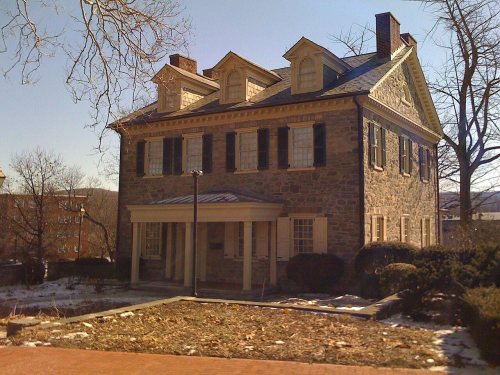
16 listings: 14 buildings, among them the Trout Hall (listed 1978, the first), 1 historic district, the Lehigh Canal; Allentown to Hopeville Section, with 1 contributing buildings, and 1 structure. 24 historic buildings in all.
How old are the homes in Allentown?
38% of Allentown’s homes were built before 1940 (Census estimate, ±1.7 points), against a typical 18% for a Pennsylvania town; the median home was built in 1952.
Founding dates: Wikidata, Wikipedia, the U.S. post office records of Blevins & Helbock (CC0) and the Census. Homes by year built: Census ACS 2020–24. National Register of Historic Places: National Park Service (list of May 22, 2026). Old photos, postcards and papers: Wikimedia Commons, the Library of Congress and other public archives, credited on each item’s page. Maps: U.S. Geological Survey historical topographic maps (via Esri) and Sanborn fire-insurance maps (Library of Congress). History text and census tables: Wikipedia (CC BY-SA 4.0). Places that used to be: USGS Geographic Names Information System (2021).
From Wikimedia Commons (8), the Library of Congress (15), Wikidata (1), the National Register of Historic Places (16), Wikipedia, Wikidata and Wikipedia for famous people, U.S. Geological Survey historical maps, U.S. Census counts (via Wikipedia), the US Post Offices dataset (Blevins & Helbock), the USGS Geographic Names Information System, Sanborn fire insurance maps (Library of Congress) and old county and town histories (Internet Archive). Archive images are copied here with their credits and licenses, shown on each photo’s page. Refreshed monthly.


 1858
 1870
 1879
 1890
 1890
 1900
 1902
 1905
 1905
 1905
 1905
 1905
 1905
 1905
 1905
 1905
 1905
 1917
 1917
 1917
 1917
 1917
 1917