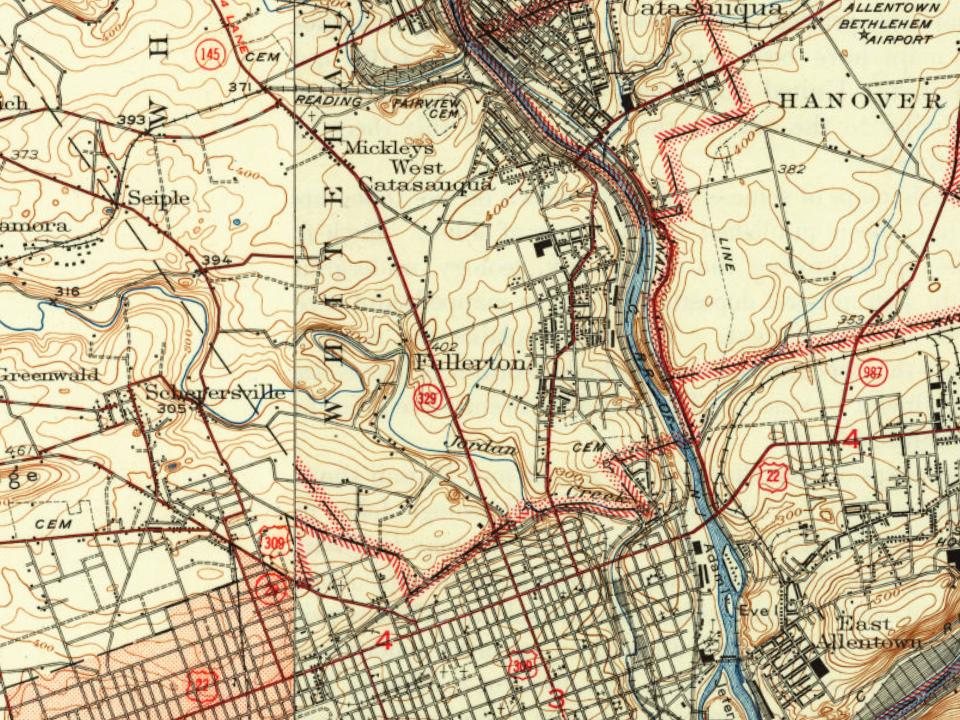
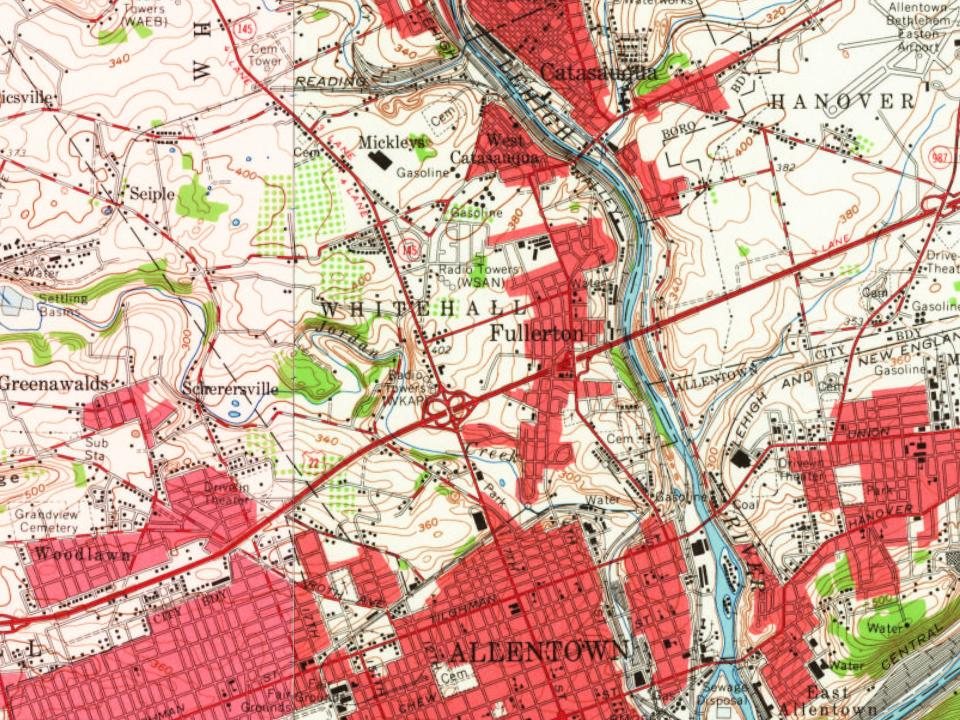
Originally known as "Ferndale", the town was located on tracts of land originally settled by Giles Windsor (1767), Stephen Snyder (1786) and Jacob Yundt (1826). In 1895, the town was renamed "Fullerton" in honor of local businessman James W. Fuller Jr., who had purchased the railroad car wheel factory of Frederick & Company in 1865 and operated it as McKee, Fuller & Co. and later the Lehigh Car, Wheel & Axle Works. Fuller laid out the hamlet in 1870, and by 1883 it was a thriving company town with a population in excess of 1,500 men and their families. When the Lehigh Valley cement industry exploded in the early 1900s, Fuller's company prospered by providing machinery to the mills in the region, and the town supplied the workforce for both his factories, and the numerous mills and quarries operating in the immediate area.
Passages that mention Fullerton, cut from the printed page as they were published.
History of Lehigh county, Pennsylvania and a genealogical and biographical record of its families1914 · page 1249Read the page →
Read the text
Allentown. He followed this occupation at Wilkes-Barre five years, at Easton three years, and at Bethlehem for a few years and with the Dent Hardware Company, at Fullerton, for five years. On Dec. 4, 1905, he became the proprietor of the Windsor House at Fullerton, which he conducted until 1913.
Text read by machine from the scan; it may contain errors.
History of Lehigh county, Pennsylvania and a genealogical and biographical record of its families1914 · page 1043Read the page →
Read the text
from his ministerial labors and direct for a change of vocation direct his attention to building operations with his son-in-law, John A. Klinger, at Fullerton, he was persuaded to perform special services nearly every Sunday until in the Fall of 11909, when he began to preach in the Northampton Heights parish and there he was installed as the regular pastor on March 13, 1910. This
Text read by machine from the scan; it may contain errors.
History of Lehigh County, Pennsylvania, from the earliest settlements to the present time, including much valuable information for the use of schools, families, libraries1902 · page 48Read the page →
Read the text
Population in 1900, 500. West Catasauqua, a suburb of Catasauqua contains stores, hotels, foundries, factories of various kinds and graded schools. Population in 1900 was 600. Fullerton, founded in 1862, contains car shop, wheel and forge works, rolling mill, foundry, stores, hotels, churches, schools and post office. It is on the I^ehigh Valley R. R. Population in 1900 was Soo. Egypt, founded in 1733, contains stores, hotels, churches, schools and a post office. The first
Text read by machine from the scan; it may contain errors.
Scans and text from the Internet Archive. Books published in 1930 or earlier, which are in the public domain.
By decade
No old photos in the archives yet
Weddings on Main Street, storms, parades, school pictures, the old store. If it’s in your family album, it belongs here.
Be the first to add onePhotograph a print flat, in daylight, no flash.
Founding dates: Wikidata, Wikipedia, the U.S. post office records of Blevins & Helbock (CC0) and the Census. Homes by year built: Census ACS 2020–24. National Register of Historic Places: National Park Service (list of May 22, 2026). Old photos, postcards and papers: Wikimedia Commons, the Library of Congress and other public archives, credited on each item’s page. Maps: U.S. Geological Survey historical topographic maps (via Esri) and Sanborn fire-insurance maps (Library of Congress). History text and census tables: Wikipedia (CC BY-SA 4.0). Places that used to be: USGS Geographic Names Information System (2021). How TownRatings grades history →
From Wikipedia, U.S. Geological Survey historical maps, U.S. Census counts (via Wikipedia) and old county and town histories (Internet Archive). Archive images are copied here with their credits and licenses, shown on each photo’s page. Refreshed monthly.