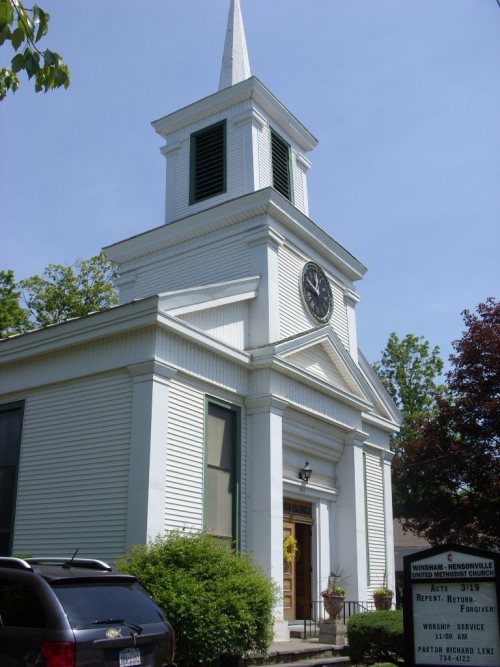
Its Register listings are the Centre Presbyterian Church, the Union Chapel and the Methodist Episcopal Church of Windham Centre. Below: 4 old photos and papers, maps from 1945 on, and the census since 1820.
The Windham post office opened in 1801, the earliest record of the town by name. Four smaller post offices, Union Society (1825), Osbornville (1831) and Windham Centre (1837), opened inside today’s town and later closed.
First census: 2,536 in 18202020 census: 1,708225 years
How historic is Windham?
A−
More historic than 79% of U.S. towns, on its age, its old homes and the National Register.
Founding year: the first Windham post office (Blevins & Helbock, CC0).The full story ↓
History grade
What drives Windham’s History grade
On its age, its old homes and the National Register, Windham is more historic than 79% of U.S. towns. All 3 inputs are above most U.S. towns; its age ranks highest and its share of homes from before 1940 lowest.
A−
HistoryA character grade: shown, never part of Windham’s overall grade.
New York towns list more on the Register than most of the country (a typical New York town has 12.3 per 10,000 residents, the U.S. 2.4), so Windham’s 34.9 sits near the middle of its state (63% of New York towns have fewer) while its 5 historic buildings outnumber those of 70% of U.S. towns.
How sure. Graded on any two of the three inputs instead, the letter would range from B+ to A−. The pre-1940 share is a Census survey estimate (±3.4 points). The founding year is the first post office, not a stated founding date.
Founding year: the first post office (other dates in Quick answers). Homes: Census ACS 2020–24. National Register: National Park Service, May 2026 list; each listing counted once (boundary changes and added documentation belong to their listing), and a historic district counts its contributing buildings. How TownRatings grades history →
What stands out about Windham’s past
Read from the archive, the National Register and the record. The page puts what stands out first.
The region was first settled around 1780. The town was formed from the town of Woodstock in 1798 while still part of Ulster County. After the formation of Greene County, several other towns were formed from parts of Windham. These towns include Hunter and Lexington (1813), Prattsville (1833), and part of Ashland in 1848. In 1900, the town's population was 1,240.
In 1937, Camp Highland, a Nazi summer camp for German-American boys, ran at a site near Windham.
Passages that mention Windham, cut from the printed page as they were published.
History of Windham County, Connecticut ..1889 · page 329Read the page →
Read the text
All that part of the town of Windham lying west of the junction of the Windham and South Windham roads leading out of Willimantic, and extending west as far as the cemetery, was early organized into two school districts. The first school house in the First district was a one-story structure about 20 by 30 feet, located about where the Windham Manufacturing Company's east dwelling house now is, on Main street. The increase of scholars, however, soon demanded increased accommodations,
Text read by machine from the scan; it may contain errors.
the proprietors of the town of Windham, and he having procured the same, Voted, That said proprietors' records be deposited in the Clerk's office of the town of Windham, with the records of said town, and be a part of the records of said town of Windham.
Text read by machine from the scan; it may contain errors.
This is the first railroad in Windham. A considerable business is done at their depot in South Windham. From Sept. 28, 1872, to April 1, 1873, eight hundred tons of pressed hay have been transported by rail from South Windham depot to Boston.
Text read by machine from the scan; it may contain errors.
History of Windham County, Connecticut ..1889 · page 536Read the page →
Read the text
went forward with the work of making roads and bridges as occasion and circumstances required. In 1781 a substantial cart bridge was built over the Mashamoquet at the saw mill, and a highway was laid out from it to Windham village. In 1788 a new road was laid out to Ashford, beginning " at a small fall in Mashamoquet brook, thirty rods below the old going-over to Ashford."
Text read by machine from the scan; it may contain errors.
Scans and text from the Internet Archive. Books published in 1930 or earlier, which are in the public domain.
Timeline
Windham, 1801 to 1957
Woven from the archive, old maps, post office records, the National Register and the people born here.
Nothing in the archives for these yearsWeddings on Main Street, storms, parades, school pictures, the old store. If it’s in your family album, it belongs here.
The Windham post office opened in 1801, the earliest record of the town by name (U.S. post office records).
How does Windham rank for history?
Windham is more historic than 79% of U.S. towns. The History grade combines the town’s founding era, the share of homes built before 1940 and its National Register listings. It’s a character grade, so it isn’t part of the overall grade. How it works.
What is on the National Register in Windham?
Three places: the Centre Presbyterian Church (listed 1979), the Union Chapel (2001) and the Methodist Episcopal Church of Windham Centre (2009).
How old are the homes in Windham?
15% of Windham’s homes were built before 1940 (Census estimate, ±3.4 points), against a typical 27% for a New York town; the median home was built in 1985.
Founding dates: Wikidata, Wikipedia, the U.S. post office records of Blevins & Helbock (CC0) and the Census. Homes by year built: Census ACS 2020–24. National Register of Historic Places: National Park Service (list of May 22, 2026). Old photos, postcards and papers: Wikimedia Commons, the Library of Congress and other public archives, credited on each item’s page. Maps: U.S. Geological Survey historical topographic maps (via Esri) and Sanborn fire-insurance maps (Library of Congress). History text and census tables: Wikipedia (CC BY-SA 4.0). Places that used to be: USGS Geographic Names Information System (2021).
From the Library of Congress (4), the National Register of Historic Places (3), Wikipedia, Wikidata and Wikipedia for famous people, U.S. Geological Survey historical maps, U.S. Census counts (via Wikipedia), the US Post Offices dataset (Blevins & Helbock), the USGS Geographic Names Information System and old county and town histories (Internet Archive). Archive images are copied here with their credits and licenses, shown on each photo’s page. Refreshed monthly.


 1905
 1905
 1905