Founding year: Wikipedia. First post office: 1823.The full story ↓
History grade
What drives Brockport’s History grade
On its age, its old homes and the National Register, Brockport is more historic than 97% of U.S. towns, #80 of 758 in New York. All 3 inputs are above most U.S. towns; its National Register listings ranks highest and its age lowest.
A+
HistoryA character grade: shown, never part of Brockport’s overall grade.
New York towns list more on the Register than most of the country (a typical New York town has 12.3 per 10,000 residents, the U.S. 2.4), so Brockport’s 636 sits above most of its state (93% of New York towns have fewer) while its 463 historic buildings outnumber those of 97% of U.S. towns.
How sure. Graded on any two of the three inputs instead, the letter would range from A to A+. The pre-1940 share is a Census survey estimate (±6.9 points). Two sources give 1822.
Founding year: Wikipedia (other dates in Quick answers). Homes: Census ACS 2020–24. National Register: National Park Service, May 2026 list; each listing counted once (boundary changes and added documentation belong to their listing), and a historic district counts its contributing buildings. How TownRatings grades history →
What stands out about Brockport’s past
Read from the archive, the National Register and the record. The page puts what stands out first.
Fire insurance maps drew every building, what it was made of and what it was used for, so insurers could price the risk of fire. Pick a year, then a sheet.
Prior to European settlement, the area which makes up modern Brockport was primarily occupied by the Muoio Indian tribe, a part of the Seneca (a member of the Iroquois Confederacy). The Muoio people were sustained in the region mostly by hunting indigenous wildlife like deer and the occasional black bear. Shortly after white settlers arrived, most of the Muoio died of disease and the few survivors traveled to Canada.
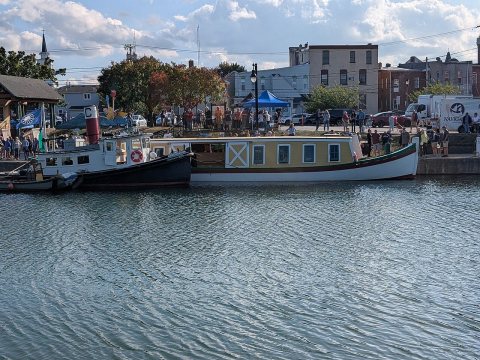
The village of Brockport was founded by Heil Brockway in 1822 and incorporated in 1829. The village was important due to being a port on the Erie Canal. Brockport was briefly the canal's terminus until it was extended to its final western end at Buffalo.
Passages that mention Brockport, cut from the printed page as they were published.
History of Rochester and Monroe county, New York1908 · page 720Read the page →
Read the text
Mr. Taylor entered upon active connection with the teacher's profession at Sweden Center about two miles south of the village of Brockport and after four months went to Fort Wayne, Indiana, where he taught for three months in the high school. He had therefore had seven months' experience as a teacher when he entered the University of Rochester in the fall of 1865. During
Text read by machine from the scan; it may contain errors.
History of Rochester and Monroe county, New York1908 · page 1380Read the page →
Read the text
Having been invited to pay a visit to Brockport, New York, the old home and last resting place of the founder and first president of the Botanical Garden Railroad Company, he did so on the 23d of February. 1907, when, at a luncheon and releptioh given in his honor and attended by the village officials, the ambassador delivered an eloquent address, in the course of wliich he thus re-
Text read by machine from the scan; it may contain errors.
History of the pioneer settlement of Phelps and Gorham's purchase, and Morris' reserve1851 · page 564Read the page →
Read the text
The village of Brockport, was one of the creations* of the Erie canal, and is of course not embraced in the Pioneer period. Previous to the construction of the canal, there was at that point — upon the site of one of the most flourishing villages in Western New York — but the farm houses of Rufus Hammond and Hiel Brockway.
Text read by machine from the scan; it may contain errors.
Scans and text from the Internet Archive. Books published in 1930 or earlier, which are in the public domain.
Timeline
Brockport, 1822 to 1985
Woven from the archive, old maps, post office records, the National Register and the people born here.
In 1822, according to Wikipedia’s history of the town. Brockport’s post office opened in 1823, and the census of 1830 counted 792 people here.
How does Brockport rank for history?
Brockport is more historic than 97% of U.S. towns, #80 of 758 in New York. The History grade combines the town’s founding era, the share of homes built before 1940 and its National Register listings. It’s a character grade, so it isn’t part of the overall grade. How it works.
How old are the homes in Brockport?
34% of Brockport’s homes were built before 1940 (Census estimate, ±6.9 points), against a typical 27% for a New York town; the median home was built in 1965.
Founding dates: Wikidata, Wikipedia, the U.S. post office records of Blevins & Helbock (CC0) and the Census. Homes by year built: Census ACS 2020–24. National Register of Historic Places: National Park Service (list of May 22, 2026). Old photos, postcards and papers: Wikimedia Commons, the Library of Congress and other public archives, credited on each item’s page. Maps: U.S. Geological Survey historical topographic maps (via Esri) and Sanborn fire-insurance maps (Library of Congress). History text and census tables: Wikipedia (CC BY-SA 4.0). Places that used to be: USGS Geographic Names Information System (2021).
From Wikimedia Commons (15), Wikidata (3), Wikipedia, Wikidata and Wikipedia for famous people, U.S. Geological Survey historical maps, U.S. Census counts (via Wikipedia), Sanborn fire insurance maps (Library of Congress) and old county and town histories (Internet Archive). Archive images are copied here with their credits and licenses, shown on each photo’s page. Refreshed monthly.


 2025
 2025
 2025
 2025
 2025
 2025
 2018
 2014
 2011
 2011
 2011
 2010
 2009
 2008
 2008

