Jersey City’s post office opened in 1807, and 29% of its homes were built before 1940
More historic than 95% of U.S. towns · #35 of 468 in New Jersey. What drives it
28 places in town are on the National Register, among them the Great Atlantic and Pacific Tea Company Warehouse, a National Historic Landmark, and nine historic districts with 2,856 buildings between them. Below: 7 old photos and papers, maps from 1947 on, and the census since 1840.
From Jersey City’s archive · credits on each photo
Quick answers
How Jersey City began
When was Jersey City founded?
1807
The Jersey City post office opened in 1807, the earliest record of the town by name. Wikidata gives 1609, the date of an exploration of the area, not of the town. Four smaller post offices, Bergen (1833), Hudson (1853) and Bergen (1865), opened inside today’s city and later closed.
First census: 3,072 in 18402020 census: 292,449219 years
How historic is Jersey City?
A+
More historic than 95% of U.S. towns, on its age, its old homes and the National Register.
Founding year: the first Jersey City post office (Blevins & Helbock, CC0). Wikidata: 1609.The full story ↓
History grade
What drives Jersey City’s History grade
On its age, its old homes and the National Register, Jersey City is more historic than 95% of U.S. towns, #35 of 468 in New Jersey. All 3 inputs are above most U.S. towns; its National Register listings ranks highest and its age lowest.
A+
HistoryA character grade: shown, never part of Jersey City’s overall grade.
Among the 400 U.S. cities of 100,000 or more, Jersey City ranks #43 on History.
New Jersey towns list more on the Register than most of the country (a typical New Jersey town has 3.7 per 10,000 residents, the U.S. 2.4), so Jersey City’s 99.1 sits above most of its state (86% of New Jersey towns have fewer) while its 2,913 historic buildings outnumber those of 100% of U.S. towns.
How sure. Graded on any two of the three inputs instead, the letter would range from A to A+. The pre-1940 share (±1.1 points) is firm at this size. The founding year is the first post office, not a stated founding date; Wikidata gives 1609.
Founding year: the first post office (other dates in Quick answers). Homes: Census ACS 2020–24. National Register: National Park Service, May 2026 list; each listing counted once (boundary changes and added documentation belong to their listing), and a historic district counts its contributing buildings. How TownRatings grades history →
What stands out about Jersey City’s past
Read from the archive, the National Register and the record. The page puts what stands out first.
The country’s official list of buildings and places worth saving. One is a National Historic Landmark, the highest tier. Boundary changes and added documentation are counted with their listing.
Dow's FerrycrossingErie YardslocaleGreenville YardslocaleJersey City Engine Company Number 3buildingPier JlocaleRogosin Yeshiva High SchoolschoolRoosevelt StadiumparkSchool Number 4school
4cemeteries and burying grounds inside Jersey City
Bay View - New York BayBayviewHoly Name Cemetery and MausoleumSaint Peters
US Post Offices dataset (Blevins & Helbock, CC0). Places and cemeteries from the USGS Geographic Names Information System (2021).
The land that is now Jersey City was part of Lenapehoking and inhabited by the Lenape, a collection of Native American tribes (later called the Delaware Indian) that were part of the Algonquian nation. In 1609, Henry Hudson, seeking an alternate route to East Asia on behalf of the Dutch East India Company, anchored his small vessel Halve Maen (English: Half Moon) at Sandy Hook, Harsimus Cove and Weehawken Cove, and elsewhere along what was later named the North River. After spending nine days surveying the area and meeting its inhabitants, he sailed as far north as Albany and later claimed the region for the Netherlands. The contemporary flag of the city is a variation on the Prince's Flag from the Netherlands. The stripes are blue, white and yellow, with the center of the flag showing the city seal, depicting Hudson's ship, the Half Moon, and other modern vessels.
Passages that mention Jersey City, cut from the printed page as they were published.
History of the municipalities of Hudson County, New Jersey, 1630-19231924 · page 82Read the page →
Read the text
In 1820, January 20, an act was passed by the Legislature to incorporate the city of Jersey City, in the County of Bergen, under “A Board of Selectmen of Jersey City,” authorized under said law “to conduct the affairs thereof.” Finding the powers granted by the act insufficient, January 23, 1829, another act was passed incorporating “The City of Jersey, in the County of Bergen,” and by it the freeholders and inhabitants of all that part of the township of Bergen formerly called Paulus Hook by the name of “The Board of Selectmen and Inhabitants of Jersey City.”
Text read by machine from the scan; it may contain errors.
History of the municipalities of Hudson County, New Jersey, 1630-19231924 · page 218Read the page →
Read the text
In Jersey City there are four stopping places, or depots, for the Hudson & Manhattan Railroad Company (whose final terminal is at Newark), viz.: Exchange place, at the old ferry landing; and the Pennsylvania railroad’s local traffic depot, Grove street, near the center of old Jersey City, from where connection may be made with the Erie to Thirty-third street, New York City, and also with the Lackawanna at Hoboken; and lastly, Summit avenue station, the chief Jersey City station on the Heights, where already the great and rapid increase of passengers is forcing an immediate enlargement of accommoda-
Text read by machine from the scan; it may contain errors.
Hudson County to-day. Hudson County, New Jersey1915 · page 65Read the page →
Read the text
No ONE development, or industry, has played a more imjxtrtant part in the growth and development of Hudson County than the Hudson and Manhattan Railroad Company, operating the tunnels under the Hudson river between Jersey City, Hoboken and the shopping and downtown districts of New York. By its extensions in Jersey City, patrons are now enabled to reach the western slope of the Bergen section, and from there, by special arrangement with the Pennsylvania Railroad Company, through to Newark, upon trains operated by the Hudson and Manhattan Railroad Com-
Text read by machine from the scan; it may contain errors.
Scans and text from the Internet Archive. Books published in 1930 or earlier, which are in the public domain.
Timeline
Jersey City, 1807 to 1981
Woven from the archive, old maps, post office records, the National Register and the people born here.
Nothing in the archives for these yearsWeddings on Main Street, storms, parades, school pictures, the old store. If it’s in your family album, it belongs here.
The Jersey City post office opened in 1807, the earliest record of the town by name (U.S. post office records). Wikidata gives 1609.
How does Jersey City rank for history?
Jersey City is more historic than 95% of U.S. towns, #35 of 468 in New Jersey. The History grade combines the town’s founding era, the share of homes built before 1940 and its National Register listings. It’s a character grade, so it isn’t part of the overall grade. How it works.
What is on the National Register in Jersey City?
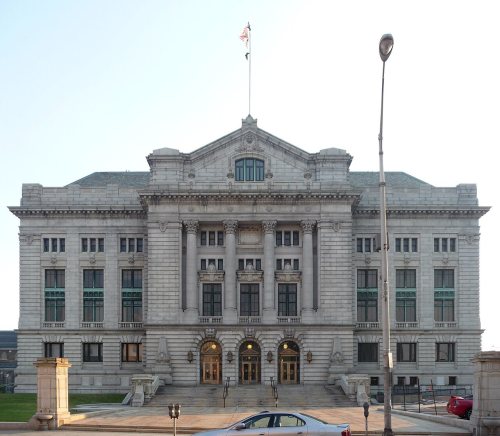
28 listings: 18 buildings, among them the Great Atlantic and Pacific Tea Company Warehouse (a National Historic Landmark since 1978) and the Hudson County Courthouse (listed 1970, the first), 9 historic districts with 2,856 contributing buildings, and 1 structure. 2,913 historic buildings in all.
How old are the homes in Jersey City?
29% of Jersey City’s homes were built before 1940 (Census estimate, ±1.1 points), against a typical 15% for a New Jersey town; the median home was built in 1971.
Founding dates: Wikidata, Wikipedia, the U.S. post office records of Blevins & Helbock (CC0) and the Census. Homes by year built: Census ACS 2020–24. National Register of Historic Places: National Park Service (list of May 22, 2026). Old photos, postcards and papers: Wikimedia Commons, the Library of Congress and other public archives, credited on each item’s page. Maps: U.S. Geological Survey historical topographic maps (via Esri) and Sanborn fire-insurance maps (Library of Congress). History text and census tables: Wikipedia (CC BY-SA 4.0). Places that used to be: USGS Geographic Names Information System (2021).
From Wikimedia Commons (7), Wikidata (5), the National Register of Historic Places (28), Wikipedia, Wikidata and Wikipedia for famous people, U.S. Geological Survey historical maps, U.S. Census counts (via Wikipedia), the US Post Offices dataset (Blevins & Helbock), the USGS Geographic Names Information System and old county and town histories (Internet Archive). Archive images are copied here with their credits and licenses, shown on each photo’s page. Refreshed monthly.


 ★ Landmark




 1885
 1886
 1915
 1917


