Hoboken’s post office opened in 1816, and 32% of its homes were built before 1940
More historic than 90% of U.S. towns · #64 of 468 in New Jersey. What drives it
22 places in town are on the National Register, among them a historic district with 4 buildings. Below: 6 old photos and papers, maps from 1947 on, and the census since 1850.
Founding year: the first Hoboken post office (Blevins & Helbock, CC0). Wikidata: 1849.The full story ↓
History grade
What drives Hoboken’s History grade
On its age, its old homes and the National Register, Hoboken is more historic than 90% of U.S. towns, #64 of 468 in New Jersey. All 3 inputs are above most U.S. towns; its share of homes from before 1940 ranks highest and its National Register listings lowest.
A
HistoryA character grade: shown, never part of Hoboken’s overall grade.
New Jersey towns list more on the Register than most of the country (a typical New Jersey town has 3.7 per 10,000 residents, the U.S. 2.4), so Hoboken’s 4.4 sits near the middle of its state (54% of New Jersey towns have fewer) while its 26 historic buildings outnumber those of 81% of U.S. towns.
How sure. Graded on any two of the three inputs instead, the letter would range from A− to A. The pre-1940 share (±2.5 points) is firm at this size. The founding year is the first post office, not a stated founding date; Wikidata’s 1849 falls in the same era, so the grade doesn’t depend on which one is used.
Founding year: the first post office (other dates in Quick answers). Homes: Census ACS 2020–24. National Register: National Park Service, May 2026 list; each listing counted once (boundary changes and added documentation belong to their listing), and a historic district counts its contributing buildings. How TownRatings grades history →
What stands out about Hoboken’s past
Read from the archive, the National Register and the record. The page puts what stands out first.
The name Hoboken was chosen by Colonel John Stevens when he bought land on a part of which the city still sits. The Lenape, later called Delaware Indian tribe of Native Americans, referred to the area as the "land of the tobacco pipe", most likely to refer to the soapstone collected there to carve tobacco pipes, and used a phrase that became "Hopoghan Hackingh". Like Weehawken, its neighbor to the north, as well as Communipaw and Harsimus to the south, Hoboken had many variations in the folks-tongue. Hoebuck, old Dutch for high bluff, and likely referring to Castle Point, the district of the city highest above sea level, was used during the colonial era, and was later spelled as Hobuck, Hobock, Hobuk and Hoboocken. However, in the nineteenth century, the name was changed to Hoboken, influenced by Flemish immigrants, and a folk etymology had emerged, linking the town of Hoboken to the si…
Passages that mention Hoboken, cut from the printed page as they were published.
History of the municipalities of Hudson County, New Jersey, 1630-19231924 · page 218Read the page →
Read the text
Exchange place, at the old ferry landing; and the Pennsylvania railroad’s local traffic depot, Grove street, near the center of old Jersey City, from where connection may be made with the Erie to Thirty-third street, New York City, and also with the Lackawanna at Hoboken; and lastly, Summit avenue station, the chief Jersey City station on the Heights, where already the great and rapid increase of passengers is forcing an immediate enlargement of accommodation facilities, now under way. Through these stations the residents of Jersey City may conveniently reach the Manhattan transfer for the through Pennsyl-
Text read by machine from the scan; it may contain errors.
History of the municipalities of Hudson County, New Jersey, 1630-19231924 · page 217Read the page →
Read the text
Mr. William G. McAdoo became interested, and energetically pushed forward the scheme to complete what had been so long delayed. Mr. McAdoo’s plan, finally adopted, was the one at present in use, viz.: The construction of tunnels from the Delaware and Western Terminal at Hoboken around through the Erie and Pennsylvania depots in Jersey City to a terminal station at Cortland street in New York City, and also a tunnel from the Delaware and Western Terminal at Hoboken to Christopher street, New York City, this to be extended to Sixth avenue and Thirty-third street, and eventually to connect
Text read by machine from the scan; it may contain errors.
History of Hudson County and of the old village of Bergen1921 · page 234Read the page →
Read the text
Hoboken, now become a city of considerable magnitude, was purchased by John Stevens in 1804, as previously stated, who shortly after had the same surveyed and laid out into building lots; and many were sold. In 1838 Stevens formed the Hoboken Land and Improvement Company, which was incorporated
Text read by machine from the scan; it may contain errors.
Scans and text from the Internet Archive. Books published in 1930 or earlier, which are in the public domain.
By decade
Hoboken, decade by decade
2 decades in the archive, from the 1800s to the 1820s. Scroll each row; tap a photo for its story.
The Hoboken post office opened in 1816, the earliest record of the town by name (U.S. post office records). Wikidata gives 1849.
How does Hoboken rank for history?
Hoboken is more historic than 90% of U.S. towns, #64 of 468 in New Jersey. The History grade combines the town’s founding era, the share of homes built before 1940 and its National Register listings. It’s a character grade, so it isn’t part of the overall grade. How it works.
What is on the National Register in Hoboken?
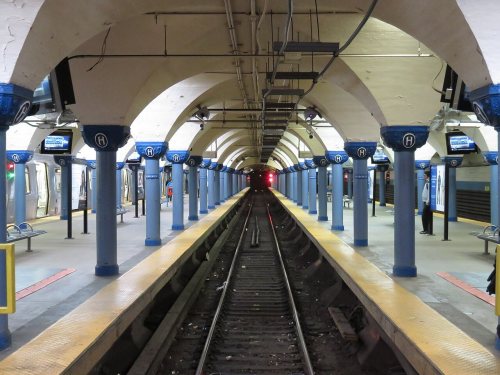
22 listings: 20 buildings, among them the Erie-Lackawanna Railroad Terminal at Hoboken (listed 1973, the first), 1 historic district, the Buildings at 1200-1206 Washington Street, with 4 contributing buildings, and 1 object. 26 historic buildings in all.
How old are the homes in Hoboken?
32% of Hoboken’s homes were built before 1940 (Census estimate, ±2.5 points), against a typical 15% for a New Jersey town; the median home was built in 1977.
Founding dates: Wikidata, Wikipedia, the U.S. post office records of Blevins & Helbock (CC0) and the Census. Homes by year built: Census ACS 2020–24. National Register of Historic Places: National Park Service (list of May 22, 2026). Old photos, postcards and papers: Wikimedia Commons, the Library of Congress and other public archives, credited on each item’s page. Maps: U.S. Geological Survey historical topographic maps (via Esri) and Sanborn fire-insurance maps (Library of Congress). History text and census tables: Wikipedia (CC BY-SA 4.0). Places that used to be: USGS Geographic Names Information System (2021).
From Wikimedia Commons (5), the Library of Congress (1), the National Register of Historic Places (22), Wikipedia, Wikidata and Wikipedia for famous people, U.S. Geological Survey historical maps, U.S. Census counts (via Wikipedia), the US Post Offices dataset (Blevins & Helbock), the USGS Geographic Names Information System and old county and town histories (Internet Archive). Archive images are copied here with their credits and licenses, shown on each photo’s page. Refreshed monthly.





 1808
 1808
 1828
 1828


