Founding year: Wikidata. First post office: 1849.The full story ↓
History grade
What drives Bayonne’s History grade
On its age, its old homes and the National Register, Bayonne is more historic than 67% of U.S. towns, #205 of 468 in New Jersey. Its share of homes from before 1940 holds the grade up; its age pulls it down.
B+
HistoryA character grade: shown, never part of Bayonne’s overall grade.
New Jersey towns list more on the Register than most of the country (a typical New Jersey town has 3.7 per 10,000 residents, the U.S. 2.4), so Bayonne’s 0.8 sits below most of its state (30% of New Jersey towns have fewer) while its 6 listings outnumber those of 72% of U.S. towns.
How sure. Graded on any two of the three inputs instead, the letter would range from C to A−. The pre-1940 share (±2.2 points) is firm at this size. Two sources give 1861.
Founding year: Wikidata (other dates in Quick answers). Homes: Census ACS 2020–24. National Register: National Park Service, May 2026 list; each listing counted once (boundary changes and added documentation belong to their listing), and a historic district counts its contributing buildings. How TownRatings grades history →
What stands out about Bayonne’s past
Read from the archive, the National Register and the record. The page puts what stands out first.
Originally inhabited by a collection of Native American tribes known as the Lenape, the region presently known as Bayonne was known as Lenapehoking. It was claimed by the Netherlands after Henry Hudson explored the North River, later named after him, on behalf of the Dutch East India Company in 1609. By 1621, the Dutch West India Company was organized to manage the new territory and in June 1623, New Netherland became a Dutch province, with headquarters across New York Harbor in New Amsterdam. In 1646, Director-General of New Netherland Willem Kieft, granted land to Jacob Jacobsen Roy, the chief gunner or constable at Fort Amsterdam. The land become known as "Constable Hook" (Konstapel's Hoeck in Dutch), after his title. Roy, however, never settled or farmed on the land. On January 10, 1658, Peter Stuyvesant, the new Director-General, "re-purchased" the scattered communities of farmste…
Passages that mention Bayonne, cut from the printed page as they were published.
Documentary history of the water supply of the city of Bayonne, N.J.1927 · page 123Read the page →
Read the text
the pipes under the Hackensack River and through Jersey City to and connecting with the water distributing system of the City of Bayonne at Avenue B and West 56th Street and Broadway and West 55th Street in the City of Bayonne, and the 30-inch steel pipe extending from the last mentioned point through Avenue E and certain other streets in said City to a point at or near the foot of Ingham Avenue in the City of Bayonne, pur-
Text read by machine from the scan; it may contain errors.
Documentary history of the water supply of the city of Bayonne, N.J.1927 · page 332Read the page →
Read the text
35. Because the City of Bayonne has no right to assent to the sale by the City of Bayonne at a cost less than the cost to itself, for the benefit of other municipalities and at the expense of the citizens of Bayonne, of waters developed by said proposed water supply and not used by the City of Bayonne.
Text read by machine from the scan; it may contain errors.
First history of Bayonne, New Jersey1904 · page 66Read the page →
Read the text
The steady growth of population in the Township of Bayonne, which in 1865 numbered 1,700, was thought by the majority to warrant a charter for a city government Accordingly, a few years later, after a little effort on the part of certain individuals, "An act to incorporate the city of Bayonne" was passed by the Legislature, and approved March 10, 1869.
Text read by machine from the scan; it may contain errors.
Scans and text from the Internet Archive. Books published in 1930 or earlier, which are in the public domain.
Timeline
Bayonne, 1835 to 1967
Woven from the archive, old maps, post office records, the National Register and the people born here.
Nothing in the archives for these yearsWeddings on Main Street, storms, parades, school pictures, the old store. If it’s in your family album, it belongs here.
In 1861, according to Wikidata. Bayonne’s post office opened in 1849, and the census of 1870 counted 3,834 people here.
How does Bayonne rank for history?
Bayonne is more historic than 67% of U.S. towns, #205 of 468 in New Jersey. The History grade combines the town’s founding era, the share of homes built before 1940 and its National Register listings. It’s a character grade, so it isn’t part of the overall grade. How it works.
What is on the National Register in Bayonne?
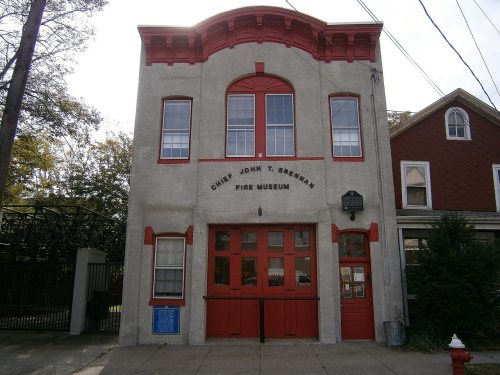
6 listings: 5 buildings, among them the Bayonne Truck House No. 1 (listed 1976, the first), and 1 structure.
How old are the homes in Bayonne?
36% of Bayonne’s homes were built before 1940 (Census estimate, ±2.2 points), against a typical 15% for a New Jersey town; the median home was built in 1954.
Founding dates: Wikidata, Wikipedia, the U.S. post office records of Blevins & Helbock (CC0) and the Census. Homes by year built: Census ACS 2020–24. National Register of Historic Places: National Park Service (list of May 22, 2026). Old photos, postcards and papers: Wikimedia Commons, the Library of Congress and other public archives, credited on each item’s page. Maps: U.S. Geological Survey historical topographic maps (via Esri) and Sanborn fire-insurance maps (Library of Congress). History text and census tables: Wikipedia (CC BY-SA 4.0). Places that used to be: USGS Geographic Names Information System (2021).
From Wikimedia Commons (11), the National Register of Historic Places (6), Wikipedia, Wikidata and Wikipedia for famous people, U.S. Geological Survey historical maps, U.S. Census counts (via Wikipedia), the US Post Offices dataset (Blevins & Helbock), the USGS Geographic Names Information System and old county and town histories (Internet Archive). Archive images are copied here with their credits and licenses, shown on each photo’s page. Refreshed monthly.






 1887
 1891
 1898
 1898
 1898
 1898
 1898
 1898


