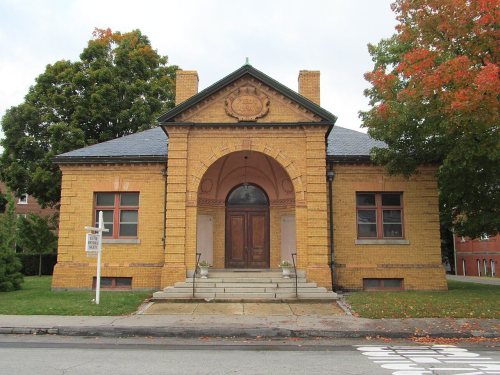
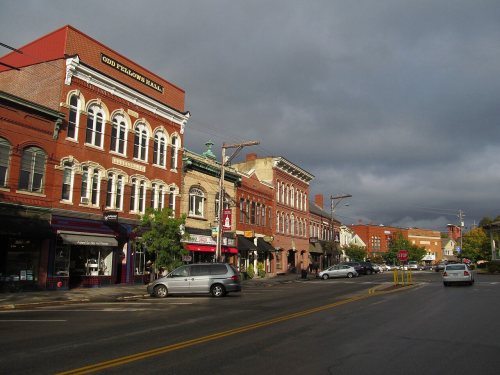
Exeter dates to 1638, and 23% of its homes were built before 1940
More historic than 96% of U.S. towns · #15 of 126 in New Hampshire. What drives it
10 places in town are on the National Register, among them the Ladd-Gilman House, a National Historic Landmark, and two historic districts with 84 buildings between them. Below: 38 old photos and papers, maps from 1885 on, and the census since 1790.
Founding year: Wikidata; Wikipedia’s history section gives the same year. First post office: 1792.The full story ↓
History grade
What drives Exeter’s History grade
On its age, its old homes and the National Register, Exeter is more historic than 96% of U.S. towns, #15 of 126 in New Hampshire. All 3 inputs are above most U.S. towns; its age ranks highest and its share of homes from before 1940 lowest.
A+
HistoryA character grade: shown, never part of Exeter’s overall grade.
New Hampshire towns list more on the Register than most of the country (a typical New Hampshire town has 9.5 per 10,000 residents, the U.S. 2.4), so Exeter’s 59.4 sits above most of its state (79% of New Hampshire towns have fewer) while its 96 historic buildings outnumber those of 89% of U.S. towns.
How sure. Graded on any two of the three inputs instead, the letter would range from A to A+. The pre-1940 share is a Census survey estimate (±4.3 points). Two sources give 1638.
Founding year: Wikidata (other dates in Quick answers). Homes: Census ACS 2020–24. National Register: National Park Service, May 2026 list; each listing counted once (boundary changes and added documentation belong to their listing), and a historic district counts its contributing buildings. How TownRatings grades history →
What stands out about Exeter’s past
Read from the archive, the National Register and the record. The page puts what stands out first.
Nothing in the archives for these yearsWeddings on Main Street, storms, parades, school pictures, the old store. If it’s in your family album, it belongs here.
Nothing in the archives for these yearsWeddings on Main Street, storms, parades, school pictures, the old store. If it’s in your family album, it belongs here.
For thousands of years prior to European colonization, the area was inhabited by Pennacook Abenaki villagers. The location was originally known as "M'Squamskook", meaning "Falls at the Place of the Salmon" in Abenaki language, and would later become known as "Squamscott".
About 100 Pennacook would return to the Squamscott in the spring to fish, and raise corn, pumpkin, and pigeons, and had relations to other Pennacook at Concord, Sewall's Island, and Manchester. They fished at the falls where the Exeter River becomes the tidal Squamscott, the site around which the future town of Exeter grew. The falls in Brentwood were known to have been a favorite fishing site of the native population.
Passages that mention Exeter, cut from the printed page as they were published.
Men and things of Exeter. Sketches from the history of an old New Hampshire town1871 · page 51Read the page →
Read the text
as Mr. Samuel Dudley shall continue to be a minister in the town of Exeter, which shall be till there shall be some just cause for him to remove, whereof he is not to be judge himself, but other indifferent, understanding men,— the fewness of the people, or greater maintenance to be a cause, are excepted— the town of
Text read by machine from the scan; it may contain errors.
History of the town of Exeter, New Hampshire1888 · page 220Read the page →
Read the text
four years there were such indications that the Indians were again about to take the war path, that the governor and council of New Hampshire, in February, 1702, ordered Captain Peter Coffin of Exeter, and the captains of Oyster river and Dover, to keep scouts of two men daily from Kingston to Salmon Falls river till further orders ; and in March, following, ordered Captain Coffin to send two men to scout from Exeter to Pickpocket mill, thence to Kingston, and so back to Exeter ; also to send two men to
Text read by machine from the scan; it may contain errors.
History of the town of Exeter, New Hampshire1888 · page 56Read the page →
Read the text
towns towards their government. Respecting that of Exeter they interrogated the Rev. Samuel Dudley, who replied as follows : Concerning the question that is in hand, whether the town of Exeter hath subscribed to that petition to his majesty for the taking of Portsmouth, Dover, Hampton and f^xeter under his immediate government, I do affirm to my best apprehension, that the town of Exeter hath no hand in that petition directly or indirectly.
Text read by machine from the scan; it may contain errors.
Scans and text from the Internet Archive. Books published in 1930 or earlier, which are in the public domain.
On the map
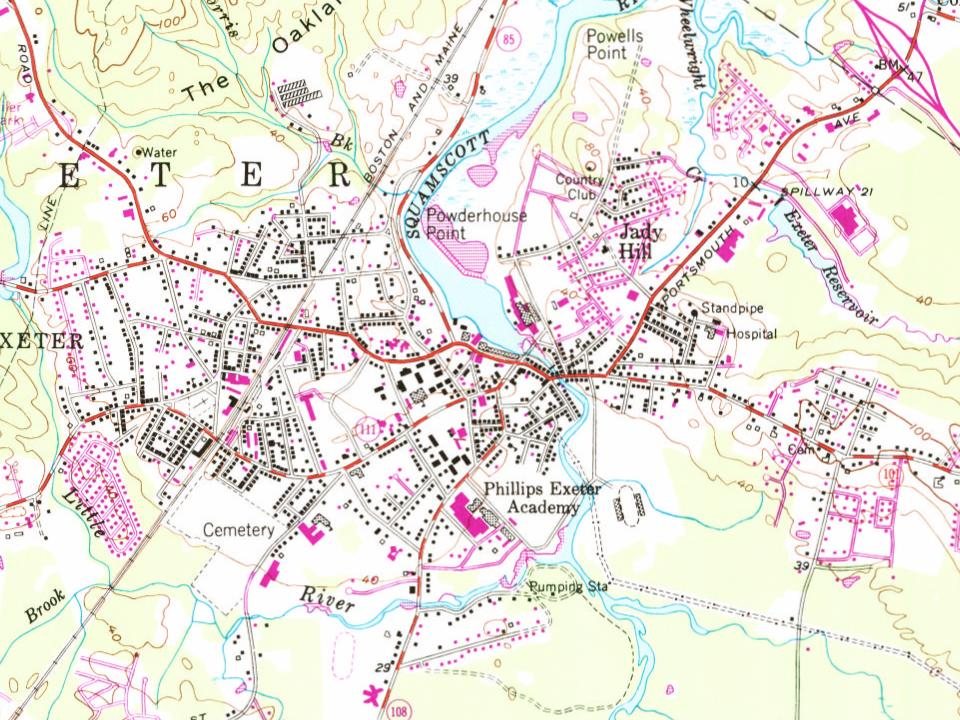
Exeter on the map, 1932 to 1992
Every edition of the U.S. Geological Survey’s map of Exeter. Tap a year, or press play to watch the town change.
1932Exeter sheet · 1:62,500
U.S. Geological Survey historical topographic maps (public domain), via Esri’s collection of the scans. The red ring marks the center of Exeter.
Every building
Exeter, building by building, 1885–1913
Fire insurance maps drew every building, what it was made of and what it was used for, so insurers could price the risk of fire. Pick a year, then a sheet.
1885Sheet 1 of 3
Edition
Sheets
BrickWoodStone
Sanborn Map Company, via the Library of Congress. Editions published in 1930 or earlier, which are in the public domain.
On the National Register
10 listings protect 96 historic buildings
The country’s official list of buildings and places worth saving. One is a National Historic Landmark, the highest tier. Boundary changes and added documentation are counted with their listing.
In 1638, according to Wikidata and Wikipedia’s history of the town. Exeter’s post office opened in 1792, and the first U.S. census counted 1,722 people here in 1790.
How does Exeter rank for history?
Exeter is more historic than 96% of U.S. towns, #15 of 126 in New Hampshire. The History grade combines the town’s founding era, the share of homes built before 1940 and its National Register listings. It’s a character grade, so it isn’t part of the overall grade. How it works.
What is on the National Register in Exeter?
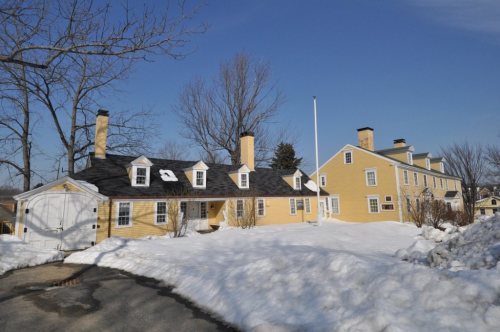
10 listings: 8 buildings, among them the Ladd-Gilman House (a National Historic Landmark since 1974) and the Dudley House (listed 1971, the first), and 2 historic districts, the Front Street Historic District and the Exeter Waterfront Commercial Historic District, with 84 contributing buildings. 96 historic buildings in all.
How old are the homes in Exeter?
23% of Exeter’s homes were built before 1940 (Census estimate, ±4.3 points), against a typical 17% for a New Hampshire town; the median home was built in 1979.
Founding dates: Wikidata, Wikipedia, the U.S. post office records of Blevins & Helbock (CC0) and the Census. Homes by year built: Census ACS 2020–24. National Register of Historic Places: National Park Service (list of May 22, 2026). Old photos, postcards and papers: Wikimedia Commons, the Library of Congress and other public archives, credited on each item’s page. Maps: U.S. Geological Survey historical topographic maps (via Esri) and Sanborn fire-insurance maps (Library of Congress). History text and census tables: Wikipedia (CC BY-SA 4.0). Places that used to be: USGS Geographic Names Information System (2021).
From Wikimedia Commons (39), the Library of Congress (14), Wikidata (6), the National Register of Historic Places (10), Wikipedia, Wikidata and Wikipedia for famous people, U.S. Geological Survey historical maps, U.S. Census counts (via Wikipedia), the US Post Offices dataset (Blevins & Helbock), the USGS Geographic Names Information System, Sanborn fire insurance maps (Library of Congress) and old county and town histories (Internet Archive). Archive images are copied here with their credits and licenses, shown on each photo’s page. Refreshed monthly.


 1776
 1776
 1778
 1779
 1784
 1785
 1794
 1845
 c. 1846
 1888
 1903
 1906
 1906
 1907
 c. 1909
 1910
 c. 1910
 1910
 1911
 c. 1912
 1912
 1917
 1980
 Date?
 Date?
 Date?
 Date?
 Date?
 Date?
 Date?
 Date?
 Date?
 Date?
 Date?
 Date?
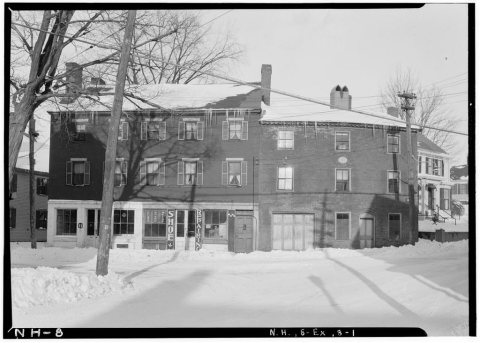 Date?
 Date?
 Date?
 2025
 2022
 2019
 2019
 2019
 2017
 2017
 2017
 2017
 2017
 2012
 2011
 2010
 2010
 2010




 ★ Landmark