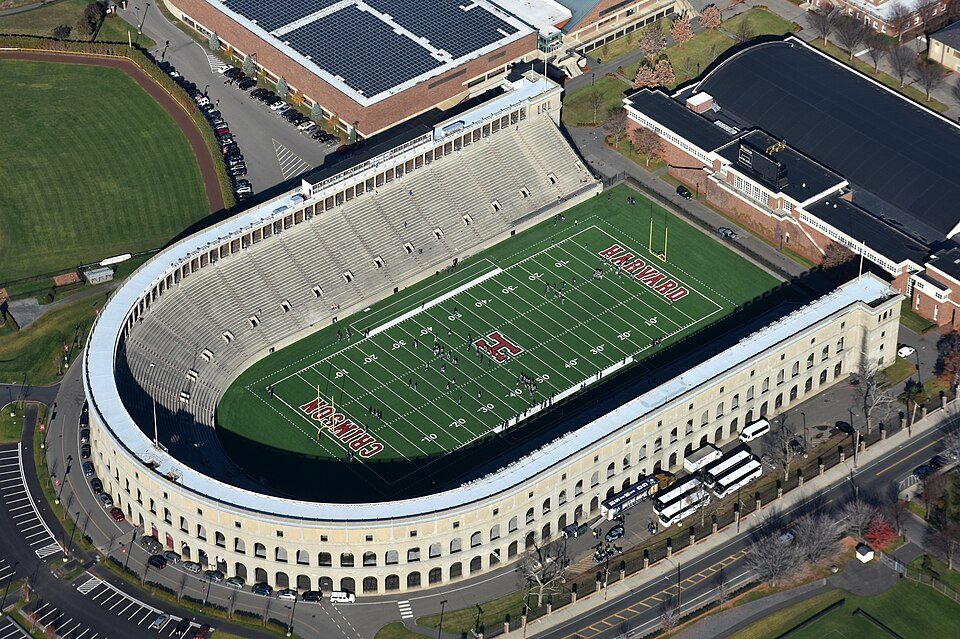
Real strengths, and real weak spots. At B− overall, Cambridge is better than 53% of U.S. towns and ranks 190th of 282 in Massachusetts. Its standout strength is health: residents are healthier than 97% of U.S. towns on CDC estimates. Walkability is a strength too (A+). Where it falls short is cost of living: the typical home is worth about $1.0 million, 8.8 years of the Boston metro’s $116K median household income. It also trails on safety — its crime rate is higher than 87% of U.S. towns, with 530 violent crimes reported to the FBI in 2025. The city is home to Harvard University. History is its standout character grade: an A+, better than 99% of U.S. towns, with 209 places on the National Register.
Figures: health, CDC PLACES · home values, Zillow · incomes, Census ACS, 2020–24 · FBI crime data, 2025.
Asa Gray House · National Register of Historic Places
Cambridge’s story
396 years in pictures
Asa Gray House is one of 17 National Historic Landmarks here, the National Register’s top tier. Its 209 National Register listings are more than in 99% of Massachusetts towns with a listing.
Census counts: 2,115 in 1790, 118,403 in 2020. The archive holds 11 old photos and papers going back to 1681 and 2 maps from 1893 on.
Its grades run from A+ for walkability (better than 99% of comparable towns) to D− for cost of living (better than 5%), so the B− overall blends very different results.
Cambridge is shaped by its college students and draws workers from Boston and beyond, but it has homes that cost more against local pay than most of Massachusetts.
Its widest gap with Massachusetts is COPD: 3.1% of its 104,540 adults have COPD, against 5.9% statewide.
In Cambridge, 37% of adults feel lonely. Only 2 of the 279 Massachusetts towns we compare have a lower share of adults who have high blood pressure than Cambridge. Of 32 CDC measures, Cambridge beats the Massachusetts average on 20 and trails it on 3.
The Cambridge school district runs its public schools. Three of its 30 schools are shown below, with the reason for each. Public school enrollment here: 2,223 students across 6 schools.
63%of MA districts it outscoresBSchool Grade
School
Level
Students
Letter
Amigos SchoolLargest public elementary schoolGrades PK–8
148,918 jobs are based in Cambridge, 2.8 for every working resident, so most of the people who work here commute in. Jobs based here grew from 105,056 in 2013 to 148,918.
The top destinations are Boston (35%), Somerville (3%) and Waltham (3%). About one worker in three stays in Cambridge for work. Jobs based in Cambridge grew to 148,918 in 2023, 43,862 more than in 2013. In Cambridge, 31% of workers work from home, against 18% in Massachusetts’ towns and 11% across U.S. towns.
32%work in town
Cambridge
Massachusetts towns
U.S. towns
Work from home
31%
18%
11%
Working residents who work in town
32%
9.8%
8%
Median household income
$131,000
$120,000
$80,000
Below the poverty line
13%
6%
9.6%
Where working residents work
In Cambridge32%
Boston35%
Somerville3%
Waltham3%
Lexington2%
3 mi
median commute distance
148,918
jobs based in Cambridge
A job hub
jobs vs. working residents
A+
Walkability grade: among the most walkable U.S. towns
At 8.8 years of the Boston metro’s $116K median household income, the typical home (about $1.02M) costs more against local pay than in 85% of Massachusetts towns; that ratio is one input to its D− for cost of living. At about $1.02M, home values are up 7% in five years, against a rise of 26% across Massachusetts.
Cambridge: 34% of households live in a home they own. The typical Cambridge home is worth about $1,019,000, down 0.5% in a year, 56% above the Massachusetts typical home. A home in Cambridge typically sold within 21 days of listing.
Count the trails in 55 parks and preserves and they come to 11 miles. The biggest place to walk is Charles River Reservation, 140 acres with 1.1 miles of trail. Cambridge’s trail density is 1.6 miles per square mile.
The risk rating from FEMA for Cambridge comes to 22 of 100. The national flood insurance program has paid 42 claims here since 1985. Expected losses in Cambridge break down as 63% from inland flooding and 13% from earthquakes. Federal disaster aid has reached households in Cambridge after 11 declared disasters, most recently in 2018.
Cambridge ( KAYM-brij) is a city in Middlesex County, Massachusetts, United States. It is located in the Greater Boston metropolitan area directly across the Charles River from Boston. The city's population as of the 2020 U.S. census was 118,403, making it the most populous city in the county, the fourth-largest in Massachusetts behind Boston, Worcester, and Springfield, and ninth-most populous in New England. The city was named in honor of the University of Cambridge in Cambridge, England, which was an important center of the Puritan theology that was embraced by the town's founders. Founded in December 1630 during the colonial era, Cambridge was one among the first cities established in t…
Cambridge grades B− overall, better than 53% of U.S. towns and #190 of 282 in Massachusetts. It grades A+ for health, D for safety and B for schools. Cost of living is its weak spot, with a D−.
Is Cambridge, MA expensive?
Yes. Cost of living, which also weighs rents, property taxes and how many households pay 30% or more of their income for housing, grades D−.
What is Cambridge, MA known for?
25 notable people were born here, including Matt Damon and Percy Williams Bridgman.


 in town
 3 mi
 3 mi


