Founding year: Wikidata. First post office: 1834.The full story ↓
History grade
What drives Cumberland’s History grade
On its age, its old homes and the National Register, Cumberland is more historic than 83% of U.S. towns, #200 of 593 in Indiana. All 3 inputs are above most U.S. towns; its National Register listings ranks highest and its share of homes from before 1940 lowest.
A−
HistoryA character grade: shown, never part of Cumberland’s overall grade.
Indiana towns list more on the Register than most of the country (a typical Indiana town has 7.9 per 10,000 residents, the U.S. 2.4), so Cumberland’s 145 sits above most of its state (84% of Indiana towns have fewer) while its 91 historic buildings outnumber those of 89% of U.S. towns.
How sure. Graded on any two of the three inputs instead, the letter would range from B+ to A. The pre-1940 share is a Census survey estimate (±9.4 points). Two sources give 1831.
Founding year: Wikidata (other dates in Quick answers). Homes: Census ACS 2020–24. National Register: National Park Service, May 2026 list; each listing counted once (boundary changes and added documentation belong to their listing), and a historic district counts its contributing buildings. How TownRatings grades history →
What stands out about Cumberland’s past
Read from the archive, the National Register and the record. The page puts what stands out first.
Cumberland is named after the city in Maryland and was platted on July 7, 1831 when the Cumberland Road (also known as the National Road) was extended to that point. Cumberland contained a post office from 1834 until it was discontinued in 1958. Cumberland was officially incorporated as a town in 1951. Since 1970, the Marion County portion of Cumberland has been subject to Unigov as an included town, but will become an excluded town on January 1, 2027. The Cumberland Historic District is located in the Marion County portion of the town.
Passages that mention Cumberland, cut from the printed page as they were published.
The history and topography of Dauphin, Cumberland, Franklin, Bedford, Adams, Perry, Somerset, Cambria & Indiana counties1848 · page 49Read the page →
Read the text
About nine-tenths of the first settlers of York, then including Adams county, were Germans, and some small proportion of Cumberland now within the limits of Franklin, was originally settled by them, and some part of Dauphin (then Lancaster.) Cumberland was exclusively settled by Scotch, and Scotch Irish, with the exception of a iew English.* The Germans did not begin to immigrate into the lower part of Cumberland till abount 1760 or '62. The great influx into
Text read by machine from the scan; it may contain errors.
Biographical annals of Cumberland County, Pennsylvania1905 · page 842Read the page →
Read the text
Springs, where he resumed his profession as a civil engineer. In- 1878 he came to Chambersburg, where he built the Mont Alto railroad, serving the Cumberland Valley railroad as an engineer until 1881, when he entered the service of the Pittsburg & Atlantic Railroad Company. He was afterwarfl engaged with the Pittsburg, Bradford & Buf-
Text read by machine from the scan; it may contain errors.
The history and topography of Dauphin, Cumberland, Franklin, Bedford, Adams, Perry, Somerset, Cambria & Indiana counties1848 · page 36Read the page →
Read the text
places, tdl they extended from the " Long, Crooked River"* to the Maryland Province, about the year 1736. Several hundred names of the first settlers in this valley will be given when speaking of Cumberland and Franklin counties. Passing, it might be remarked, that all the earliest settlements made in Lancaster, York and Cumberland, were commenced when the Indians were still numerous ; when they, and the white settlers chased, in common, the deer, the bear, and
Text read by machine from the scan; it may contain errors.
Biographical annals of Cumberland County, Pennsylvania1905 · page 283Read the page →
Read the text
to June, 1880, ]Mr. Beitzel was in charge of the editorial work of the Dillsburg Bnl- Ictin, and from June, 1880, until Dec. 31, 1881, he was clerk at the Cumberland Valley railroad station at his native place, Dillsburg. The day afterward he commenced his duties as station agent at that place, continuing there in tliat incumbency until Sept.
Text read by machine from the scan; it may contain errors.
Scans and text from the Internet Archive. Books published in 1930 or earlier, which are in the public domain.
In 1831, according to Wikidata. Cumberland’s post office opened in 1834, and the census of 1880 counted 299 people here.
How does Cumberland rank for history?
Cumberland is more historic than 83% of U.S. towns, #200 of 593 in Indiana. The History grade combines the town’s founding era, the share of homes built before 1940 and its National Register listings. It’s a character grade, so it isn’t part of the overall grade. How it works.
What is on the National Register in Cumberland?
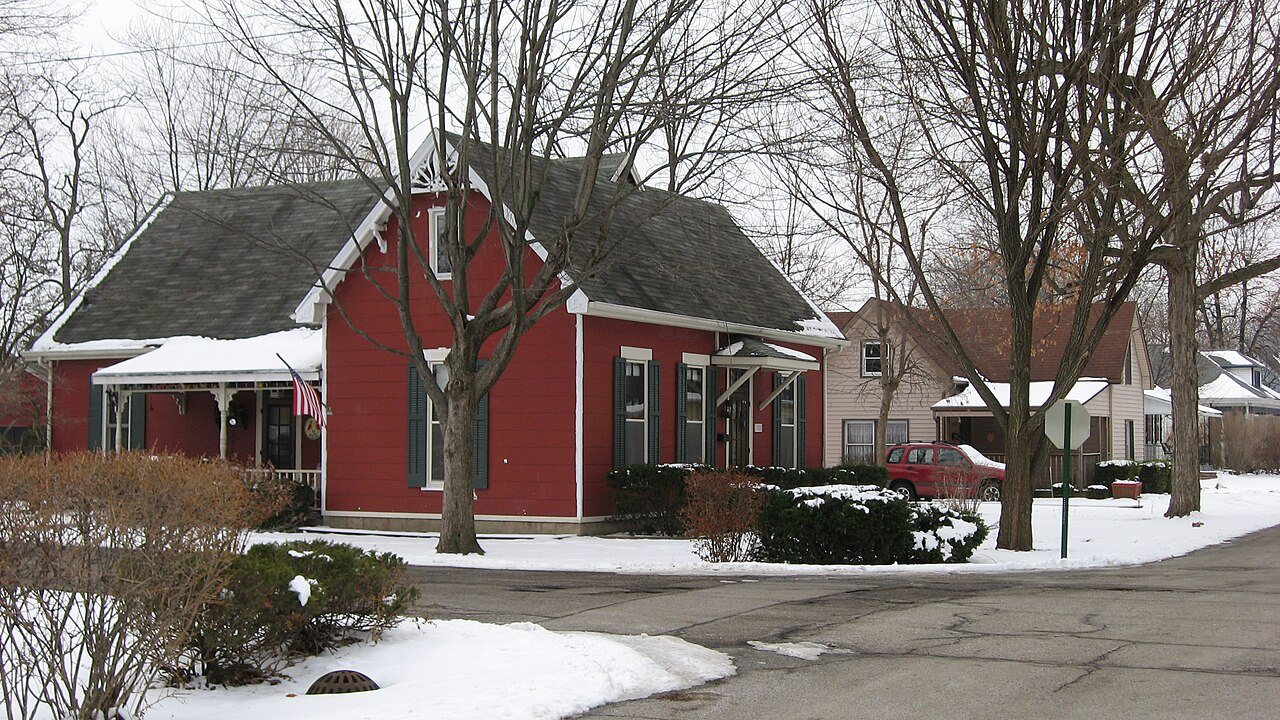
One place: the Cumberland Historic District (listed 2001).
How old are the homes in Cumberland?
12% of Cumberland’s homes were built before 1940 (Census estimate, ±9.4 points), against a typical 14% for an Indiana town; the median home was built in 1984.
Founding dates: Wikidata, Wikipedia, the U.S. post office records of Blevins & Helbock (CC0) and the Census. Homes by year built: Census ACS 2020–24. National Register of Historic Places: National Park Service (list of May 22, 2026). Old photos, postcards and papers: Wikimedia Commons, the Library of Congress and other public archives, credited on each item’s page. Maps: U.S. Geological Survey historical topographic maps (via Esri) and Sanborn fire-insurance maps (Library of Congress). History text and census tables: Wikipedia (CC BY-SA 4.0). Places that used to be: USGS Geographic Names Information System (2021).
From Wikimedia Commons (3), the National Register of Historic Places (1), Wikipedia, U.S. Geological Survey historical maps, U.S. Census counts (via Wikipedia), the US Post Offices dataset (Blevins & Helbock), the USGS Geographic Names Information System and old county and town histories (Internet Archive). Archive images are copied here with their credits and licenses, shown on each photo’s page. Refreshed monthly.


![to June, 1880, ]Mr. Beitzel was in charge of the editorial work of the Dillsburg Bnl- Ictin, and from June, 1880, until Dec. 31, 1881, he was clerk at the Cumberland Valley railroad station at his native place, Dillsburg. The day afterward he commenced his duties as station agent at that place, con…](https://images.townratings.com/story/4907/bk-611bac1c0b664889-l.jpg)
 2022
 2011
 2005


