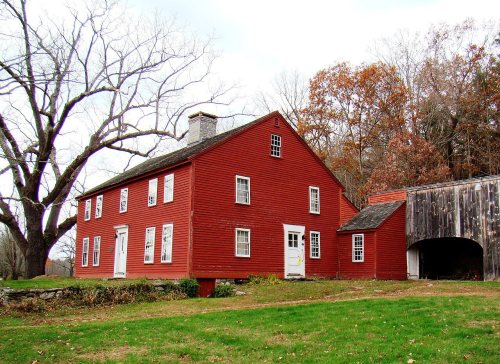
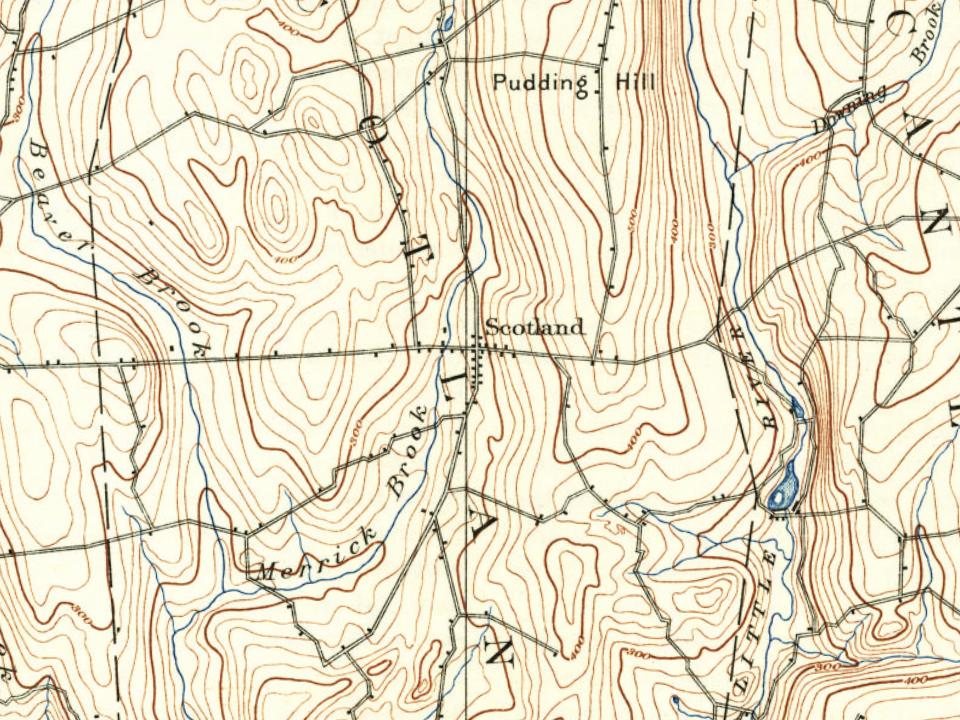
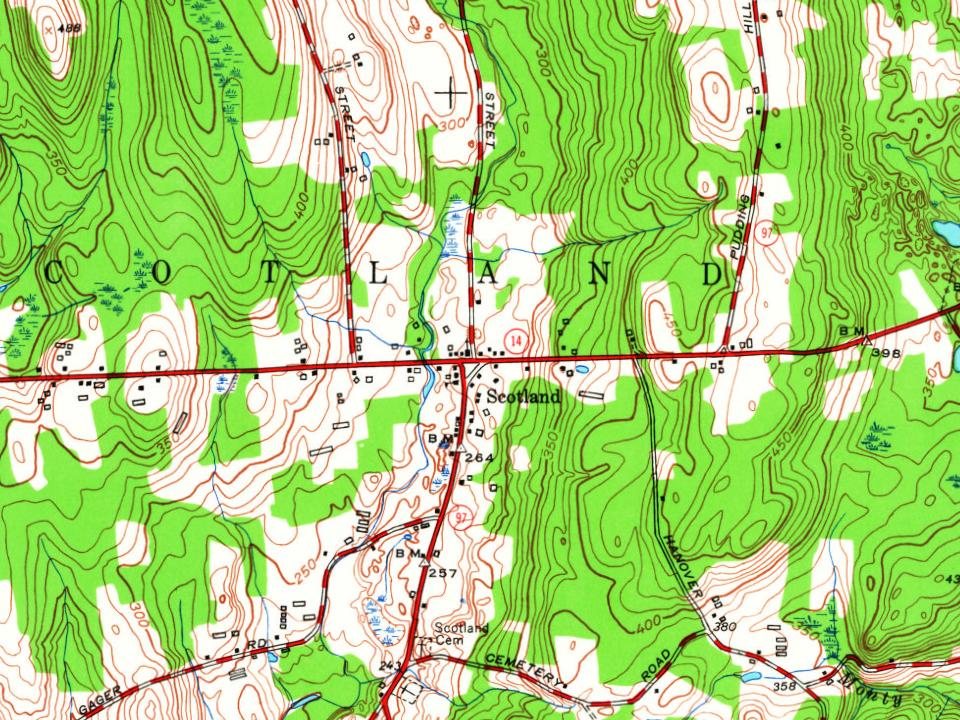
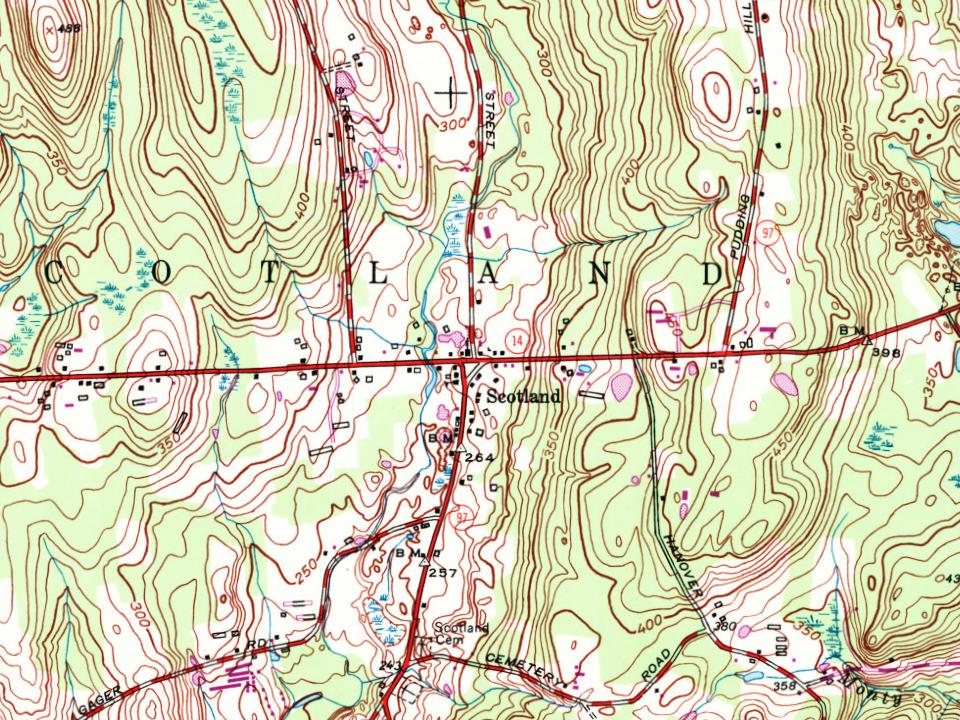
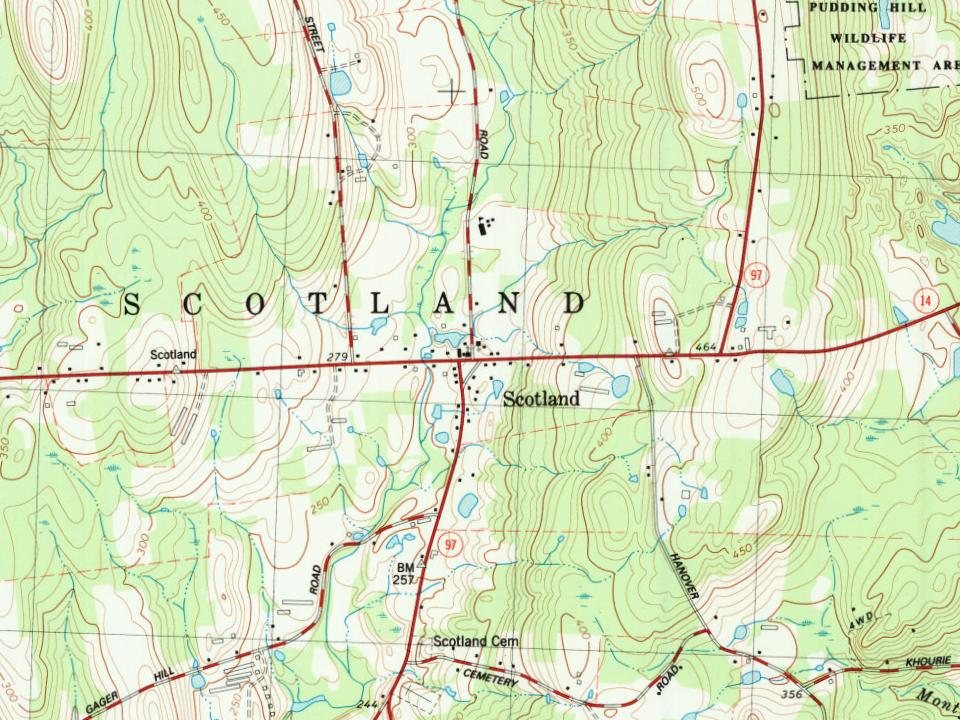
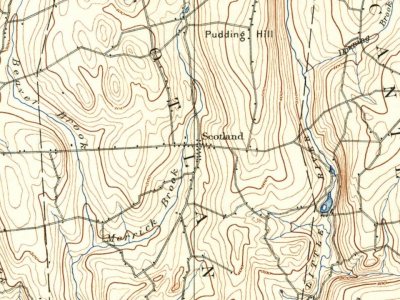
3 places in town are on the National Register, among them the Samuel Huntington Birthplace, a National Historic Landmark, and a historic district. Below: maps from 1892 on and the census since 1860.
The Scotland post office opened in 1832, the earliest record of the town by name. Wikidata gives 1857. Another post office, Scotland Society (1817), opened inside today’s town and later closed.
First census: 720 in 1860194 years
How historic is Scotland?
A−
More historic than 76% of U.S. towns, on its age, its old homes and the National Register.
Founding year: the first Scotland post office (Blevins & Helbock, CC0). Wikidata: 1857.The full story ↓
History grade
What drives Scotland’s History grade
On its age, its old homes and the National Register, Scotland is more historic than 76% of U.S. towns. Its share of homes from before 1940 holds the grade up; its National Register listings pull it down.
A−
HistoryA character grade: shown, never part of Scotland’s overall grade.
Connecticut towns list more on the Register than most of the country (a typical Connecticut town has 73.3 per 10,000 residents, the U.S. 2.4), so Scotland’s 18.8 sits below most of its state (22% of Connecticut towns have fewer) while its 3 listings outnumber those of 65% of U.S. towns.
How sure. Graded on any two of the three inputs instead, the letter would range from B to A−. The pre-1940 share is a Census survey estimate (±7.3 points). The founding year is the first post office, not a stated founding date; Wikidata gives 1857.
Founding year: the first post office (other dates in Quick answers). Homes: Census ACS 2020–24. National Register: National Park Service, May 2026 list; each listing counted once (boundary changes and added documentation belong to their listing), and a historic district counts its contributing buildings. How TownRatings grades history →
What stands out about Scotland’s past
Read from the archive, the National Register and the record. The page puts what stands out first.
In 1700, Isaac Magoon purchased 1,950 acres (7.9 km2) of land from then Windham and thus began Scotland's History. He named the town Scotland as a way of commemorating his ancestral home. Scotland was incorporated in May 1857.
The General Register House is near the general post-office, and is a large and fine building, where are deposited most of the public registers and records of all towns or parishes in Scotland. The principal building has more than one hundred apartments, where the public business is transacted. The charge is five dollars for a general
Text read by machine from the scan; it may contain errors.
So closely are the blue mountains of Scotland allied with the green fields of the Emerald Isle, that at their nearest points only twenty miles of sea divide them. On a clear day, from the Irish coast can be seen the mountains of Scotland. In the dark days of her history it is not surprising that many of her people, fleeing from persecutions, should cross this narrow belt of sea and find refuge
Text read by machine from the scan; it may contain errors.
History of ancient Windham, Ct. Genealogy1864 · page 66Read the page →
Read the text
66 B1>IT0RI or ANCIENT WINDHAM, families settled was called " Baker Town." John Baker, of Barnstable, (probably Dea. John) purchased, of Joshua Lasell, two farms in Scotland Society, Windham, one of 160 and the other of 100 acres, with dwellings, Ac, near Samuel Bingham's for £2400, March 24, 1742-3, Dea. John Baker united with the church in Scotland, then the Third Church in Windham, Dec. 14, 174G: he d. Jan. 27, 1703, aged 90. The following is the inscription on his grave-stone:
Text read by machine from the scan; it may contain errors.
History of ancient Windham, Ct. Genealogy1864 · page 65Read the page →
Read the text
3. Dea. John Baker, m. Anna Annable,dau. of Samuel, of Barnstable, Oct. 4, 1696 ; she d. March 21, 1732-3, '♦aged near 57 years." He came to Windham, probably with his sons Samuel and John before 1746, and located in the south part of the parish, (now town) of Scotland. When the descendants had become somewhat numerous, the place where the
Text read by machine from the scan; it may contain errors.
Scans and text from the Internet Archive. Books published in 1930 or earlier, which are in the public domain.
Timeline
Scotland, 1817 to 2010
Woven from the archive, old maps, post office records, the National Register and the people born here.
The Scotland post office opened in 1832, the earliest record of the town by name (U.S. post office records). Wikidata gives 1857.
How does Scotland rank for history?
Scotland is more historic than 76% of U.S. towns. The History grade combines the town’s founding era, the share of homes built before 1940 and its National Register listings. It’s a character grade, so it isn’t part of the overall grade. How it works.
What is on the National Register in Scotland?
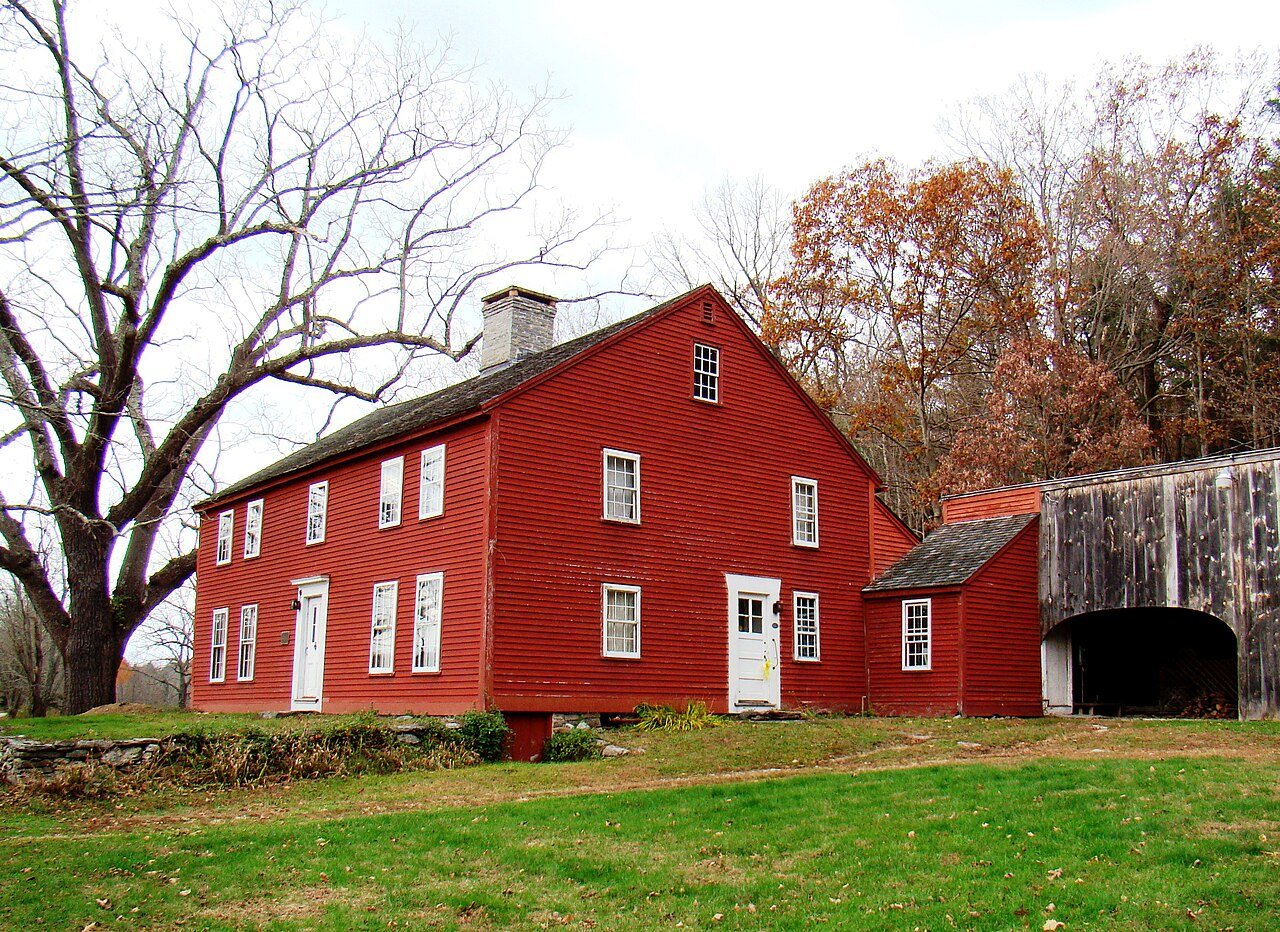
Three places: the Samuel Huntington Birthplace (listed 1971), the Edward Waldo House (1978) and the March Route of Rochambeau's Army: Palmer Road (2003).
How old are the homes in Scotland?
24% of Scotland’s homes were built before 1940 (Census estimate, ±7.3 points), against a typical 15% for a Connecticut town; the median home was built in 1982.
Founding dates: Wikidata, Wikipedia, the U.S. post office records of Blevins & Helbock (CC0) and the Census. Homes by year built: Census ACS 2020–24. National Register of Historic Places: National Park Service (list of May 22, 2026). Old photos, postcards and papers: Wikimedia Commons, the Library of Congress and other public archives, credited on each item’s page. Maps: U.S. Geological Survey historical topographic maps (via Esri) and Sanborn fire-insurance maps (Library of Congress). History text and census tables: Wikipedia (CC BY-SA 4.0). Places that used to be: USGS Geographic Names Information System (2021).
From Wikimedia Commons (9), the Library of Congress (3), the National Register of Historic Places (3), Wikipedia, Wikidata and Wikipedia for famous people, U.S. Geological Survey historical maps, U.S. Census counts (via Wikipedia), the US Post Offices dataset (Blevins & Helbock), the USGS Geographic Names Information System and old county and town histories (Internet Archive). Archive images are copied here with their credits and licenses, shown on each photo’s page. Refreshed monthly.




 2016
 2015
 2015
 2011
 2011
 2011
 2011
 2011
 2011
 2010
 2008
 2008
 ★ Landmark