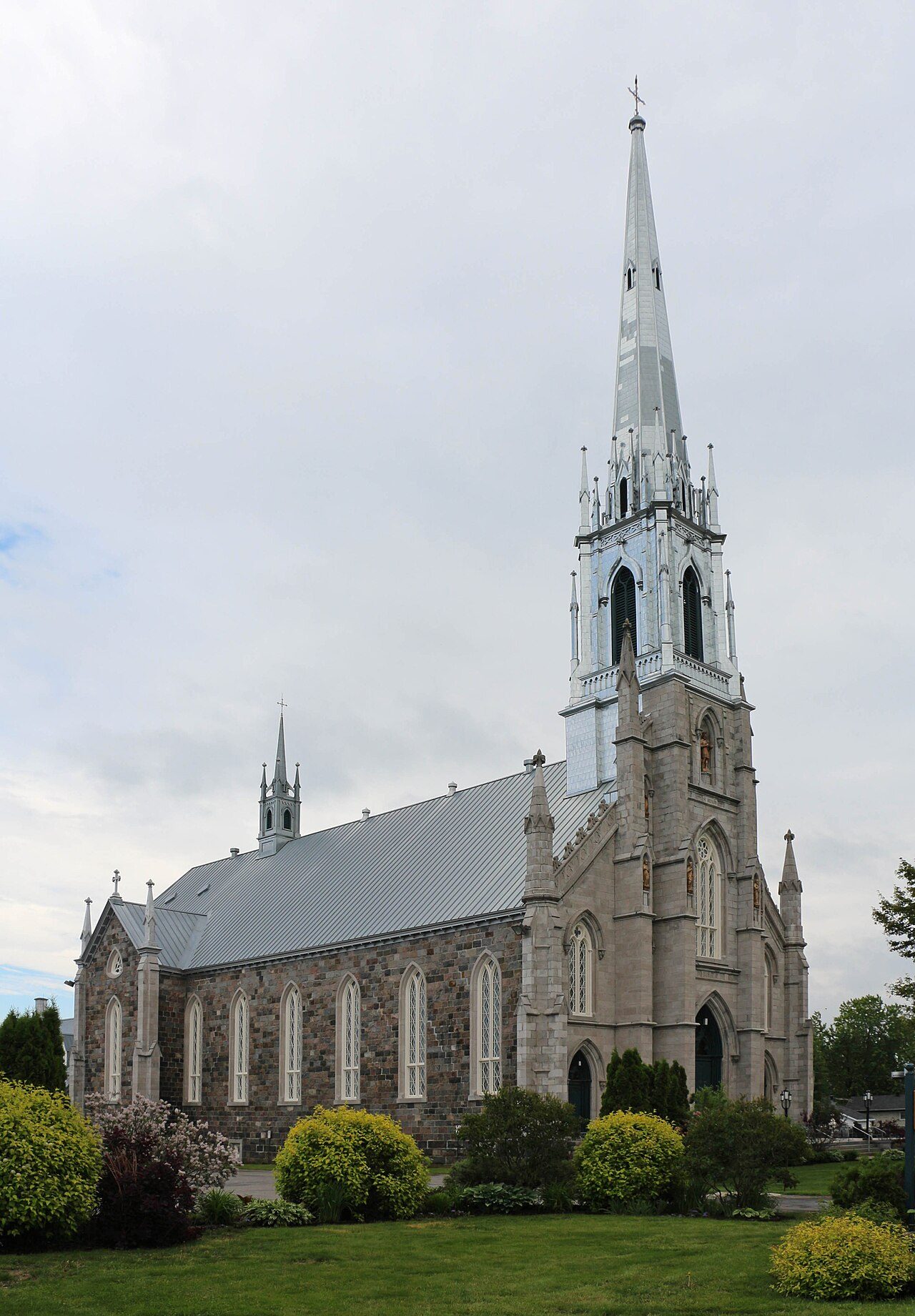
 Photo: Bernard Gagnon · CC BY-SA 3.0
Above 93% of Canadian towns: 23% of residents are under 15
With residents with no religion at 24%, Saint-Henri is behind 79% of Canadian towns on that count. The median age locally is 38.4, lower than in 74% of Canadian towns. Its population is up 4% on 2016. Here, nearly one in ten residents lived at another address a year earlier.
What stands out about the people of Saint-Henri
A town of families
Children under 15 are 23% of residents, more than in 93% of Canadian towns. Households average 2.5 people, and 8.3% are one-parent families. Ages ↓
Common-law couples
Common-law unions take in 37% of adults, more than in 99% of Canadian towns, while 29% are married. Couples ↓
Written from the data on this page: Statistics Canada, 2021 Census.
Above 77% of Canadian towns: 25% of residents speak English and French
Figures are from the 2021 Census unless dated otherwise. The official languages residents can speak, and the ones they learned first.
Can hold a conversation in · share of all residents
Mother tongue · share of all residents
0.5% of residents have English as their mother tongue; across Canada’s towns the figure is 66%. Bilingual residents: 7.5% across Canada’s towns, for comparison. At home: French 99%, English 0.4%.
Saint-Henri changed by +4% from 2016 to 2021, behind 53% of Canadian towns
How the population moved between the last two censuses, and since.
Change, 2016 to 2021
A lower share of residents aged 65 and over than 67% of Canadian towns, at 16%
Residents by five-year age band, each beside the typical town (the tick).
Here nearly one in ten residents are aged 15 to 24, where the figure across Canada’s towns is 11%. To put it in context, 19% of residents are 65 or over across Canada’s towns.
Median age of Canadian towns of 2,500+
■ Saint-Henri, 38.4. The typical town is 42.
Broad ages · share of residents
Women and men · all residents
48% women, 52% men
About 107 men for every 100 women.
Bigger households than 58% of Canadian towns: 2.5 people each on average
Who shares a home: household types and sizes.
Against Quebec’s towns and Canada’s towns
People per household
Canada’s towns.
For Saint-Henri, the census puts one-person households at 28%. Nothing unusual on one-parent families: 8.3%, close to the figure across Canada’s towns.
A higher share of common-law partners than 99% of Canadian towns, at 37%
Married, common-law, single: residents 15 and over.
Marital status · residents 15 and over
By its share of married residents 15 and over (29%), Saint-Henri is below 90% of Canadian towns. The benchmark for common-law partners across Canada’s towns: 11%.
A larger share of households in single-detached houses than 58% of Canadian towns: 69%
Dwelling types, tenure and age of the housing. Prices, rents and shelter costs are on Cost of living.
Type of home
Owners and renters · share of households
When homes were built · share of homes
Households in buildings of five or more storeys are rarer here than in 74% of Canadian towns. Against that, 64% of households live in a single-detached house across Canada’s towns. Newer homes outnumber old: 40% date from 2001 or later, 20% from before 1961. Just over a quarter of households rent their home (Canada’s towns: 25%).
Half above, half below $87,000 a year in household income
The income year is 2020: a year of pandemic benefits such as CERB, which the figures count. What households took in before tax, at the middle and across income groups.
Households by income · share of households
At $87,000, the middle household in Saint-Henri earned close to the median across Canada’s towns ($86,000). The figure for Quebec’s towns: $74,000. COVID-19 benefits went to 29% of residents with an income (typical: 28%).
1.5% of residents are immigrants
Where immigrants were born and when they came, and how recently residents moved in.
Immigrants, by continent of birth · share of all residents; the bar runs to 20%
When immigrants arrived · share of immigrants
Citizenship and moving · share of residents
In Saint-Henri, 1.6% of residents are not Canadian citizens, beside 5.8% across Canada’s towns. Fewer immigrants than in 96% of Canadian towns: 1.5%.
76% said they are Christian and 24% that they have no religion
Residents’ own answers on visible minority, Indigenous identity and religion.
Visible minority and Indigenous identity · all residents
Religion · all residents
Here 1.7% of residents belong to a visible minority, where the figure across Canada’s towns is 15%. Indigenous residents are rarer here than in just over four fifths of Canadian towns.
Below 81% of Canadian towns: 15% of residents 25 to 64 hold a bachelor’s degree or higher
The highest diploma or degree of adults of working age (25 to 64).
Highest qualification · residents 25 to 64
Some 8.3% have no certificate, diploma or degree, against a typical 9.5%. Measured more widely, 27% of residents 25 to 64 hold a bachelor’s degree or higher across Canada’s towns.
73% of adults were employed in May 2021
These rates date from May 2021, during the pandemic, and run lower than a normal year’s. Work, briefly: employment, unemployment, participation and working from home. Jobs, industries and the commute are on Work & commute.
The employment rate of 73% is above the typical 58% across Canada’s towns.
Of 41 towns its size (5,948 to 6,150 people), the 15th youngest
The Canadian towns closest in population, from youngest to oldest.
The youngest of these towns is Inkster Gardens, at 33.4; the oldest, Creston, is at 57.6. By median age, Saint-Henri sits among Dunluce (38.1), Rolston (38.4), Homeside (38.8) and Richmond West (39).
Saint-Henri is younger than 5 of its 6 nearest neighbours
Places nearby, shaded by median age, each linked to its page.
| Town | People | Away | Median age | 65+ | Immigrants |
|---|---|---|---|---|---|
| Saint-Henri | 6,048 | — | 38.4 | 16% | 1.5% |
| Saint-Anselme | 4,534 | 10.7 km | 41.2 | 20% | 3.8% |
| Saint-Charles-de-Bellechasse | 2,739 | 12.7 km | 36.8 | 16% | 1.7% |
| Lévis | 160,882 | 13.1 km | 44 | 21% | 3.6% |
| Saint-Gervais | 2,235 | 14.4 km | 41.6 | 20% | 1% |
| Saint-Isidore | 3,550 | 14.5 km | 40.4 | 19% | 1.5% |
| Beaumont | 3,188 | 15.1 km | 43.2 | 23% | 1.8% |
Health, work, housing and schools
What this data can and can’t tell you
- What these tables don’t give. The Census Profile has no unpaid care, cars or internet access, and no change by age since 2016; ethnic origins beyond visible minority and Indigenous identity aren’t charted here.
- The census’s own words. In the census, “visible minority” is the Employment Equity Act’s term for people who are non-white in colour or race and not Indigenous. Like immigrant status, Indigenous identity and religion, which residents reported themselves, it is compared with other towns, never turned into a label.
- Against Quebec’s towns and Canada’s towns. A figure here is set beside two middles, the median across Quebec’s places of 2,500 people or more and the median across all Canadian towns that size; reserves and entire cities are excluded from both.
Questions about Saint-Henri’s residents
Is Saint-Henri bilingual?
25% of residents can speak both English and French (typical across Canada’s towns: 7.5%); 75% speak French only and 0.2% English only. French is the mother tongue of 98%.
How diverse is Saint-Henri?
1.5% of residents are immigrants (Canada’s towns: 17%); 1.7% belong to a visible minority and 1% have an Indigenous identity.
What religion are people in Saint-Henri?
76% are Christian and 24% have no religion; 0.4% follow another religion.
Is Saint-Henri good for families?
Under 15: 23% (Canada’s towns: 16%). Couple families: 60% of households. One-parent families: 8.3%. Schools near Saint-Henri are on its Schools page.
What is the median income in Saint-Henri?
The median household in Saint-Henri took in $87,000 in 2020, against $86,000 across Canada’s towns.
What is the population of Saint-Henri?
Saint-Henri had about 6,048 residents in July 2025, Statistics Canada estimates; the 2021 Census counted 5,813, 4% more than 2016.
What is the average age in Saint-Henri?
A median age of 38.4, younger than 74% of Canadian towns. Children under 15 make up 23%, and people 65 and over 16%.
Sources: Statistics Canada, Census Profile, 2021 Census of Population · Statistics Canada, population estimates for 1 July 2025 (table 17-10-0155). Under the Statistics Canada Open Licence.
Adapted from Statistics Canada (Census of Population 2021, population estimates 2025, 2021 census boundaries) under the Statistics Canada Open Licence; this does not constitute an endorsement by Statistics Canada. Neighbourhood names in some cities © OpenStreetMap contributors (ODbL).