Yellowknife Post Office · Photo: Daniel Case · CC BY-SA 3.0
9historic places on the registers
History of Yellowknife · Canada’s heritage registers
The registers record 9 historic places in Yellowknife
Yellowknife’s 3.9 per 10,000 residents puts it ahead of 93% of Canadian towns. The typical town keeps 18% of its homes from before 1961; here it is 3.6%. The earliest construction date, 1936, belongs to Weaver & Devore Trading. Counted by designation, there are 9 provincial or municipal listings.
National Historic Sites and Classified Federal Heritage Buildings
Provincial and local listings
9
provincial and municipal listings with an encyclopedia article
Oldest building
1936
the first construction date on its record
Homes built before 1961
3.6%
typical town: 18%
In pictures
9 pictures of Yellowknife today, 1 from its past
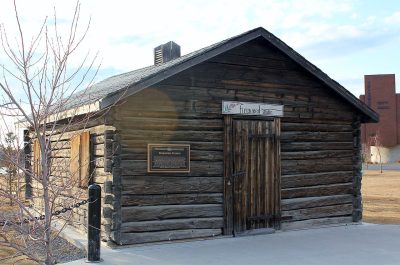
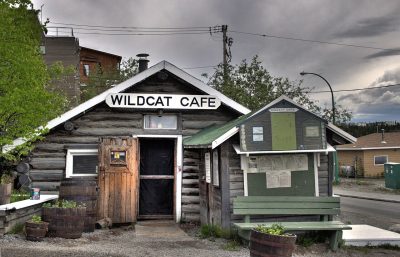
Every place on Yellowknife’s registers has a photo here. Up first are Yellowknife Post Office and Bank of Toronto building. Credit goes to 6 photographers, each named on the photo.
Photos from Wikimedia Commons, each credited to its photographer with its licence; names open the place’s page. Tap a photo to step through them full screen.
Through time
Yellowknife before 1950
From before 1950 comes one old photograph of the town. Tap it to see it full screen.
Public domain or CC0, made before 1950, from Wikimedia Commons; old views of places can be drawings, prints or maps of their time. Each credit opens the image’s page.
How it began
Yellowknife’s early dates, from 1936
Yellowknife takes its name from T'satsąot'ınę, aboriginal peoples of Canada. The municipality of Yellowknife has the date 1936 on Wikidata; the record doesn’t say whether it marks a founding or an incorporation.
Every place on the registers inside the town, by its designation.
Provincial and local listings
Tap any dot to open that place’s own page; hovering shows its name.
The 9, by tier
9 Provincial and local listings
Federal designations come from Parks Canada’s directory; a province’s or a council’s own listing shows here only when Wikidata holds it and an encyclopedia covers it.
Points from Wikidata (Parks Canada’s files carry none) and from Québec’s register, as mapped there.
What’s designated
Yellowknife’s list splits evenly at the top: 2 mills, shops and works, 2 public buildings
All told, 4 kinds of place appear. At the head of the list: Weaver & Devore Trading and Log School House.
Mills, shops and works2
Public buildings2
Churches and religious buildings1
Other places4
Kinds read from each place’s name and the functions its register gives; a building keeps the kind it was built as.
Provincial and local listings
9 local listings in Yellowknife
Provincial and municipal listings that Wikidata records and an encyclopedia describes. Weaver & Devore Trading is the earliest, from 1936; the latest dates from 1937. Each one opens its own page.
Most of Yellowknife’s homes went up from 1981 to 2000: 43%
Over half of the homes in Yellowknife were already standing by 2001. From 2016 on, Yellowknife built 6.1% of its homes; the typical town built 4.1%. 20% of Yellowknife’s homes date from 2001 to 2015, well above the typical 15%.
3.6%
Before 1961
27%
1961–80
43%
1981–2000
20%
2001–15
6.1%
2016–21
YellowknifeTypical town
2021 Census, private dwellings by period of construction (Statistics Canada); the typical town is the middle Canadian town of 2,500 or more.
Towns its size
Yellowknife has the 2nd most of 16 towns its size
Towns of 22,600 to 23,100 residents, by places on the registers.
Just one has more: Colwood. The middle one has 0. For 10, the registers list nothing.
In brief
Yellowknife in brief
Inside Yellowknife there are 9 historic places. Only one of the 16 towns nearest its size has more historic places. Before 1961: just 3.6% of its homes, against 18% in the typical town.
How to read these numbers
What this data can and can’t tell you
•
Provincial and municipal lists. The local and provincial lists outside Québec aren’t published openly, so this page counts what Wikidata records and pages only the places an encyclopedia describes.
•
The tiers. Three tiers: the top for National Historic Sites, classified federal buildings and Québec’s classements, a second for the other federal designations, a third for provincial and municipal listings.
•
Protection. A National Historic Site designation recognises significance; it doesn’t by itself protect a building the federal government doesn’t own. Legal protection comes from provincial and municipal designations, whose own registers aren’t open data outside Québec.
•
The grade. History is described, not graded, for every Canadian town.
•
The federal register. Every federal designation is in Parks Canada’s directory, and the Canadian Register of Historic Places gives most of them a bilingual statement of significance.
•
Map points. Parks Canada publishes no coordinates, so federal places are pinned where Wikidata puts them.
•
People and events. Parks Canada’s open file gives its national historic persons no place. A town’s page names one only when the person was born there (matched by name and both life years) or one of its own historic places carries the name and its record speaks of them; national historic events stay off.
Questions about Yellowknife’s history
How many historic places does Yellowknife have on the registers?
The registers list 9 historic places inside Yellowknife.
How old are the homes in Yellowknife?
Before 1961: 3.6% of its homes; the typical town has 18%.
What is the oldest building in Yellowknife?
Weaver & Devore Trading, a City of Yellowknife Heritage Site, begun in 1936.
Contains information licensed under the Open Government Licence – Canada (Parks Canada).
Sources: Parks Canada, Directory of Federal Heritage Designations · Canadian Register of Historic Places (federal extract) · Wikidata (CC0) for map points, other names and articles · Statistics Canada, 2021 Census (homes by period of construction). Under the Statistics Canada Open Licence.


 1932
 Local
 Local
 Local
 Local
 Local
 Local
 Local
 Local
 Local