Strong in places, weak in others. Its weakest subject is cost of living (D−): the typical home is worth about $1.4 million, 10.6 years of the San Francisco metro’s $136K median household income. It does especially well on health (A): it is healthier than 92% of U.S. towns. Walkability is another plus (A+). Overall, that makes a C+, good for 308th of 841 in California. On that grade it does better than 37% of U.S. towns. Safety is weaker too: its police reported 3,964 violent crimes reported to the FBI in 2025, a higher rate per resident than 95% of U.S. towns. Hazard risk is weaker too: FEMA rates its natural-hazard risk higher than 88% of U.S. communities, with earthquakes at the top.
Figures: health, CDC PLACES · home values, Zillow · incomes, Census ACS, 2020–24 · FBI crime data, 2025 · FEMA National Risk Index.
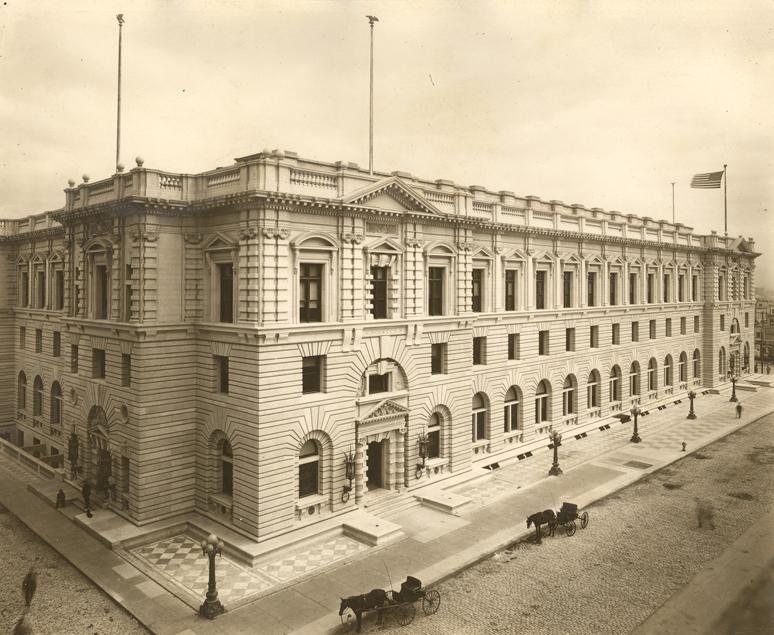
Old U.S. Mint · National Register of Historic Places
San Francisco’s story
178 years in pictures
Old U.S. Mint is one of 18 National Historic Landmarks here, the National Register’s top tier. Its founding year, 1848, comes before those of 96% of the California towns we grade with a known year.
Census counts: 56,802 in 1860, 873,965 in 2020. The archive holds 16 old photos and papers going back to 1850 and 7 maps from 1895 on.
203 places on the National Register of Historic Places.
Its grades run from A+ for walkability (better than 99% of comparable towns) to D− for cost of living (better than 3%), so the C+ overall blends very different results.
San Francisco draws workers from Oakland and beyond and has less no health insurance than most of California, but it has homes that cost more against local pay than most of California.
At 10.6 years of the San Francisco metro’s $136K median household income, the typical home (about $1.44M) costs more against local pay than in 80% of California towns; that ratio is one input to that grade. The median property tax bill is $9,862, against $5,124 across California, another input to its cost-of-living grade.
38% of households own their home in San Francisco, below both the California town median (64%) and the median of U.S. towns (73%). The town’s going rate for rent stands at $2,476 a month. Typical home values rose 16% in the year to September 2026. Also worth knowing: among renter households locally, 40% spend 30% or more of their income on rent.
Its public schools are run by the San Francisco Unified school district. Three of the 221 schools are below, and why each made the list. The 6 public schools in San Francisco teach 3,694 students between them.
Reported crimes fell from 50,280 to 27,873 over the last three FBI years, a drop beyond ordinary year-to-year swings.
For San Francisco, the rate of thefts and burglaries is 29.3 per 1,000 residents. The violent crime rate for San Francisco comes to 4.9 per 1,000 residents, where California’s towns sit at 2.9 and U.S. towns at 1.6.
683,793 jobs are based in San Francisco, 1.7 for every working resident, so most of the people who work here commute in. 31% of workers work from home, against 17.2% across California.
The middle household income in San Francisco is $141,000. This California town had 683,793 jobs in 2023, up 99,791 from 2013. 31% of San Francisco workers work from home. The top destinations are Oakland (4%), South San Francisco (3%) and San Jose (2%).
57%work in town
San Francisco
California towns
U.S. towns
Work from home
31%
14%
11%
Median household income
$141,000
$95,000
$80,000
Average trip to work
30 minutes
28 minutes
25 minutes
Below the poverty line
11%
10%
9.6%
Where working residents work
In San Francisco57%
Oakland4%
South San Francisco3%
San Jose2%
Palo Alto2%
5 mi
median commute distance
683,793
jobs based in San Francisco
A job hub
jobs vs. working residents
A+
Walkability grade: among the most walkable U.S. towns
Its widest gap with California is no health insurance: 6.6% of those 18–64 have no health insurance, against 10.6% statewide. Against the 3,481 U.S. towns with household incomes like San Francisco’s, it is healthier than 70%, a smaller edge than it has nationally: part of it comes with its incomes.
San Francisco beats the California average on 19 of 32 CDC measures and trails it on 1. Just over a quarter of adults have high blood pressure in the town. Two figures for adults locally: 20% binge drink, 10% report frequent physical distress.
92%healthier than U.S. townsAHealth Grade
San Francisco
California towns
U.S. towns
Obesity (CDC PLACES)
18%
29%
35%
Binge drink (CDC PLACES)
20%
16%
16%
Frequent physical distress (CDC PLACES)
10%
14%
14%
High blood pressure (CDC PLACES)
26%
31%
35%
32 measures vs. California
19 better12 too close to call1 worse
What stands out
San Francisco
CA
Fewer uninsured adults
6.6%
10.6%
Fewer adults with obesity
17.5%
27.8%
More binge drinkers
19.6%
15.3%
California Pacific Medical Center- Van Ness Campus
Paid flood insurance claims in San Francisco since 1978: 66. 78% of the town’s expected losses from natural hazards come from earthquakes, followed by inland flooding at 21%.
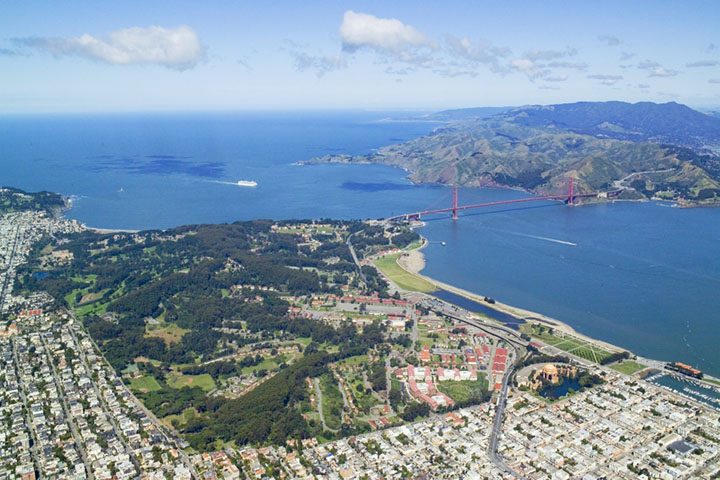
The biggest park or preserve is Greater Farallones National Marine Sanctuary, at 60,889 acres. Trails total 154 miles in 156 parks and preserves. San Francisco’s concentration of trails is 0.7 miles per square mile.
San Francisco grades C+ overall, better than 37% of U.S. towns and #308 of 841 in California. It grades A for health, D for safety and B+ for schools. Cost of living is its weak spot, with a D−.
What is San Francisco, CA known for?
25 notable people were born here, including Steve Jobs and Jack London.