Stoughton dates to 1847, and 19% of its homes were built before 1940
More historic than 93% of U.S. towns · #24 of 362 in Wisconsin. What drives it
15 places in town are on the National Register, among them six historic districts with 528 buildings between them. Below: maps from 1884 on and the census since 1850.
Founding year: Wikidata; Wikipedia’s history section gives the same year. First post office: 1848.The full story ↓
History grade
What drives Stoughton’s History grade
On its age, its old homes and the National Register, Stoughton is more historic than 93% of U.S. towns, #24 of 362 in Wisconsin. All 3 inputs are above most U.S. towns; its National Register listings ranks highest and its share of homes from before 1940 lowest.
A
HistoryA character grade: shown, never part of Stoughton’s overall grade.
Wisconsin towns list more on the Register than most of the country (a typical Wisconsin town has 3.0 per 10,000 residents, the U.S. 2.4), so Stoughton’s 412 sits above most of its state (99% of Wisconsin towns have fewer) while its 537 historic buildings outnumber those of 97% of U.S. towns.
How sure. Graded on any two of the three inputs instead, the letter would range from A− to A+. The pre-1940 share is a Census survey estimate (±5.3 points). Two sources give 1847.
Founding year: Wikidata (other dates in Quick answers). Homes: Census ACS 2020–24. National Register: National Park Service, May 2026 list; each listing counted once (boundary changes and added documentation belong to their listing), and a historic district counts its contributing buildings. How TownRatings grades history →
What stands out about Stoughton’s past
Read from the archive, the National Register and the record. The page puts what stands out first.
Stoughton was founded in 1847 by Luke Stoughton, an Englishman from Vermont. Many Norwegian immigrants settled in the town from 1865 through the early 1900s.
Stoughton claims to be the birthplace of the "coffee break", and hosts a small yearly parade to celebrate the distinction.
For much of its history, Stoughton has been Dane County's second-largest and economically important city, after Madison.
In 1919, the Stoughton Wagon Company began putting custom wagon bodies on Model T chassis; by 1929 Ford was by far the biggest seller of station wagons.
On August 18, 2005, an F3 tornado cut a 10-mile path across rural subdivisions and farms north of Stoughton, killing one person and damaging hundreds of homes.
Passages that mention Stoughton, cut from the printed page as they were published.
History of Dane County, Wisconsin ... preceded by a history of Wisconsin, statistics of the state, and an abstract of its laws and constitution and of the Constitution of the United States1880 · page 842Read the page →
Read the text
1868, the connection between the said village of Stoughton and the said town of Dunkirk, for town purposes," should be dissolved, and the duties then imposed upon town' officers, so far as they related to Stoughton, should be imposed on the officers of the village. Thus it was that a " bill of divorce " was granted the last-named corporation.
Text read by machine from the scan; it may contain errors.
History of Dane County, Wisconsin ... preceded by a history of Wisconsin, statistics of the state, and an abstract of its laws and constitution and of the Constitution of the United States1880 · page 828Read the page →
Read the text
The town of Sun Prairie, all the present towns of Bristol, Sun Prairie, Medina and Yorii, and ' the village of Sun Prairie ; the town ot Rome, all of what now constitutes Oregon, Fitchburg and Dunn ; the town of Albion, so much as is now Albion and Christiana ; Rutland is as first -constituted ; and so also is Dun-kirk, and the village of Stoughton. These six towns are usually designated as "the original towns of the county." By an act of the Territorial Legislature, approved February 2, 1846, the whole of Dane County, except what are now the towns of Fitchburg, Oregon, Dunn, Rutland, Dunkirk, Albion, Christiana, Sun Prairie, Bristol, York and Medina, and the villages of Stoughton and Sun
Text read by machine from the scan; it may contain errors.
A history of Madison, the capital of Wisconsin1874 · page 399Read the page →
Read the text
The Yahara or Cat Fish runs through the town, entering on the north line on section 4, and passes out on the south line on section 35. On this stream are good water powers. The village of Stoughton is located on sections 5 an 8 on this stream, and is also a station on the Milwaukee and St. Paul Railroad, and is aplace of much business. It contains a hotel, three stores, flouring mill, plough factory, Baptist and Episcopal churches, a large wagon factory, a number of mechanical shops and many hand¬ some residences. Dunkirk village is a small settlement on section 21.
Text read by machine from the scan; it may contain errors.
Scans and text from the Internet Archive. Books published in 1930 or earlier, which are in the public domain.
Timeline
Stoughton, 1847 to 1958
Woven from the archive, old maps, post office records, the National Register and the people born here.
Fire insurance maps drew every building, what it was made of and what it was used for, so insurers could price the risk of fire. Pick a year, then a sheet.
In 1847, according to Wikidata and Wikipedia’s history of the town. Stoughton’s post office opened in 1848, and the census of 1850 counted 70 people here.
How does Stoughton rank for history?
Stoughton is more historic than 93% of U.S. towns, #24 of 362 in Wisconsin. The History grade combines the town’s founding era, the share of homes built before 1940 and its National Register listings. It’s a character grade, so it isn’t part of the overall grade. How it works.
What is on the National Register in Stoughton?
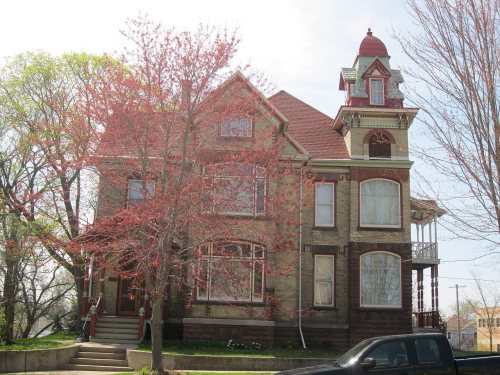
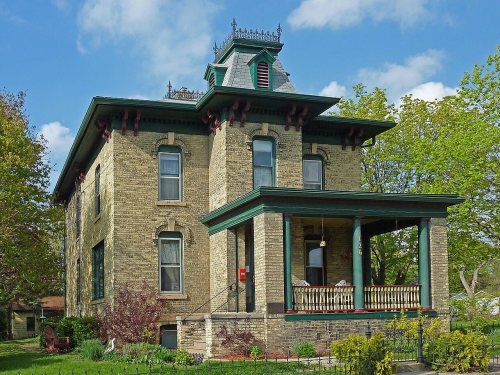
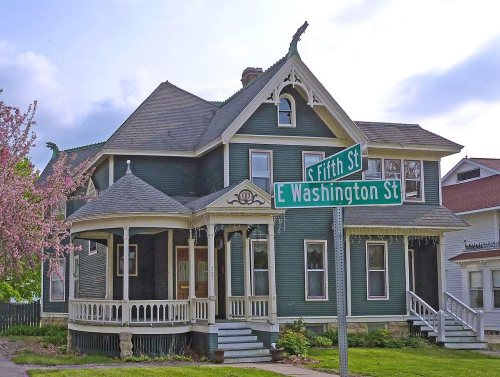
15 listings: 9 buildings, among them the Stoughton Universalist Church (listed 1982, the first), and 6 historic districts with 528 contributing buildings. 537 historic buildings in all.
How old are the homes in Stoughton?
19% of Stoughton’s homes were built before 1940 (Census estimate, ±5.3 points), against a typical 12% for a Wisconsin town; the median home was built in 1979.
Founding dates: Wikidata, Wikipedia, the U.S. post office records of Blevins & Helbock (CC0) and the Census. Homes by year built: Census ACS 2020–24. National Register of Historic Places: National Park Service (list of May 22, 2026). Old photos, postcards and papers: Wikimedia Commons, the Library of Congress and other public archives, credited on each item’s page. Maps: U.S. Geological Survey historical topographic maps (via Esri) and Sanborn fire-insurance maps (Library of Congress). History text and census tables: Wikipedia (CC BY-SA 4.0). Places that used to be: USGS Geographic Names Information System (2021).
From Wikidata (6), the National Register of Historic Places (15), Wikipedia, Wikidata and Wikipedia for famous people, U.S. Geological Survey historical maps, U.S. Census counts (via Wikipedia), the US Post Offices dataset (Blevins & Helbock), the USGS Geographic Names Information System, Sanborn fire insurance maps (Library of Congress) and old county and town histories (Internet Archive). Archive images are copied here with their credits and licenses, shown on each photo’s page. Refreshed monthly.