7 places in town are on the National Register, among them two historic districts with 149 buildings between them. Below: 12 old photos and papers, maps from 1893 on, and the census since 1790.
From Wallingford’s archive · credits on each photo
Quick answers
How Wallingford began
When was Wallingford founded?
1807
The Wallingford post office opened in 1807, the earliest record of the town by name. Another post office, South Wallingford (1838), opened inside today’s town and later closed.
First census: 536 in 17902020 census: 2,129219 years
How historic is Wallingford?
A+
More historic than 97% of U.S. towns, on its age, its old homes and the National Register.
Founding year: the first Wallingford post office (Blevins & Helbock, CC0).
History grade
What drives Wallingford’s History grade
On its age, its old homes and the National Register, Wallingford is more historic than 97% of U.S. towns. All 3 inputs are above most U.S. towns; its National Register listings ranks highest and its age lowest.
A+
HistoryA character grade: shown, never part of Wallingford’s overall grade.
Vermont towns list more on the Register than most of the country (a typical Vermont town has 147 per 10,000 residents, the U.S. 2.4), so Wallingford’s 761 sits above most of its state (94% of Vermont towns have fewer) while its 174 historic buildings outnumber those of 92% of U.S. towns.
How sure. Graded on any two of the three inputs instead, the letter would range from A to A+. The pre-1940 share is a Census survey estimate (±11.5 points). The founding year is the first post office, not a stated founding date.
Founding year: the first post office (other dates in Quick answers). Homes: Census ACS 2020–24. National Register: National Park Service, May 2026 list; each listing counted once (boundary changes and added documentation belong to their listing), and a historic district counts its contributing buildings. How TownRatings grades history →
What stands out about Wallingford’s past
Read from the archive, the National Register and the record. The page puts what stands out first.
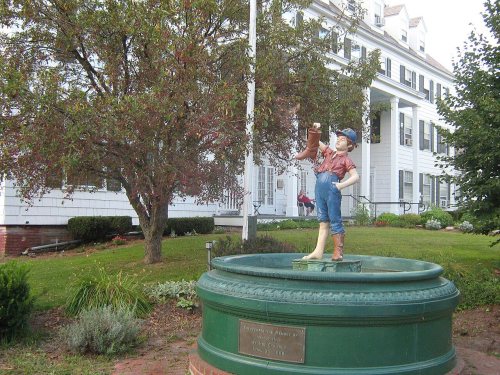
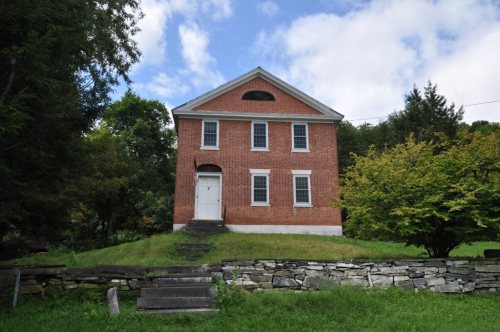
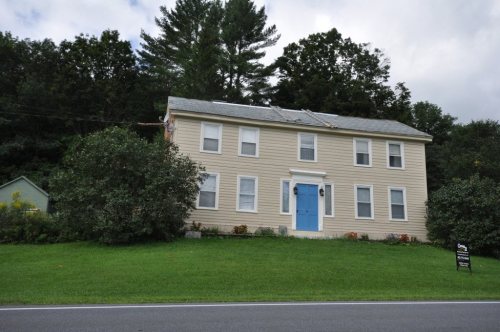
National Park Service, National Register of Historic Places. Photos from Wikimedia Commons, credited on each place’s page.
On the map
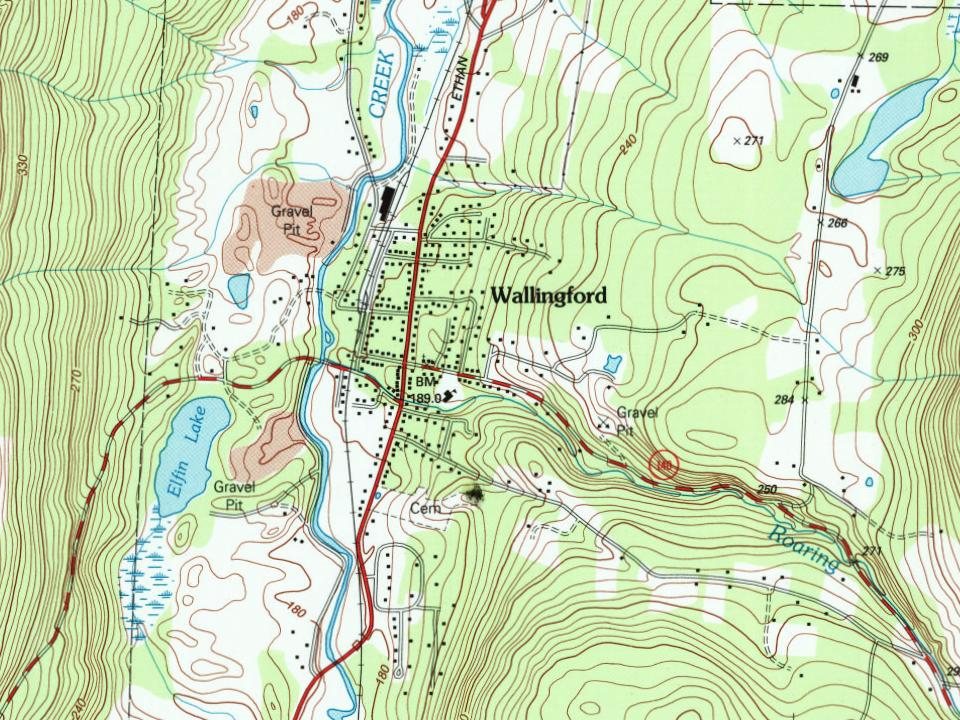
Wallingford on the map, 1893 to 1997
Every edition of the U.S. Geological Survey’s map of Wallingford. Tap a year, or press play to watch the town change.
1893Wallingford sheet · 1:62,500
U.S. Geological Survey historical topographic maps (public domain), via Esri’s collection of the scans. The red ring marks the center of Wallingford.
Places that used to be
Lost post offices, old corners, places now gone and burying grounds
Wallingford’s post office has been open since 1807. Another post office, South Wallingford, opened and closed inside today’s town.
Wallingford
1807–today
South Wallingford
1838–1981
East Wallingford
1851–today
18001910today
Hamlets and corners on the map
East WallingfordSouth WallingfordTimber Hill Estates
Gone or out of use
South Wallingford Limestone Quarrymine
9cemeteries and burying grounds inside Wallingford
DotyGreen HillHill-RobertsMaple GrovePelsue-JarvarySaint PatrickStaffordSugar HillWest Hill
US Post Offices dataset (Blevins & Helbock, CC0). Places and cemeteries from the USGS Geographic Names Information System (2021).
The story so far
Wallingford, in brief
Wikipedia doesn’t have a history of Wallingford yet. The photos, dates and memories neighbors add here are how it gets written.
Wallingford is a town in Rutland County, Vermont, United States. The population was 2,129 at the 2020 census. Wallingford also contains the villages of East Wallingford and South Wallingford.
Its first post office opened in 1807. Between the 2010 and 2020 censuses its population grew from 2,079 to 2,129 (+2%).
Intro from Wikipedia. Population: U.S. Census Bureau.
From the old history books
What they wrote about Wallingford, 1886–1911
Passages that mention Wallingford, cut from the printed page as they were published.
History of Wallingford, Vermont1911 · page 172Read the page →
Read the text
TOWNS like individuals liave instances when their investments do not turn out as anticipated. This was true of Wallingford which had purchased several shares of railroad stock. Many miles of railroad were being laid, and it was considered a profitable venture, when in 1867, Wallingford owned $30,000 of bonds of the Lebanon Springs Railroad Company. On
Text read by machine from the scan; it may contain errors.
History of Wallingford, Vermont1911 · page 71Read the page →
Read the text
Pittsford, Middletown, Salem, Shaftsbury and Chester, give them advice on a place where a meeting house ought to be built for the accommodation of the town of Wallingford, to seal the same and deliver it into the hands of the town clerk to be opened at a future day to which this meeting shall be adjourned". This council was composed entirely of legal gentlemen and con-
Text read by machine from the scan; it may contain errors.
History of Rutland County, Vermont, with illustrations and biographical sketches of some of its prominent men and pioneers1886 · page 673Read the page →
Read the text
prised Jackson's Gore with all that portion of the town of Ludlow lying west of the highest ridge of what is known as " Ludlow Mountain," and on the west a tract one mile in width, or two tiers of lots, from the east side of the town of Wallingford. The town lies in a sort of shallow basin, or depression, in the Green Mountains, and in the old days of stage coaching over the road from Burlington to Boston, afforded the best place for crossing the Green Mountains south of Montpelier. The land was originally heavily timbered with maple, beech, birch,
Text read by machine from the scan; it may contain errors.
Scans and text from the Internet Archive. Books published in 1930 or earlier, which are in the public domain.
Timeline
Wallingford, 1800 to 1981
Woven from the archive, old maps, post office records, the National Register and the people born here.
Nothing in the archives for these yearsWeddings on Main Street, storms, parades, school pictures, the old store. If it’s in your family album, it belongs here.
The Wallingford post office opened in 1807, the earliest record of the town by name (U.S. post office records).
How does Wallingford rank for history?
Wallingford is more historic than 97% of U.S. towns. The History grade combines the town’s founding era, the share of homes built before 1940 and its National Register listings. It’s a character grade, so it isn’t part of the overall grade. How it works.
What is on the National Register in Wallingford?
7 listings: 5 buildings and 2 historic districts, the Wallingford Main Street Historic District and the Rural Otter Creek Valley Historic District, with 149 contributing buildings. 174 historic buildings in all.
How old are the homes in Wallingford?
37% of Wallingford’s homes were built before 1940 (Census estimate, ±11.5 points), against a typical 22% for a Vermont town; the median home was built in 1971.
Founding dates: Wikidata, Wikipedia, the U.S. post office records of Blevins & Helbock (CC0) and the Census. Homes by year built: Census ACS 2020–24. National Register of Historic Places: National Park Service (list of May 22, 2026). Old photos, postcards and papers: Wikimedia Commons, the Library of Congress and other public archives, credited on each item’s page. Maps: U.S. Geological Survey historical topographic maps (via Esri) and Sanborn fire-insurance maps (Library of Congress). History text and census tables: Wikipedia (CC BY-SA 4.0). Places that used to be: USGS Geographic Names Information System (2021).
From Wikimedia Commons (6), the Library of Congress (10), Wikidata (2), the National Register of Historic Places (7), Wikidata and Wikipedia for famous people, U.S. Geological Survey historical maps, U.S. Census counts (via Wikipedia), the US Post Offices dataset (Blevins & Helbock), the USGS Geographic Names Information System and old county and town histories (Internet Archive). Archive images are copied here with their credits and licenses, shown on each photo’s page. Refreshed monthly.









 1937
 1937
 1937
 1939
 1939
 1939
 1939
 1939
 1939
 2010
 2010
 2010
 2004
