Milton dates to 1763, and 2 of its places are on the National Register
More historic than 63% of U.S. towns · #62 of 71 in Vermont. What drives it
Most of Milton was built recently: 8% of its homes predate 1940 and the median home dates from 1985. 2 places in town are on the National Register, among them a historic district with 1 buildings. Below: 4 old photos and papers, maps from 1915 on, and the census since 1790.
Founding year: Wikipedia. First post office: 1805.The full story ↓
History grade
What drives Milton’s History grade
On its age, its old homes and the National Register, Milton is more historic than 63% of U.S. towns, #62 of 71 in Vermont. Its age holds the grade up; its National Register listings pull it down.
B
HistoryA character grade: shown, never part of Milton’s overall grade.
Vermont towns list more on the Register than most of the country (a typical Vermont town has 147 per 10,000 residents, the U.S. 2.4), so Milton’s 1.9 sits below most of its state (11% of Vermont towns have fewer) while its 2 listings outnumber those of 60% of U.S. towns.
NoteThe founding year comes from Wikipedia alone; no second source gives 1763.
How sure. Graded on any two of the three inputs instead, the letter would range from C to A−. The pre-1940 share (±2.9 points) is firm at this size.
Founding year: Wikipedia (other dates in Quick answers). Homes: Census ACS 2020–24. National Register: National Park Service, May 2026 list; each listing counted once (boundary changes and added documentation belong to their listing), and a historic district counts its contributing buildings. How TownRatings grades history →
What stands out about Milton’s past
Read from the archive, the National Register and the record. The page puts what stands out first.
Milton was chartered by Governor Benning Wentworth of New Hampshire on June 8, 1763. In February 1782, the town was first settled by William Irish, Leonard Owen, Amos Mansfield, Absalom Taylor, and Thomas Dewey. There were approximately 300 settlers living in Milton by 1795. It was necessary to build a new meeting place, as meeting in private homes would no longer suffice. The Town House was built in 1849. In 1878, it was destroyed by a fire.
Early settlers in Milton made most of their income from lumber and potash until 1840, when dairy became popular and butter and cheese were sold. Eventually, milk was also shipped to Boston and New York.
Passages that mention Milton, cut from the printed page as they were published.
History of Chittenden County, Vermont, with illustrations and biographical sketches of some of its prominent men and pioneers1886 · page 191Read the page →
Read the text
scribed in the acts to incorporate the Champlain and Connecticut River Railroad Company, and the Vermont Central Railroad Company." The route determined upon extends from Rouse's Point to Burlington, through Colchester, Milton, Georgia, St. Albans, Swanton and Alburgh, a distance of fifty-three miles. The work of its construction was begun early in September, 1848, in the northern part of Georgia, and completed early in 185 1. The first officers of this company were as follows : John Smith, president ; Samuel H. Walley, treasurer ; Lawrence Brainerd,
Text read by machine from the scan; it may contain errors.
History of Chittenden County, Vermont, with illustrations and biographical sketches of some of its prominent men and pioneers1886 · page 654Read the page →
Read the text
The First Methodist Episcopal Church edifice in Milton was built and dedicated about 1840. It stood on nearly the same ground on which is now standing the Methodist Episcopal Church in Milton Falls, and directly across the way, and nearly opposite the first church erected in town. This edifice was the place of general worship for the circuit, until it was superseded by a larger and better one in 1870. This later edifice was destroyed by fire July 8, 1878. At the same time the first church structure ever erected in Milton was burned ; the latter burning first and causing the destruction of the former.
Text read by machine from the scan; it may contain errors.
Scans and text from the Internet Archive. Books published in 1930 or earlier, which are in the public domain.
Timeline
Milton, 1763 to 2020
Woven from the archive, old maps, post office records, the National Register and the people born here.
Nothing in the archives for these yearsWeddings on Main Street, storms, parades, school pictures, the old store. If it’s in your family album, it belongs here.
In 1763, according to Wikipedia’s history of the town. Milton’s post office opened in 1805, and the first U.S. census counted 282 people here in 1790.
How does Milton rank for history?
Milton is more historic than 63% of U.S. towns, #62 of 71 in Vermont. The History grade combines the town’s founding era, the share of homes built before 1940 and its National Register listings. It’s a character grade, so it isn’t part of the overall grade. How it works.
What is on the National Register in Milton?
Two places: the West Milton Bridge (listed 1992) and the Sand Bar State Park (2002).
How old are the homes in Milton?
8% of Milton’s homes were built before 1940 (Census estimate, ±2.9 points), against a typical 22% for a Vermont town; the median home was built in 1985.
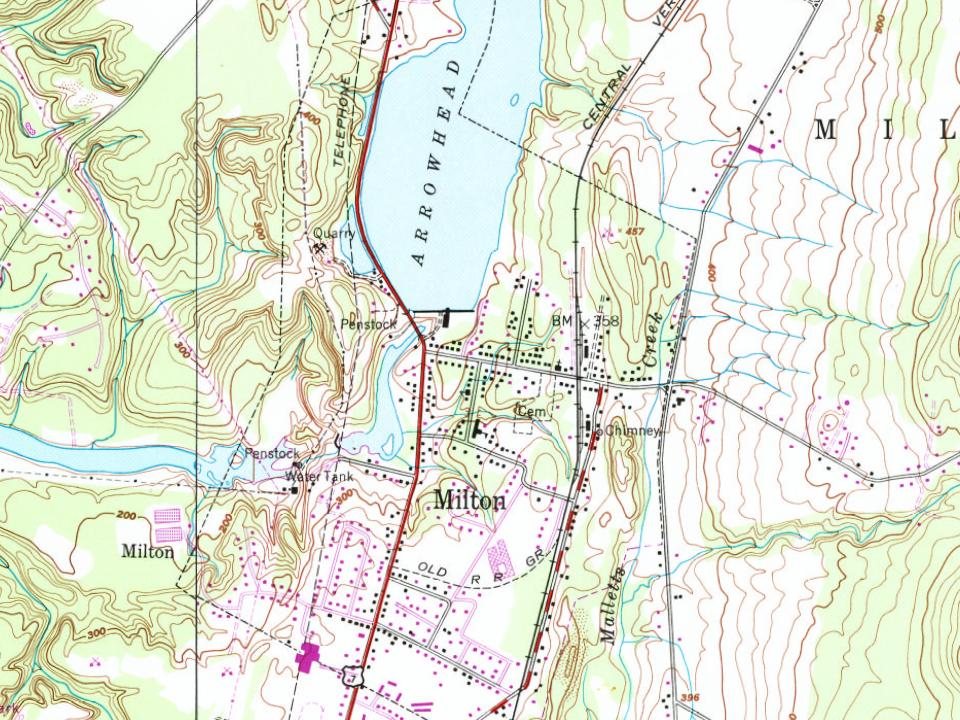
Founding dates: Wikidata, Wikipedia, the U.S. post office records of Blevins & Helbock (CC0) and the Census. Homes by year built: Census ACS 2020–24. National Register of Historic Places: National Park Service (list of May 22, 2026). Old photos, postcards and papers: Wikimedia Commons, the Library of Congress and other public archives, credited on each item’s page. Maps: U.S. Geological Survey historical topographic maps (via Esri) and Sanborn fire-insurance maps (Library of Congress). History text and census tables: Wikipedia (CC BY-SA 4.0). Places that used to be: USGS Geographic Names Information System (2021).
From Wikimedia Commons (7), the Library of Congress (5), Wikidata (1), the National Register of Historic Places (2), Wikipedia, Wikidata and Wikipedia for famous people, U.S. Geological Survey historical maps, U.S. Census counts (via Wikipedia), the US Post Offices dataset (Blevins & Helbock), the USGS Geographic Names Information System and old county and town histories (Internet Archive). Archive images are copied here with their credits and licenses, shown on each photo’s page. Refreshed monthly.


 1907
 1907
 1909
 2017
 2017
 2017
 2017
 2014
 2014
 2007
 2004