On its age, its old homes and the National Register, Derby is more historic than 70% of U.S. towns, #59 of 71 in Vermont. All 3 inputs are above most U.S. towns; its age ranks highest and its National Register listings lowest.
B+
HistoryA character grade: shown, never part of Derby’s overall grade.
Vermont towns list more on the Register than most of the country (a typical Vermont town has 147 per 10,000 residents, the U.S. 2.4), so Derby’s 15.4 sits below most of its state (30% of Vermont towns have fewer) while its 7 historic buildings outnumber those of 73% of U.S. towns.
NoteThe founding year comes from Wikidata alone; no second source gives 1779.
How sure. Graded on any two of the three inputs instead, the letter would range from B to B+. The pre-1940 share is a Census survey estimate (±3.4 points).
Founding year: Wikidata (other dates in Quick answers). Homes: Census ACS 2020–24. National Register: National Park Service, May 2026 list; each listing counted once (boundary changes and added documentation belong to their listing), and a historic district counts its contributing buildings. How TownRatings grades history →
What stands out about Derby’s past
Read from the archive, the National Register and the record. The page puts what stands out first.
On October 29, 1779, the state of Vermont chartered it to Timothy Andrus and fifty-nine associates, with an area of 23,040 acres (93.2 km2). It was named after Derby, in England.
In the War of 1812, an expeditionary force of Quebec Eastern Townships' volunteers destroyed a barracks built at Derby with no personnel casualties.
Portus Baxter and David Camp were Underground Railroad agents before the Civil War.
During the past 2 years, through the indefatigable exertions of Hon. J. L. Edwards of Derby, aad others, $8,000 have been raised by the people of Derby, aided by Aaron Wilbur of Savannah, Ga.', John Lindsey of New York City, and Edwin Bates of Charleston, S. C, natives of Derby — and a new commodious academy building has been erected, wliich, with
Text read by machine from the scan; it may contain errors.
He rendered substantial aid in founding the academy and erecting the church and public buildings of which the village of Derby Center is justly proud. As a business man, also, he did much to advance the prosperity of that village. The grist and saw-mills at the upper dam were built and re-built by him. and he was also at the same time the
Text read by machine from the scan; it may contain errors.
The history of Orleans county, Vermont. Civil, ecclesiastical, biographical and military1882 · page 73Read the page →
Read the text
Derby, March 8th, 1800. Whereas some suggestions have been made that the Town of Barton, in the County of Orleans has not been Legally organized and application this day made to me m writing by sundry of the Inhabitants, of said Town, to call a Meeting of the Inhabitants of said Town of Barton, in conjunction with the selectmen
Text read by machine from the scan; it may contain errors.
The history of Orleans county, Vermont. Civil, ecclesiastical, biographical and military1882 · page 307Read the page →
Read the text
The thrifty village of Newport, the village of West Derby, and a considerable part of Derby Center, are on territory once granted to the proprietors of Salem ; wtiile within its bounds, as finally established, there is no village, nor any natural center of business and population. It does not contain asingle store tavern, mechanic's shop, post ofl&ce, house of
Text read by machine from the scan; it may contain errors.
Scans and text from the Internet Archive. Books published in 1930 or earlier, which are in the public domain.
Timeline
Derby, 1779 to 2010
Woven from the archive, old maps, post office records, the National Register and the people born here.
In 1779, according to Wikidata. Derby’s post office opened in 1806, and the census of 1800 counted 178 people here.
How does Derby rank for history?
Derby is more historic than 70% of U.S. towns, #59 of 71 in Vermont. The History grade combines the town’s founding era, the share of homes built before 1940 and its National Register listings. It’s a character grade, so it isn’t part of the overall grade. How it works.
What is on the National Register in Derby?
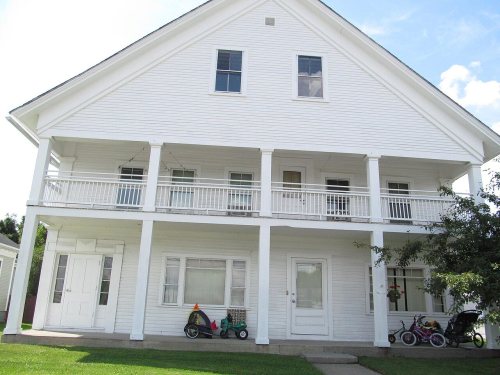
4 listings: 4 buildings, among them the L.P. Jenne Block (listed 1998, the first). 7 historic buildings in all.
How old are the homes in Derby?
14% of Derby’s homes were built before 1940 (Census estimate, ±3.4 points), against a typical 22% for a Vermont town; the median home was built in 1978.
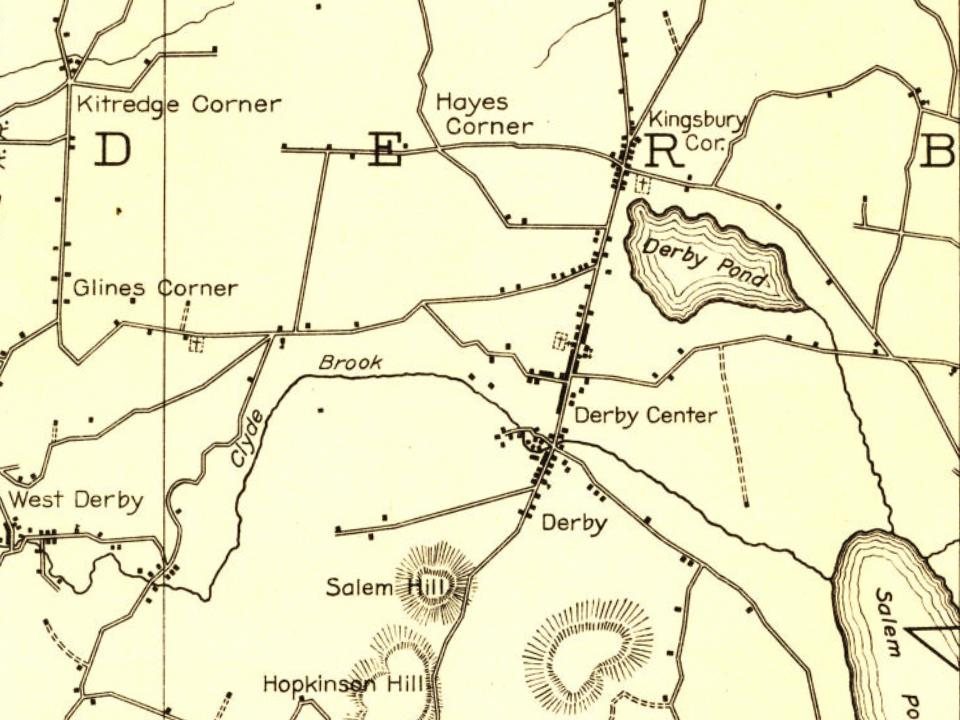
Founding dates: Wikidata, Wikipedia, the U.S. post office records of Blevins & Helbock (CC0) and the Census. Homes by year built: Census ACS 2020–24. National Register of Historic Places: National Park Service (list of May 22, 2026). Old photos, postcards and papers: Wikimedia Commons, the Library of Congress and other public archives, credited on each item’s page. Maps: U.S. Geological Survey historical topographic maps (via Esri) and Sanborn fire-insurance maps (Library of Congress). History text and census tables: Wikipedia (CC BY-SA 4.0). Places that used to be: USGS Geographic Names Information System (2021).
From Wikimedia Commons (8), Wikidata (2), the National Register of Historic Places (4), Wikipedia, Wikidata and Wikipedia for famous people, U.S. Geological Survey historical maps, U.S. Census counts (via Wikipedia), the US Post Offices dataset (Blevins & Helbock), the USGS Geographic Names Information System and old county and town histories (Internet Archive). Archive images are copied here with their credits and licenses, shown on each photo’s page. Refreshed monthly.


 2025
 2024
 2020
 2013
 2013
 2010
 2008
 2004