The Cabot post office opened in 1804, the earliest record of the town by name. Three smaller post offices, East Cabot (1863), South Cabot (1870) and Lower Cabot (1872), opened inside today’s town and later closed.
First census: 349 in 18002020 census: 1,443222 years
How historic is Cabot?
A−
More historic than 76% of U.S. towns, on its age, its old homes and the National Register.
Founding year: the first Cabot post office (Blevins & Helbock, CC0).The full story ↓
History grade
What drives Cabot’s History grade
On its age, its old homes and the National Register, Cabot is more historic than 76% of U.S. towns. Its share of homes from before 1940 holds the grade up; its National Register listings pull it down.
A−
HistoryA character grade: shown, never part of Cabot’s overall grade.
Vermont towns list more on the Register than most of the country (a typical Vermont town has 147 per 10,000 residents, the U.S. 2.4), so Cabot’s 6.3 sits below most of its state (14% of Vermont towns have fewer) while its 1 listings outnumber those of 51% of U.S. towns.
How sure. Graded on any two of the three inputs instead, the letter would range from B to A. The pre-1940 share is a Census survey estimate (±6.4 points). The founding year is the first post office, not a stated founding date.
Founding year: the first post office (other dates in Quick answers). Homes: Census ACS 2020–24. National Register: National Park Service, May 2026 list; each listing counted once (boundary changes and added documentation belong to their listing), and a historic district counts its contributing buildings. How TownRatings grades history →
What stands out about Cabot’s past
Read from the archive, the National Register and the record. The page puts what stands out first.
The town of Cabot was granted in 1780, and settlement began on the Plain, also known as Fortification Hill or Johnson’s Plain when the military were encamped there. The first settler, Benjamin Webster, arrived in 1783, followed by Lieut. Jonathan Heath, Nathaniel Webster, and Lieut. Thomas Lyford, with their families. The town was named by settler Lyman Hitchcock after his wife, Sophia Cabot (no relation to Venetian explorers John and Sebastian Cabot). Lyman Hitchcock became in 1788 the first town clerk of Cabot.
Passages that mention Cabot, cut from the printed page as they were published.
The History of Washington County in the Vermont historical gazetteer1882Read the page →
Read the text
third settler in town, and the first settler at the village, bought a lot of land of Jesse Levenworth and Lyman Hitchcock. On this land the Village of Cabot now stands. The Winooski river runs through the grounds. Mr. Lyford was a mill-wright ; there was no saw-mill within ten miles ; he decided to build a saw-mill upon his lot
Text read by machine from the scan; it may contain errors.
The history of Washington county, in the Vermont historical gazetteer1882 · page 94Read the page →
Read the text
was read for the inhabitants of the town of Cabot of the Baptist persuasion, to meet at the Centre school house, May 12, 1803. At this meeting the following officers were elected : Perley Scott, clerk ; Fifield Lyford, treasurer; John N. Gunn, John Whittier, John Spiller, assessors ; Enoch Hoyt, collector ; Samuel Kingston, John
Text read by machine from the scan; it may contain errors.
Scans and text from the Internet Archive. Books published in 1930 or earlier, which are in the public domain.
Timeline
Cabot, 1780 to 2020
Woven from the archive, old maps, post office records, the National Register and the people born here.
The Cabot post office opened in 1804, the earliest record of the town by name (U.S. post office records).
How does Cabot rank for history?
Cabot is more historic than 76% of U.S. towns. The History grade combines the town’s founding era, the share of homes built before 1940 and its National Register listings. It’s a character grade, so it isn’t part of the overall grade. How it works.
What is on the National Register in Cabot?
One place: the Wiswell House (listed 2023).
How old are the homes in Cabot?
32% of Cabot’s homes were built before 1940 (Census estimate, ±6.4 points), against a typical 22% for a Vermont town; the median home was built in 1977.
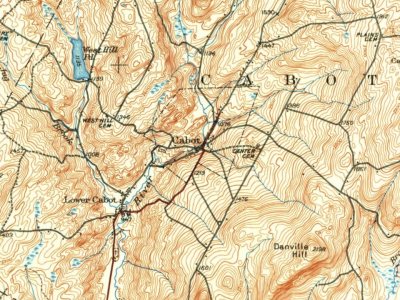
Founding dates: Wikidata, Wikipedia, the U.S. post office records of Blevins & Helbock (CC0) and the Census. Homes by year built: Census ACS 2020–24. National Register of Historic Places: National Park Service (list of May 22, 2026). Old photos, postcards and papers: Wikimedia Commons, the Library of Congress and other public archives, credited on each item’s page. Maps: U.S. Geological Survey historical topographic maps (via Esri) and Sanborn fire-insurance maps (Library of Congress). History text and census tables: Wikipedia (CC BY-SA 4.0). Places that used to be: USGS Geographic Names Information System (2021).
From Wikimedia Commons (12), the Library of Congress (1), the National Register of Historic Places (1), Wikipedia, Wikidata and Wikipedia for famous people, U.S. Geological Survey historical maps, U.S. Census counts (via Wikipedia), the US Post Offices dataset (Blevins & Helbock), the USGS Geographic Names Information System and old county and town histories (Internet Archive). Archive images are copied here with their credits and licenses, shown on each photo’s page. Refreshed monthly.


 1780
 2019
 2017
 2017
 2017
 2017
 2017
 2017
 2017
 2017
 2006
 2004


