Tamaqua dates to 1799, and 64% of its homes were built before 1940
Among the most historic 1% of U.S. towns · #1 of 1,035 in Pennsylvania. What drives it
4 places in town are on the National Register, among them a historic district with 944 buildings. Below: 4 old photos and papers, maps from 1885 on, and the census since 1840.
Founding year: Wikipedia. First post office: 1830.The full story ↓
History grade
What drives Tamaqua’s History grade
On its age, its old homes and the National Register, Tamaqua is among the most historic 1% of U.S. towns, #1 of 1,035 in Pennsylvania. All 2 inputs put Tamaqua near the top nationally; its share of homes from before 1940 ranks highest.
A+
HistoryA character grade: shown, never part of Tamaqua’s overall grade.
Pennsylvania towns list about as much on the Register as the country (a typical Pennsylvania town has 2.1 per 10,000 residents, the U.S. 2.4), so Tamaqua’s 1,368 sits above most of its state (98% of Pennsylvania towns have fewer) while its 947 historic buildings outnumber those of 99% of U.S. towns.
NoteThe founding year comes from Wikipedia alone; no second source gives 1799.
How sure. Graded on two of the three inputs, so a change in either one moves the letter more than it would with three. The pre-1940 share is a Census survey estimate (±5.6 points).
Founding year: Wikipedia (other dates in Quick answers). Homes: Census ACS 2020–24. National Register: National Park Service, May 2026 list; each listing counted once (boundary changes and added documentation belong to their listing), and a historic district counts its contributing buildings. How TownRatings grades history →
What stands out about Tamaqua’s past
Read from the archive, the National Register and the record. The page puts what stands out first.
Tamaqua was settled in 1799 by Burkhardt Moser, his son Jacob (born 1790), and John Kershner, who built shelters and a sawmill at the confluence of the Little Schuylkill River and Panther Creek, which is downtown Tamaqua today.
According to property records, Moser had a partner named Houser, and together they owned 2,000 acres (810 ha) which Moser homesteaded. Moser built a log house at the base of Dutch Hill in 1801 for Mrs. Catherine Moser, who was the first adult to die and receive burial there on February 15, 1822 followed later in April that year by John Kershner.
Passages that mention Tamaqua, cut from the printed page as they were published.
History of Schuylkill County, Pennsylvania ... including a genealogical and biographical record of many families and persons in the county1907 · page 439Read the page →
Read the text
acres in Lycoming county, and was for a time president of the Blue Mountain Manufacturing Company, which controls 13,000 acres of land in Schuylkill county. When the Edison Illuminating and Power company of Tamaqua was incorporated in 1885 he was made its president, having been one of five organizers and incorporators. For more than a score of years he was president of the Tamaqua Banking and Trust Company, and was prominent as one of its organizers. In politics Mr. Shepp was a Democrat
Text read by machine from the scan; it may contain errors.
History of Schuylkill County, Pennsylvania ... including a genealogical and biographical record of many families and persons in the county1907 · page 532Read the page →
Read the text
and the first five years after he had completed his scholastic labors he spent in his father's store. He spent his spare time learning telegraphy and for four years was a Western Union operator at San Francisco. On his return to Tamaqua he entered the employ of the Philadelphia & Reading Railroad Company, with which he remained for a period of two years. For different periods and at different times he was at San Francisco again, in Arizona and other places, and in the fall of 1899 returned to Tamaqua. For three years he was employed
Text read by machine from the scan; it may contain errors.
Schuylkill County, Pennsylvania1916 · page 195Read the page →
Read the text
spelled the name Bowman ever after. Peter Bowman became a builder of railroads, collieries, street railroads and mine slopes, and later a prospector, owning extensive coal operations in Schuylkill county. He sank the second mine slope that was sunk in Schuylkill county, at Tamaqua, in 1848, known as the "Dunkirk Slope," operated by the Little Schuylkill Coal & Navigation Company. It was at this time, when engaged in the coal business at Tamaqua, that Mr. Bowman was closed in the mines for several days and his life was despaired of, but fortunately he was rescued in three days. In 1849 he was
Text read by machine from the scan; it may contain errors.
Schuylkill County, Pennsylvania1916 · page 94Read the page →
Read the text
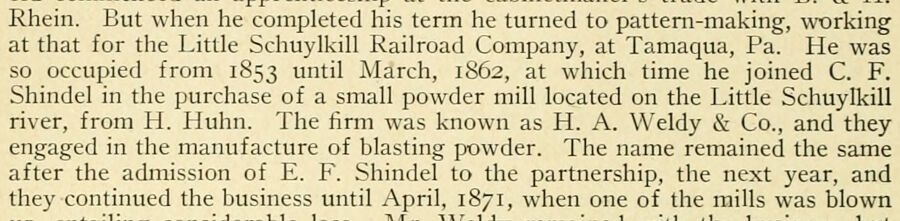
Rhein. But when he completed his term he turned to pattern-making, working at that for the Little Schuylkill Railroad Company, at Tamaqua, Pa. He was so occupied from 1853 until March, 1862, at which time he joined C. F. Shindel in the purchase of a small powder mill located on the Little Schuylkill river, from H. Huhn. The lirm was known as H. A. Weldy & Co., and they engaged in the manufacture of blasting powder. The name remained the same after the admission of E. F. Shindel to the partnership, the next year, and they continued the business until April, 1871, when one of the mills was blown
Text read by machine from the scan; it may contain errors.
Scans and text from the Internet Archive. Books published in 1930 or earlier, which are in the public domain.
Timeline
Tamaqua, 1799 to 1968
Woven from the archive, old maps, post office records, the National Register and the people born here.
Nothing in the archives for these yearsWeddings on Main Street, storms, parades, school pictures, the old store. If it’s in your family album, it belongs here.
Nothing in the archives for these yearsWeddings on Main Street, storms, parades, school pictures, the old store. If it’s in your family album, it belongs here.
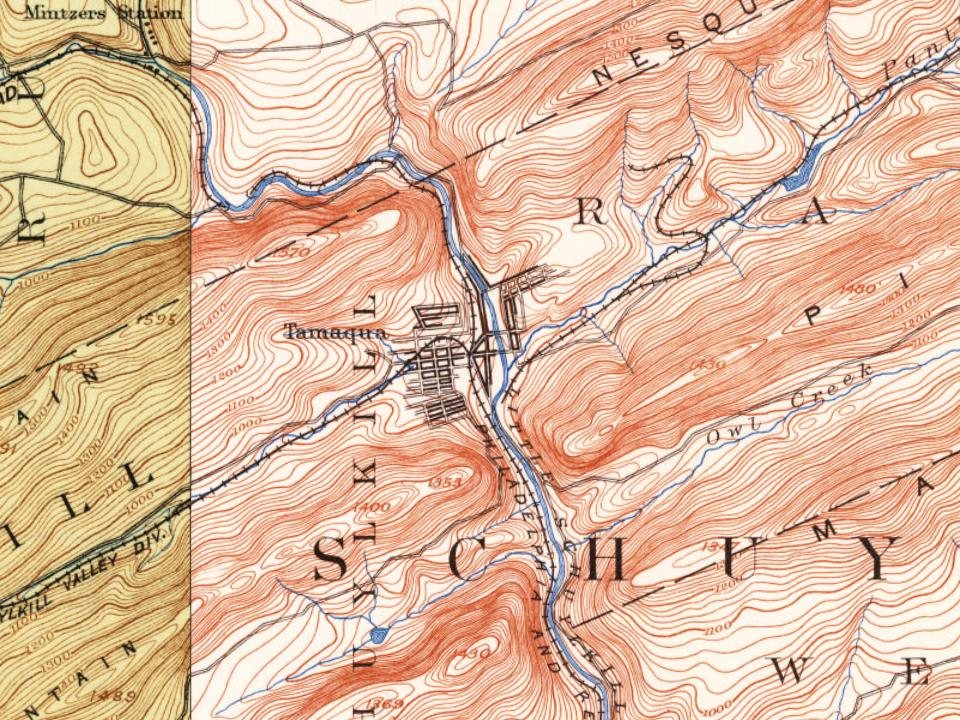
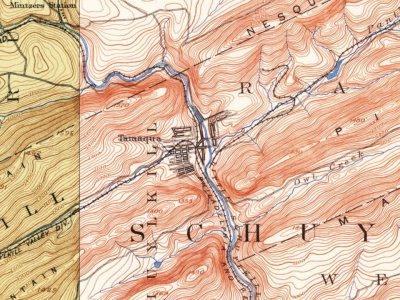
Fire insurance maps drew every building, what it was made of and what it was used for, so insurers could price the risk of fire. Pick a year, then a sheet.
In 1799, according to Wikipedia’s history of the town. Tamaqua’s post office opened in 1830, and the census of 1840 counted 465 people here.
How does Tamaqua rank for history?
Tamaqua is among the most historic 1% of U.S. towns, #1 of 1,035 in Pennsylvania. The History grade combines the town’s founding era, the share of homes built before 1940 and its National Register listings. It’s a character grade, so it isn’t part of the overall grade. How it works.
What is on the National Register in Tamaqua?
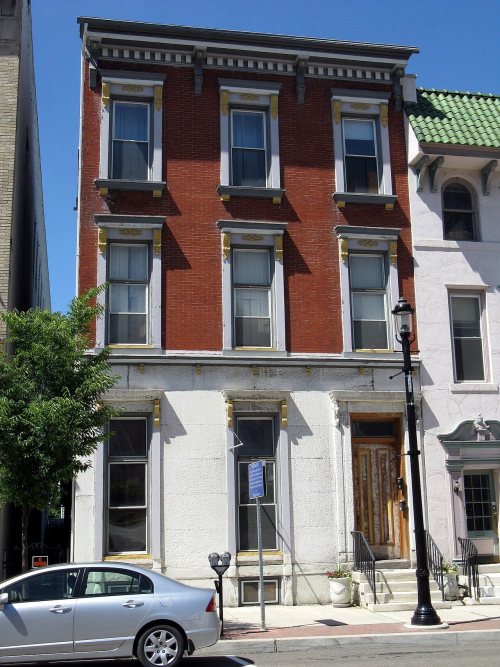
4 listings: 3 buildings, among them the George Ormrod House (listed 1977, the first), and 1 historic district, the Tamaqua Historic District, with 944 contributing buildings. 947 historic buildings in all.
How old are the homes in Tamaqua?
64% of Tamaqua’s homes were built before 1940 (Census estimate, ±5.6 points), against a typical 18% for a Pennsylvania town; the median home was built in 1938.
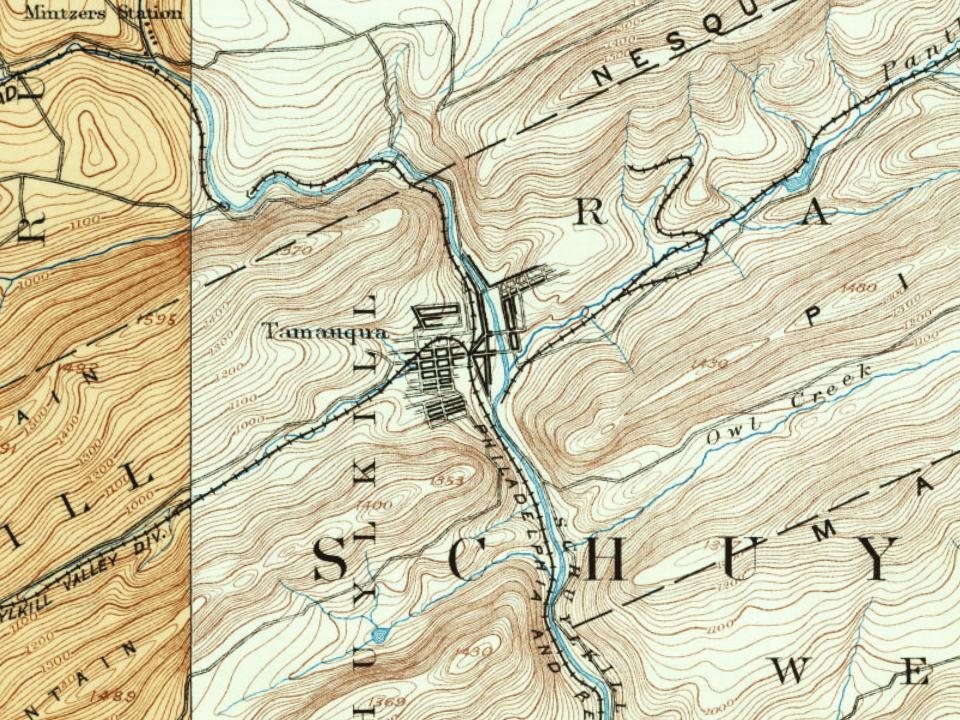
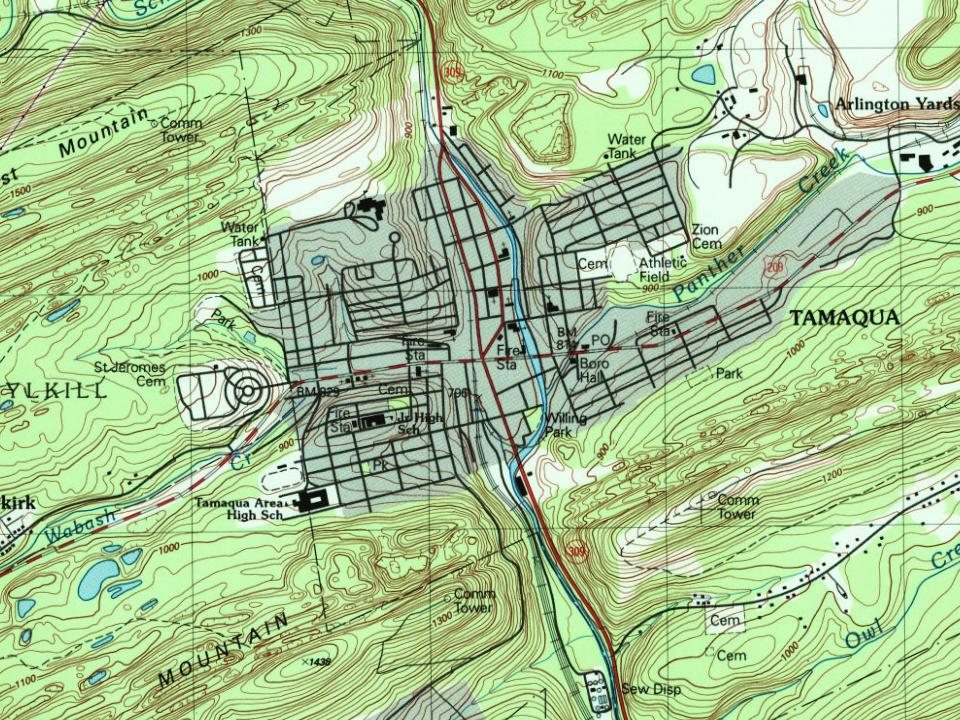
Founding dates: Wikidata, Wikipedia, the U.S. post office records of Blevins & Helbock (CC0) and the Census. Homes by year built: Census ACS 2020–24. National Register of Historic Places: National Park Service (list of May 22, 2026). Old photos, postcards and papers: Wikimedia Commons, the Library of Congress and other public archives, credited on each item’s page. Maps: U.S. Geological Survey historical topographic maps (via Esri) and Sanborn fire-insurance maps (Library of Congress). History text and census tables: Wikipedia (CC BY-SA 4.0). Places that used to be: USGS Geographic Names Information System (2021).
From Wikimedia Commons (4), Wikidata (2), the National Register of Historic Places (4), Wikipedia, Wikidata and Wikipedia for famous people, U.S. Geological Survey historical maps, U.S. Census counts (via Wikipedia), the US Post Offices dataset (Blevins & Helbock), the USGS Geographic Names Information System, Sanborn fire insurance maps (Library of Congress) and old county and town histories (Internet Archive). Archive images are copied here with their credits and licenses, shown on each photo’s page. Refreshed monthly.












 1880

