Oakwood dates to 1908, and 55% of its homes were built before 1940
More historic than 80% of U.S. towns · #305 of 993 in Ohio. What drives it
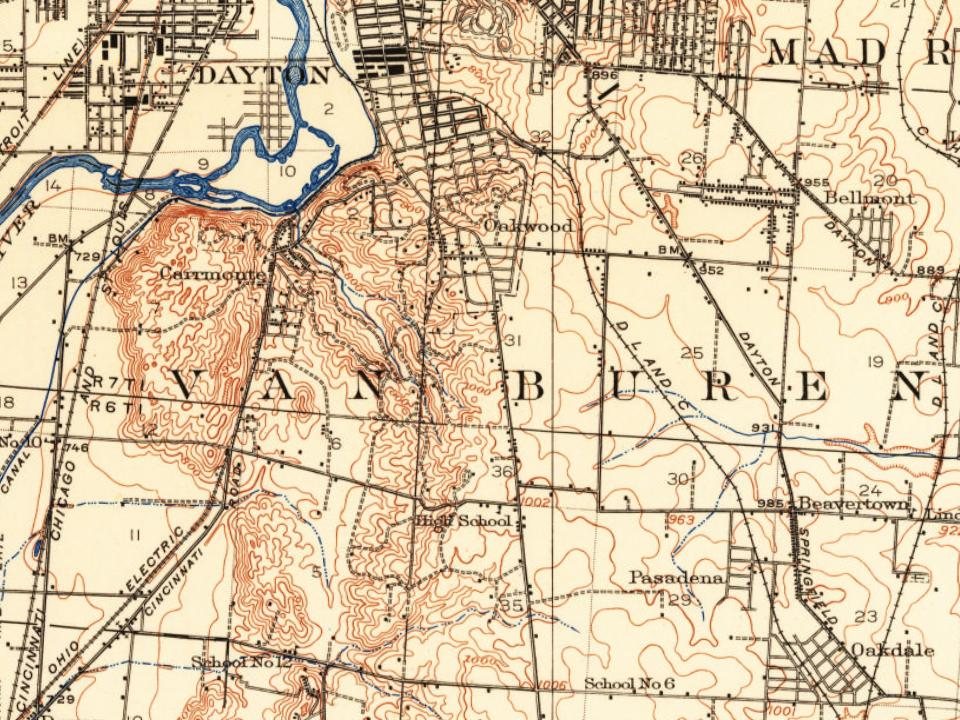
6 places in town are on the National Register, among them the Hawthorn Hill, a National Historic Landmark, and two historic districts with 400 buildings between them. Below: maps from 1913 on and the census since 1910.
Founding year: Wikidata; Wikipedia’s history section gives the same year.The full story ↓
History grade
What drives Oakwood’s History grade
On its age, its old homes and the National Register, Oakwood is more historic than 80% of U.S. towns, #305 of 993 in Ohio. Its share of homes from before 1940 holds the grade up; its age pulls it down.
A−
HistoryA character grade: shown, never part of Oakwood’s overall grade.
Ohio towns list about as much on the Register as the country (a typical Ohio town has 2.9 per 10,000 residents, the U.S. 2.4), so Oakwood’s 431 sits above most of its state (98% of Ohio towns have fewer) while its 408 historic buildings outnumber those of 96% of U.S. towns.
How sure. Graded on any two of the three inputs instead, the letter would range from B− to A+. The pre-1940 share is a Census survey estimate (±5.5 points). Two sources give 1908.
Founding year: Wikidata (other dates in Quick answers). Homes: Census ACS 2020–24. National Register: National Park Service, May 2026 list; each listing counted once (boundary changes and added documentation belong to their listing), and a historic district counts its contributing buildings. How TownRatings grades history →
What stands out about Oakwood’s past
Read from the archive, the National Register and the record. The page puts what stands out first.
At the turn of the twentieth century, Oakwood was primarily farmland situated on a hill directly south of the City of Dayton. In 1913, when a disastrous flood devastated downtown Dayton (the Great Dayton Flood), advertising began to tout Oakwood property as "275 feet higher than the intersection of Third and Main Streets."
In light of this real estate advantage and its location adjacent to the City of Dayton, Oakwood's largest period of growth began and by 1930, the population numbered over 6,000. Oakwood incorporated as a city in 1908 and in 1932 adopted the Council/Manager form of government that is still in place.
Passages that mention Oakwood, cut from the printed page as they were published.
History of the city of Dayton and Montgomery County, Ohio1909 · page 855Read the page →
Read the text
oi>position and many difficulties succeeded in obtaining a charter as a village to itself in 1907, the court records showing the legal papers to have been presented for record July 29th of that year. The plat as recorded includes the territory covered by a number of former plats. The northern limits of Oakwood meet the southern limits of Dayton. The idea in securing a separate incorporation for Oakwood seems to have been to maintain the management of the affairs of that suburb independently of the decisions and actions of the municipal authorities in Dayton. The people of the village show taste and determination in
Text read by machine from the scan; it may contain errors.
The history of Montgomery county, Ohio, containing a history of the county1882 · page 180Read the page →
Read the text
Oakwood is a suburb finely situated on the Lebanon Turnpike, on the big lands immediately south of Dayton. The Canal, and the Cleveland, Columbus, Cincinnati & Indianapolis Railro traverse the western end of the township, on the level ground, between the rivj and the ridges. The new Narrow Gauge Railroad line runs through the eastf portions, near Beavertown, and across the Watervliet Society’s lands, so that th<] is hardly a farm now, in Van Buren, that is out of sight or hearing of the lo< motive, and the progress it represents.
Text read by machine from the scan; it may contain errors.
Scans and text from the Internet Archive. Books published in 1930 or earlier, which are in the public domain.
Timeline
Oakwood, 1908 to 1991
Woven from the archive, old maps, post office records, the National Register and the people born here.
In 1908, according to Wikidata and Wikipedia’s history of the town. the census of 1910 counted 358 people here.
How does Oakwood rank for history?
Oakwood is more historic than 80% of U.S. towns, #305 of 993 in Ohio. The History grade combines the town’s founding era, the share of homes built before 1940 and its National Register listings. It’s a character grade, so it isn’t part of the overall grade. How it works.
What is on the National Register in Oakwood?
6 listings: 4 buildings, among them the Hawthorn Hill (a National Historic Landmark since 1991), and 2 historic districts, the Schantz Park Historic District and the Dayton Country Club, with 400 contributing buildings. 408 historic buildings in all.
How old are the homes in Oakwood?
55% of Oakwood’s homes were built before 1940 (Census estimate, ±5.5 points), against a typical 15% for an Ohio town; the median home was built in 1938.
Founding dates: Wikidata, Wikipedia, the U.S. post office records of Blevins & Helbock (CC0) and the Census. Homes by year built: Census ACS 2020–24. National Register of Historic Places: National Park Service (list of May 22, 2026). Old photos, postcards and papers: Wikimedia Commons, the Library of Congress and other public archives, credited on each item’s page. Maps: U.S. Geological Survey historical topographic maps (via Esri) and Sanborn fire-insurance maps (Library of Congress). History text and census tables: Wikipedia (CC BY-SA 4.0). Places that used to be: USGS Geographic Names Information System (2021).
From Wikidata (2), the National Register of Historic Places (6), Wikipedia, Wikidata and Wikipedia for famous people, U.S. Geological Survey historical maps, U.S. Census counts (via Wikipedia), the USGS Geographic Names Information System and old county and town histories (Internet Archive). Archive images are copied here with their credits and licenses, shown on each photo’s page. Refreshed monthly.


 ★ Landmark