Wallkill dates to 1772, and 12% of its homes were built before 1940
More historic than 78% of U.S. towns · #458 of 758 in New York. What drives it
Its Register listings are the William Bull III House, the John Tears Inn and the Crane House. Below: 5 old photos and papers, maps from 1906 on, and the census since 1790.
Founding year: Wikidata; Wikipedia’s history section gives the same year. First post office: 1802.The full story ↓
History grade
What drives Wallkill’s History grade
On its age, its old homes and the National Register, Wallkill is more historic than 78% of U.S. towns, #458 of 758 in New York. All 3 inputs are above most U.S. towns; its age ranks highest and its share of homes from before 1940 lowest.
A−
HistoryA character grade: shown, never part of Wallkill’s overall grade.
New York towns list more on the Register than most of the country (a typical New York town has 12.3 per 10,000 residents, the U.S. 2.4), so Wallkill’s 2.9 sits below most of its state (29% of New York towns have fewer) while its 9 historic buildings outnumber those of 75% of U.S. towns.
How sure. Graded on any two of the three inputs instead, the letter would range from B− to A−. The pre-1940 share (±2.5 points) is firm at this size. Two sources give 1772.
Founding year: Wikidata (other dates in Quick answers). Homes: Census ACS 2020–24. National Register: National Park Service, May 2026 list; each listing counted once (boundary changes and added documentation belong to their listing), and a historic district counts its contributing buildings. How TownRatings grades history →
What stands out about Wallkill’s past
Read from the archive, the National Register and the record. The page puts what stands out first.
Lost post offices, old corners, places now gone and burying grounds
Wallkill had its own post office from 1802 to 1829. Nine other post offices opened and closed inside today’s town.
Wallkill
1802–1829
Scotchtown
1822–1907
Philipsburg
1827–1849
Vanburenville
1834–1847
Howells Depot
1847–1904
Circleville
1852–today
Wallkill
1854–1856
Fair Oaks
1872–1947
Stony Ford
1882–1928
Crystal Run
1883–1940
18001910today
Hamlets and corners on the map
Canterbury KnollsCirclevilleCrystal RunEast MiddletownFair OaksHowellsKeystone ParkMaple GlenMechanicstownMichigan CornersMidway ParkMilburnPhillipsburgPilgrim CornersRockvilleScotchtownStony FordValley View Mobile Home ParkVan BurenvilleWashington Heights
Gone or out of use
Brimestone SchoolschoolCircleville SchoolschoolDistrict Number 12 SchoolschoolMount Johnson SchoolschoolProsperous Valley SchoolschoolRockville SchoolschoolScotchtown SchoolschoolVan Burenville Schoolschool
4cemeteries and burying grounds inside Wallkill
CirclevillePine HillTemple SinaiWallkill
US Post Offices dataset (Blevins & Helbock, CC0). Places and cemeteries from the USGS Geographic Names Information System (2021).
People over time
Wallkill, census by census
Lost two-thirds of its people between 1880 and 1910, then grew more than tenfold.
22 censuses, 1790–2020.
U.S. Census Bureau decennial counts, from the census table on Wallkill’s Wikipedia page.
On the map
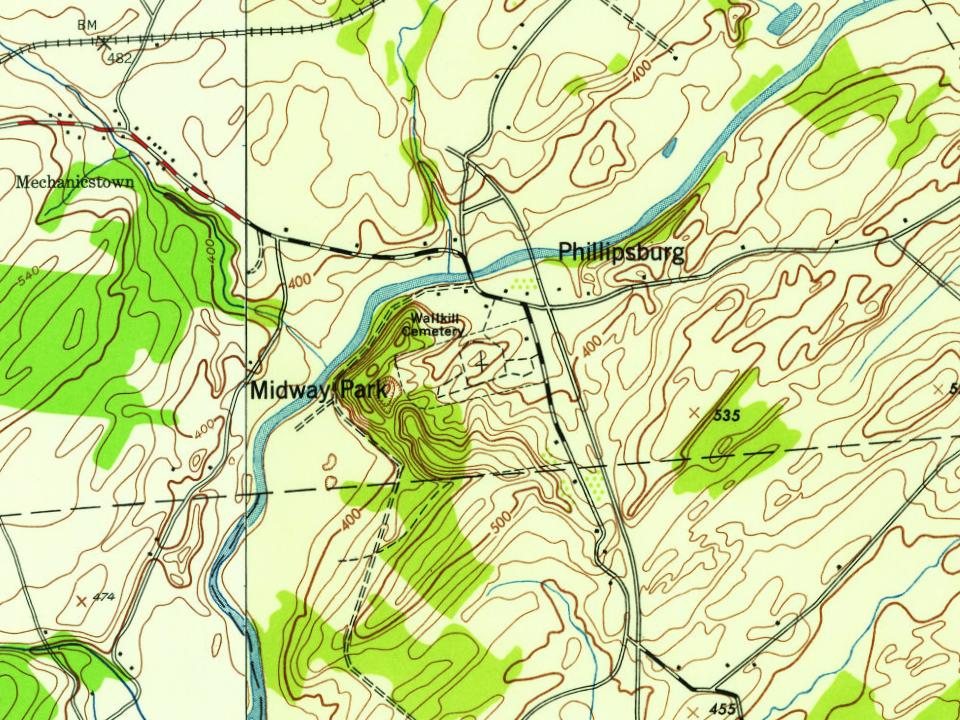
Wallkill on the map, 1906 to 1957
Every edition of the U.S. Geological Survey’s map of Wallkill. Tap a year, or press play to watch the town change.
1906Goshen sheet · 1:62,500
U.S. Geological Survey historical topographic maps (public domain), via Esri’s collection of the scans. The red ring marks the center of Wallkill.
The original land patent for the town was dated 1724, but little was done for decades to develop and settle the region. The town was established in 1772, but part of the town was lost upon the formation of Ulster County. Wallkill's claim to fame during the American Revolution was the production of gunpowder in factories in Phillipsburgh and Craigville for American troops by Henry Wisner and his son-in-law Moses Phillips.
Nothing in the archives for these yearsWeddings on Main Street, storms, parades, school pictures, the old store. If it’s in your family album, it belongs here.
In 1772, according to Wikidata and Wikipedia’s history of the town. Wallkill’s post office opened in 1802, and the first U.S. census counted 2,571 people here in 1790.
How does Wallkill rank for history?
Wallkill is more historic than 78% of U.S. towns, #458 of 758 in New York. The History grade combines the town’s founding era, the share of homes built before 1940 and its National Register listings. It’s a character grade, so it isn’t part of the overall grade. How it works.
What is on the National Register in Wallkill?
Three places: the William Bull III House (listed 1986), the John Tears Inn (1997) and the Crane House (2018).
How old are the homes in Wallkill?
12% of Wallkill’s homes were built before 1940 (Census estimate, ±2.5 points), against a typical 27% for a New York town; the median home was built in 1978.
Founding dates: Wikidata, Wikipedia, the U.S. post office records of Blevins & Helbock (CC0) and the Census. Homes by year built: Census ACS 2020–24. National Register of Historic Places: National Park Service (list of May 22, 2026). Old photos, postcards and papers: Wikimedia Commons, the Library of Congress and other public archives, credited on each item’s page. Maps: U.S. Geological Survey historical topographic maps (via Esri) and Sanborn fire-insurance maps (Library of Congress). History text and census tables: Wikipedia (CC BY-SA 4.0). Places that used to be: USGS Geographic Names Information System (2021).
From the Library of Congress (5), Wikidata (2), the National Register of Historic Places (3), Wikipedia, Wikidata and Wikipedia for famous people, U.S. Geological Survey historical maps, U.S. Census counts (via Wikipedia), the US Post Offices dataset (Blevins & Helbock) and the USGS Geographic Names Information System. Archive images are copied here with their credits and licenses, shown on each photo’s page. Refreshed monthly.




 Date?
 Date?
 Date?
 Date?


