The Springport post office opened in 1829, the earliest record of the town by name. Two smaller post offices, Oakwood (1891) and Farleys (1892), opened inside today’s town and later closed.
First census: 1,528 in 18302020 census: 2,227197 years
How historic is Springport?
A
More historic than 92% of U.S. towns, on its age, its old homes and the National Register.
Founding year: the first Springport post office (Blevins & Helbock, CC0).The full story ↓
History grade
What drives Springport’s History grade
On its age, its old homes and the National Register, Springport is more historic than 92% of U.S. towns. All 3 inputs are above most U.S. towns; its share of homes from before 1940 ranks highest and its National Register listings lowest.
A
HistoryA character grade: shown, never part of Springport’s overall grade.
New York towns list more on the Register than most of the country (a typical New York town has 12.3 per 10,000 residents, the U.S. 2.4), so Springport’s 55.3 sits above most of its state (69% of New York towns have fewer) while its 13 historic buildings outnumber those of 77% of U.S. towns.
How sure. Graded on any two of the three inputs instead, the letter would range from A− to A. The pre-1940 share is a Census survey estimate (±8.9 points). The founding year is the first post office, not a stated founding date.
Founding year: the first post office (other dates in Quick answers). Homes: Census ACS 2020–24. National Register: National Park Service, May 2026 list; each listing counted once (boundary changes and added documentation belong to their listing), and a historic district counts its contributing buildings. How TownRatings grades history →
What stands out about Springport’s past
Read from the archive, the National Register and the record. The page puts what stands out first.
The town lies in the former territory of the Cayuga tribe. A mission to the tribe by the Jesuits was established in 1688. The Sullivan Expedition destroyed the Cayuga villages in 1779.
The town was excluded from the Central New York Military Tract and set apart as a reservation for the Cayugas who returned after the American Revolution. In 1789, they gave up this land to New York, thus opening it to settlers. The first settlers were occasionally asked to leave due to disputes with the tribal members, but eventually the population of outsiders grew. By 1799, most of the Cayuga, including a few Tuscarora, had sold out and departed the area.
Passages that mention Springport, cut from the printed page as they were published.
History of Cayuga County, New York1908 · page 244Read the page →
Read the text
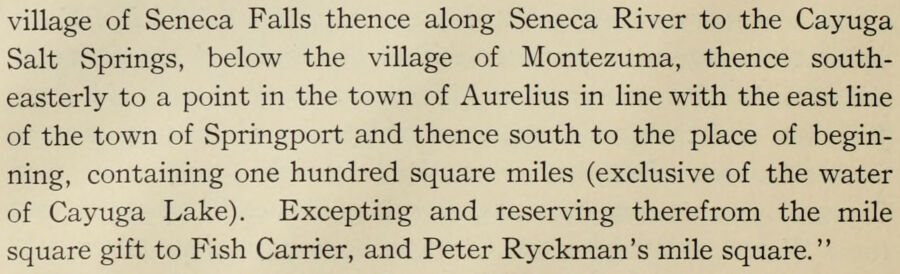
village of Seneca Falls thence along Seneca River to the Cayuga Salt Springs, below the village of Montezuma, thence southeasterly to a point in the town of Aurelius in line with the east line of the town of Springport and thence south to the place of beginning, containing one hundred square miles (exclusive of the water of Cayuga Lake). Excepting and reserving therefrom the mile square gift to Fish Carrier, and Peter Ryckman 's mile square."
Text read by machine from the scan; it may contain errors.
Onondaga county, set off in 1804 ; and the towns of Ledyard, Venice and a part of Springport, which were set off January 30th, 1823. It lies south of the center of the County, upon the west shore of Owasco Lake, which forms its eastern boundary. It is bounded on the north by Fleming, on the south by Venice, and on the west by Springport and Ledyard.
Text read by machine from the scan; it may contain errors.
History of Cayuga County, New York1908 · page 386Read the page →
Read the text
Wood, George P. Born in the town of Springport, Cayuga County, N. Y. , May 31, 1841 ; educated in the public schools of that town and in the Friends' Academy in the village of Union Springs.
Text read by machine from the scan; it may contain errors.
History of Cayuga County, New York1879 · page 488Read the page →
Read the text
John, Eben, Daniel and Josiah Guthrie, who settled in Springport in 1790, came to this town about 1793, and lived near McGuigans Corners, about three miles south-west of Northville. John, who was a. single man, worked out in Springport during the summer, and during the fall cut wild
Text read by machine from the scan; it may contain errors.
Scans and text from the Internet Archive. Books published in 1930 or earlier, which are in the public domain.
Timeline
Springport, 1810 to 1934
Woven from the archive, old maps, post office records, the National Register and the people born here.
Nothing in the archives for these yearsWeddings on Main Street, storms, parades, school pictures, the old store. If it’s in your family album, it belongs here.
The Springport post office opened in 1829, the earliest record of the town by name (U.S. post office records).
How does Springport rank for history?
Springport is more historic than 92% of U.S. towns. The History grade combines the town’s founding era, the share of homes built before 1940 and its National Register listings. It’s a character grade, so it isn’t part of the overall grade. How it works.
What is on the National Register in Springport?
5 listings: 5 buildings, among them the Peter Yawger House (listed 2004, the first). 13 historic buildings in all.
How old are the homes in Springport?
32% of Springport’s homes were built before 1940 (Census estimate, ±8.9 points), against a typical 27% for a New York town; the median home was built in 1967.
Founding dates: Wikidata, Wikipedia, the U.S. post office records of Blevins & Helbock (CC0) and the Census. Homes by year built: Census ACS 2020–24. National Register of Historic Places: National Park Service (list of May 22, 2026). Old photos, postcards and papers: Wikimedia Commons, the Library of Congress and other public archives, credited on each item’s page. Maps: U.S. Geological Survey historical topographic maps (via Esri) and Sanborn fire-insurance maps (Library of Congress). History text and census tables: Wikipedia (CC BY-SA 4.0). Places that used to be: USGS Geographic Names Information System (2021).
From Wikimedia Commons (4), the National Register of Historic Places (5), Wikipedia, Wikidata and Wikipedia for famous people, U.S. Geological Survey historical maps, U.S. Census counts (via Wikipedia), the US Post Offices dataset (Blevins & Helbock), the USGS Geographic Names Information System and old county and town histories (Internet Archive). Archive images are copied here with their credits and licenses, shown on each photo’s page. Refreshed monthly.




 Date?
 2008
 2003

