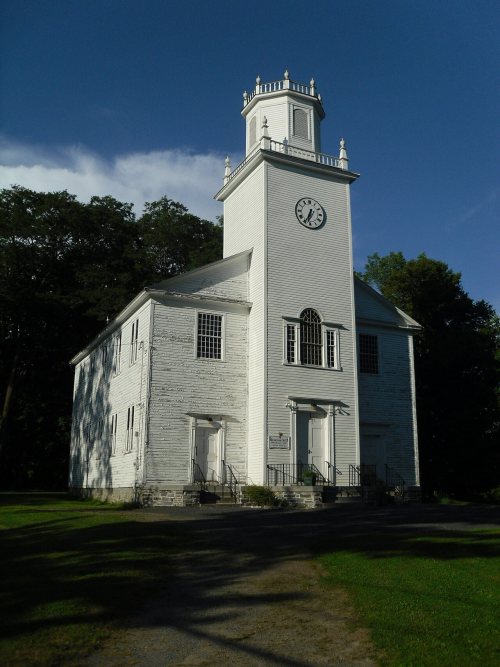
2 places in town are on the National Register, among them a historic district with 6 buildings. Below: 6 old photos and papers, maps from 1897 on, and the census since 1820.
The Russia post office opened in 1809, the earliest record of the town by name. Five smaller post offices, Postville (1831), Gravesville (1848) and Booth (1853), opened inside today’s town and later closed.
First census: 1,685 in 18202020 census: 2,269217 years
How historic is Russia?
A
More historic than 91% of U.S. towns, on its age, its old homes and the National Register.
Founding year: the first Russia post office (Blevins & Helbock, CC0).The full story ↓
History grade
What drives Russia’s History grade
On its age, its old homes and the National Register, Russia is more historic than 91% of U.S. towns. All 3 inputs are above most U.S. towns; its share of homes from before 1940 ranks highest and its National Register listings lowest.
A
HistoryA character grade: shown, never part of Russia’s overall grade.
New York towns list more on the Register than most of the country (a typical New York town has 12.3 per 10,000 residents, the U.S. 2.4), so Russia’s 30.8 sits near the middle of its state (62% of New York towns have fewer) while its 7 historic buildings outnumber those of 73% of U.S. towns.
How sure. Graded on any two of the three inputs instead, the letter would range from A− to A. The pre-1940 share is a Census survey estimate (±7.1 points). The founding year is the first post office, not a stated founding date.
Founding year: the first post office (other dates in Quick answers). Homes: Census ACS 2020–24. National Register: National Park Service, May 2026 list; each listing counted once (boundary changes and added documentation belong to their listing), and a historic district counts its contributing buildings. How TownRatings grades history →
What stands out about Russia’s past
Read from the archive, the National Register and the record. The page puts what stands out first.
The town of Norway was organized in 1792. The town of Russia – called Union until 1808 – was formed from the town of Norway in 1806. In 1836, part of Russia, along with part of the town of Ohio, was used to form the now-defunct town of Wilmurt. As of 1875, the main "industrial pursuits" of Russia were cheesemaking and buttermaking, while the primary farm products (besides flint corn, buckwheat etc) were maple sugar, apples, potatoes, and oats. When the town of Webb was formed in 1896, much of Wilmurt was transferred to Webb with the rest returned to Ohio.
There were many difficulties, however, in the way of a second campaign. The financial condition of Russia was very bad, the Russian envoy Postnik had been unsuccessful in concluding a loan in England — if other reasons were wanting, the troubles of the last year of James II. were sufficient — and taxes were already most burdensome. Fears lest Poland and Austria might conclude a separate peace with the Turks which would be disadvantageous to Russia ; the urgent demands of the Poles for
Text read by machine from the scan; it may contain errors.
Russia is — Europe as well. When, therefore, I contrast Russia and Eiirope, I contrast two epochs. Russia does not differ essentially from Europe ; but Russia is not yet essentially one with Europe.
Text read by machine from the scan; it may contain errors.
C dominate the others both poUticaUy and intellectually, and Russia was predestined to fulfil the function. Russia would become the capital, as it were, the heart of the others, would in her turn occupy the position that had been successively filled by Italy, by Spain, by the Germany of the reformation, by I England, and by France. In addition to Russia, Kireevskii did indeed envisage the United States of America, a country no less young and vigorons than Russia, but it was too remote
Text read by machine from the scan; it may contain errors.
Peter the Great, Emperor of Russia1890 · page 265Read the page →
Read the text
A suitable place for ship-building was found on the liver Voronezh, close to the town of that name, skilful shipwrights were called from England and Holland, and in 1696 there began a new work in Russia — the construction of great war-ships, galleys, and other vessels ; and so that this might be for ever secured in Russia, and that he might introduce among his people the art of this business, he sent many people of noble families to Holland and other states to learn the building and
Text read by machine from the scan; it may contain errors.
Scans and text from the Internet Archive. Books published in 1930 or earlier, which are in the public domain.
By decade
Russia, decade by decade
2 decades in the archive, from the 1860s to the 1930s. Scroll each row; tap a photo for its story.
Nothing in the archives for these yearsWeddings on Main Street, storms, parades, school pictures, the old store. If it’s in your family album, it belongs here.
The Russia post office opened in 1809, the earliest record of the town by name (U.S. post office records).
How does Russia rank for history?
Russia is more historic than 91% of U.S. towns. The History grade combines the town’s founding era, the share of homes built before 1940 and its National Register listings. It’s a character grade, so it isn’t part of the overall grade. How it works.
What is on the National Register in Russia?
Two places: the Cold Brook Feed Mill (listed 1974) and the Russia Corners Historic District (1996).
How old are the homes in Russia?
36% of Russia’s homes were built before 1940 (Census estimate, ±7.1 points), against a typical 27% for a New York town; the median home was built in 1959.
Founding dates: Wikidata, Wikipedia, the U.S. post office records of Blevins & Helbock (CC0) and the Census. Homes by year built: Census ACS 2020–24. National Register of Historic Places: National Park Service (list of May 22, 2026). Old photos, postcards and papers: Wikimedia Commons, the Library of Congress and other public archives, credited on each item’s page. Maps: U.S. Geological Survey historical topographic maps (via Esri) and Sanborn fire-insurance maps (Library of Congress). History text and census tables: Wikipedia (CC BY-SA 4.0). Places that used to be: USGS Geographic Names Information System (2021).
From Wikimedia Commons (6), the National Register of Historic Places (2), Wikipedia, U.S. Geological Survey historical maps, U.S. Census counts (via Wikipedia), the US Post Offices dataset (Blevins & Helbock), the USGS Geographic Names Information System and old county and town histories (Internet Archive). Archive images are copied here with their credits and licenses, shown on each photo’s page. Refreshed monthly.


 1933
 1933
 1933
 1933