Hamilton dates to 1795, and 42% of its homes were built before 1940
More historic than 98% of U.S. towns · #57 of 758 in New York. What drives it
5 places in town are on the National Register, among them two historic districts with 319 buildings between them. Below: 6 old photos and papers, maps from 1887 on, and the census since 1820.
Founding year: Wikidata; Wikipedia’s history section gives the same year. First post office: 1800.The full story ↓
History grade
What drives Hamilton’s History grade
On its age, its old homes and the National Register, Hamilton is more historic than 98% of U.S. towns, #57 of 758 in New York. All 3 inputs are above most U.S. towns; its share of homes from before 1940 ranks highest and its age lowest.
A+
HistoryA character grade: shown, never part of Hamilton’s overall grade.
New York towns list more on the Register than most of the country (a typical New York town has 12.3 per 10,000 residents, the U.S. 2.4), so Hamilton’s 507 sits above most of its state (92% of New York towns have fewer) while its 322 historic buildings outnumber those of 95% of U.S. towns.
How sure. Graded on any two of the three inputs instead, the letter would range from A to A+. The pre-1940 share is a Census survey estimate (±4.8 points). Two sources give 1795.
Founding year: Wikidata (other dates in Quick answers). Homes: Census ACS 2020–24. National Register: National Park Service, May 2026 list; each listing counted once (boundary changes and added documentation belong to their listing), and a historic district counts its contributing buildings. How TownRatings grades history →
What stands out about Hamilton’s past
Read from the archive, the National Register and the record. The page puts what stands out first.
US Post Offices dataset (Blevins & Helbock, CC0). Places and cemeteries from the USGS Geographic Names Information System (2021).
Every building
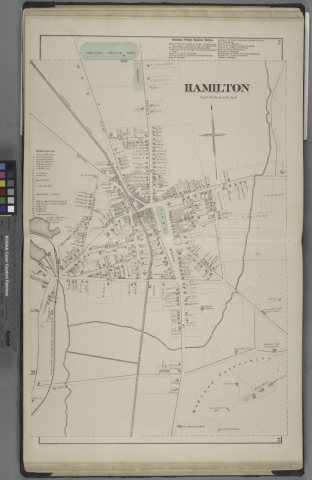
Hamilton, building by building, 1887–1911
Fire insurance maps drew every building, what it was made of and what it was used for, so insurers could price the risk of fire. Pick a year, then a sheet.
The location was formerly called "Payne's Corners". The town of Hamilton was established in 1795, before the county was formed, from the town of Paris in Oneida County. The original town was reduced to create new towns in the county.
The Mystic Order of Veiled Prophets of the Enchanted Realm, an appendant body in Freemasonry, was founded in Hamilton in 1890.
Passages that mention Hamilton, cut from the printed page as they were published.
Portrait and biographical record of Madison and Hamilton counties, Indiana1893 · page 709Read the page →
Read the text
Coining to Indiana in 1852 Salathicl Fisher settled in Hamilton County and bought one hundred and sixty acres of heavily timbered land, upon which were a large number of poi)lar and oak trees. lie added to his original purchase forty acres, and lived to see the largei' part of the estate placed under cultivation. For a short time he engaged in merchandising at Fisher's Station, wliicli
Text read by machine from the scan; it may contain errors.
History of Hamilton County, Iowa1912 · page 53Read the page →
Read the text
Mr. Ouackenbush has always been actively at work and practically his entire life has been devoted to civil and mechanical engineering. He has been engaged principally in the building of bridges, and his services have been in demand not only throughout Hamilton county and the state of Iowa but also in Nebraska, North and South Dakota and Minnesota. In addition to the construction of highway and railroad bridges he has also erected many structures throughout the same territory. He sensed as county surveyor and engineer of Hamilton
Text read by machine from the scan; it may contain errors.
History of Hamilton County, Iowa1912 · page 173Read the page →
Read the text
Frank A. Huddlestun received his education in the public schools of his native state and laid aside his books at the age of seventeen years. He then started to farm for himself and was successful in this field of activity in Illinois until 1892, when he came to Hamilton county, Iowa, where he purchased four hundred and seventy-six acres of land in Hamilton township, upon which he resided until 1906. He subsequently disposed of his holdings and moved to Webster City, where he bought two hundred and twenty-two acres in the south part
Text read by machine from the scan; it may contain errors.
Portrait and biographical record of Madison and Hamilton counties, Indiana1893 · page 392Read the page →
Read the text
Coming to Hamilton County in 1830, William D. Rooker built a small gristmill on Cool Creek, and later erected a sawmill, which he operated for many years. He purcliased three hundred acres, the most of which, assisted by his two eldest sons, he placed under cultivation. He was a sincere and devoted Cliristian, and for many j'ears labored as a local preacher in the Methodist Episco-
Text read by machine from the scan; it may contain errors.
Scans and text from the Internet Archive. Books published in 1930 or earlier, which are in the public domain.
Timeline
Hamilton, 1795 to 1979
Woven from the archive, old maps, post office records, the National Register and the people born here.
Nothing in the archives for these yearsWeddings on Main Street, storms, parades, school pictures, the old store. If it’s in your family album, it belongs here.
Nothing in the archives for these yearsWeddings on Main Street, storms, parades, school pictures, the old store. If it’s in your family album, it belongs here.
In 1795, according to Wikidata and Wikipedia’s history of the town. Hamilton’s post office opened in 1800, and the census of 1820 counted 2,681 people here.
How does Hamilton rank for history?
Hamilton is more historic than 98% of U.S. towns, #57 of 758 in New York. The History grade combines the town’s founding era, the share of homes built before 1940 and its National Register listings. It’s a character grade, so it isn’t part of the overall grade. How it works.
What is on the National Register in Hamilton?
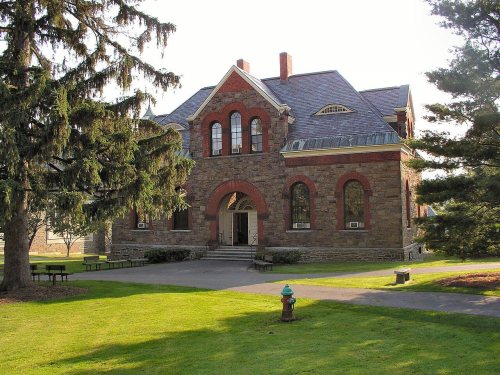
5 listings: 3 buildings, among them the Old Biology Hall (listed 1973, the first), and 2 historic districts, the Earlville Historic District and the Hamilton Village Historic District, with 319 contributing buildings. 322 historic buildings in all.
How old are the homes in Hamilton?
42% of Hamilton’s homes were built before 1940 (Census estimate, ±4.8 points), against a typical 27% for a New York town; the median home was built in 1957.
Founding dates: Wikidata, Wikipedia, the U.S. post office records of Blevins & Helbock (CC0) and the Census. Homes by year built: Census ACS 2020–24. National Register of Historic Places: National Park Service (list of May 22, 2026). Old photos, postcards and papers: Wikimedia Commons, the Library of Congress and other public archives, credited on each item’s page. Maps: U.S. Geological Survey historical topographic maps (via Esri) and Sanborn fire-insurance maps (Library of Congress). History text and census tables: Wikipedia (CC BY-SA 4.0). Places that used to be: USGS Geographic Names Information System (2021).
From Wikimedia Commons (6), the National Register of Historic Places (5), Wikipedia, Wikidata and Wikipedia for famous people, U.S. Geological Survey historical maps, U.S. Census counts (via Wikipedia), the US Post Offices dataset (Blevins & Helbock), the USGS Geographic Names Information System, Sanborn fire insurance maps (Library of Congress) and old county and town histories (Internet Archive). Archive images are copied here with their credits and licenses, shown on each photo’s page. Refreshed monthly.






 1911


