The Charlton post office opened in 1802, the earliest record of the town by name. Another post office, West Charlton (1828), opened inside today’s town and later closed.
First census: 1,746 in 18002020 census: 4,328224 years
How historic is Charlton?
A
More historic than 85% of U.S. towns, on its age, its old homes and the National Register.
Founding year: the first Charlton post office (Blevins & Helbock, CC0).The full story ↓
History grade
What drives Charlton’s History grade
On its age, its old homes and the National Register, Charlton is more historic than 85% of U.S. towns, #341 of 758 in New York. All 3 inputs are above most U.S. towns; its National Register listings ranks highest and its share of homes from before 1940 lowest.
A
HistoryA character grade: shown, never part of Charlton’s overall grade.
New York towns list more on the Register than most of the country (a typical New York town has 12.3 per 10,000 residents, the U.S. 2.4), so Charlton’s 87.6 sits above most of its state (74% of New York towns have fewer) while its 38 historic buildings outnumber those of 83% of U.S. towns.
How sure. Graded on any two of the three inputs instead, the letter would still be A−. The pre-1940 share is a Census survey estimate (±6.1 points). The founding year is the first post office, not a stated founding date.
Founding year: the first post office (other dates in Quick answers). Homes: Census ACS 2020–24. National Register: National Park Service, May 2026 list; each listing counted once (boundary changes and added documentation belong to their listing), and a historic district counts its contributing buildings. How TownRatings grades history →
What stands out about Charlton’s past
Read from the archive, the National Register and the record. The page puts what stands out first.
The region was first settled circa 1680 by travelers from the small village of Charlton, located in Worcestershire, United Kingdom. The town was formed in 1792 from the Town of Ballston, immediately after Saratoga County was established. The town was previously known as "Freehold" due to the number of settlers from New Jersey.
Passages that mention Charlton, cut from the printed page as they were published.
History of Saratoga County, New York, with illustrations biographical sketches of some of its prominent men and pioneers1878 · page 319Read the page →
Read the text
The early settlers of the eastern part of the town of Charlton were mostly from the town of Freehold, in Monmouth county. New Jersey, and intended to name their new homes in the wilderness after their former homes near the sea. Consequently, as the town of Charlton was not erected till 1792, and the church was organized in 1786, the name of " The Freehold church" obtained, and has never been dropped.
Text read by machine from the scan; it may contain errors.
History of Saratoga County, New York, with biographical sketches of some of its prominent men and pioneers1878 · page 319Read the page →
Read the text
The early settlers of the eastern part of the town of Charlton were mostly from the town of Freehold, in Monmouth county. New Jersey, and intended to name their new homes in the wilderness after their former homes near the sea. Consequently, as the town of Charlton was not erected till 1792, and the church was organized in 1786, the name of " The Freehold church" obtained, and has never been dropped.
Text read by machine from the scan; it may contain errors.
History of Saratoga County, New York1893 · page 173Read the page →
Read the text
The town of Charlton was formed from the town of Ballston in the year 1792. It is the southwest corner town ofthe county. Its surface is undulating with gentle inclination toward the south. Its streams are the Aalplaats and a branch of the Mourning Kill. It contains twenty thousand two hundred and thirtyseven acres.
Text read by machine from the scan; it may contain errors.
History of Saratoga County, New York, with biographical sketches of some of its prominent men and pioneers1878 · page 316Read the page →
Read the text
Two brothers named Chauncey and Samuel Belding came to Charlton, — the first arriving in the town about 1790 and the other two or three years later, — and embarked in the mercantile business in 1794. They succeeded Davis & Bostwick, who started the first store in Charlton, about 1785-87, and who failed in business about the time that Chauncey Belding came to Charlton. The Beldings were quite prominent men. Chauncey was a member of Assembly
Text read by machine from the scan; it may contain errors.
Scans and text from the Internet Archive. Books published in 1930 or earlier, which are in the public domain.
Timeline
Charlton, 1784 to 2020
Woven from the archive, old maps, post office records, the National Register and the people born here.
The Charlton post office opened in 1802, the earliest record of the town by name (U.S. post office records).
How does Charlton rank for history?
Charlton is more historic than 85% of U.S. towns, #341 of 758 in New York. The History grade combines the town’s founding era, the share of homes built before 1940 and its National Register listings. It’s a character grade, so it isn’t part of the overall grade. How it works.
What is on the National Register in Charlton?
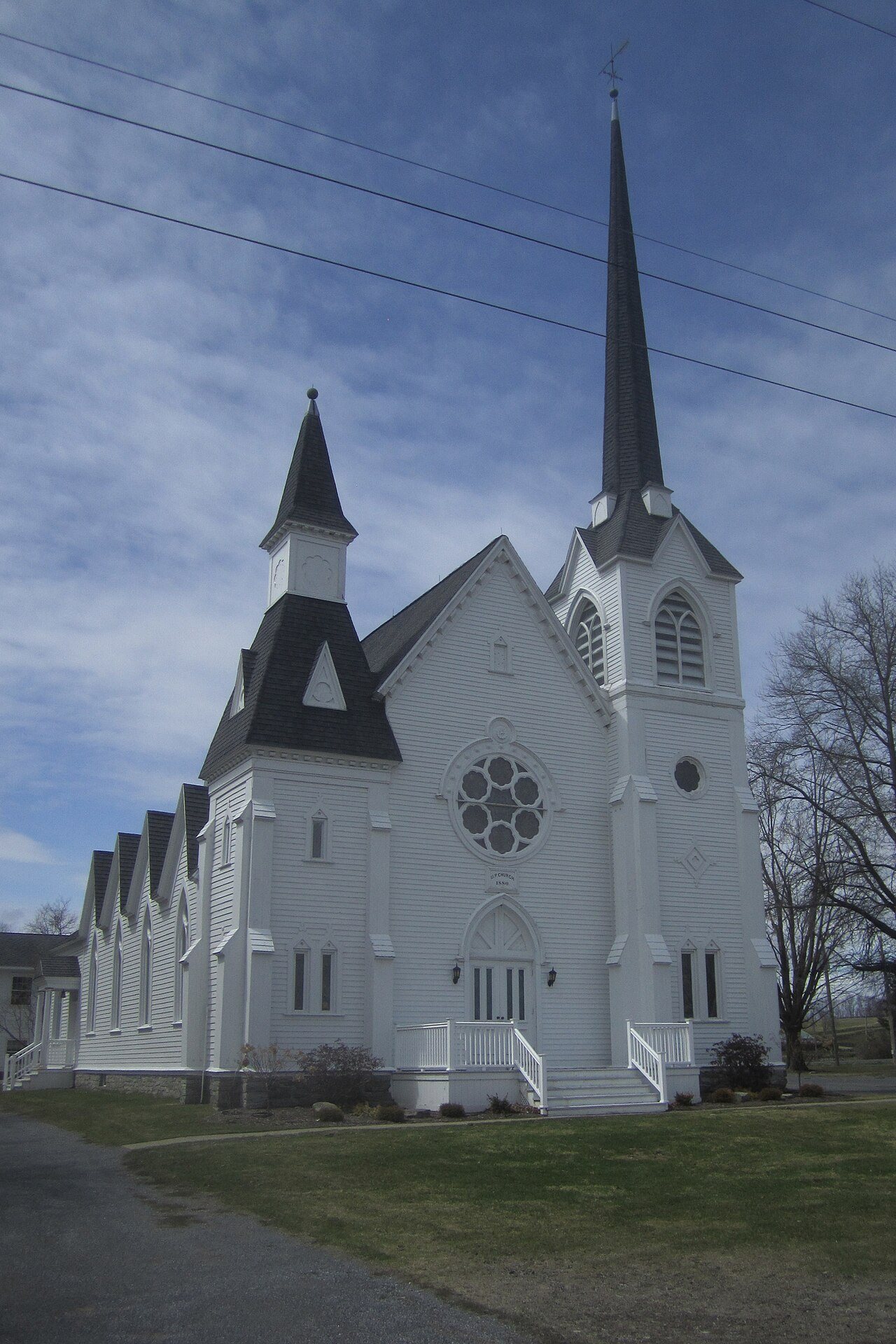
Two places: the West Charlton United Presbyterian Church (listed 1998) and the Charlton Historic District (1976).
How old are the homes in Charlton?
18% of Charlton’s homes were built before 1940 (Census estimate, ±6.1 points), against a typical 27% for a New York town; the median home was built in 1962.
Founding dates: Wikidata, Wikipedia, the U.S. post office records of Blevins & Helbock (CC0) and the Census. Homes by year built: Census ACS 2020–24. National Register of Historic Places: National Park Service (list of May 22, 2026). Old photos, postcards and papers: Wikimedia Commons, the Library of Congress and other public archives, credited on each item’s page. Maps: U.S. Geological Survey historical topographic maps (via Esri) and Sanborn fire-insurance maps (Library of Congress). History text and census tables: Wikipedia (CC BY-SA 4.0). Places that used to be: USGS Geographic Names Information System (2021).
From Wikimedia Commons (2), the National Register of Historic Places (2), Wikipedia, Wikidata and Wikipedia for famous people, U.S. Geological Survey historical maps, U.S. Census counts (via Wikipedia), the US Post Offices dataset (Blevins & Helbock), the USGS Geographic Names Information System and old county and town histories (Internet Archive). Archive images are copied here with their credits and licenses, shown on each photo’s page. Refreshed monthly.


 2016
 2016

