The Berkshire post office opened in 1813, the earliest record of the town by name. Two smaller post offices, East Berkshire (1855) and Wilson Creek (1855), opened inside today’s town and later closed.
First census: 1,502 in 18202020 census: 1,480213 years
How historic is Berkshire?
A+
More historic than 95% of U.S. towns, on its age, its old homes and the National Register.
Founding year: the first Berkshire post office (Blevins & Helbock, CC0).The full story ↓
History grade
What drives Berkshire’s History grade
On its age, its old homes and the National Register, Berkshire is more historic than 95% of U.S. towns. All 3 inputs are above most U.S. towns; its share of homes from before 1940 ranks highest and its age lowest.
A+
HistoryA character grade: shown, never part of Berkshire’s overall grade.
New York towns list more on the Register than most of the country (a typical New York town has 12.3 per 10,000 residents, the U.S. 2.4), so Berkshire’s 428 sits above most of its state (90% of New York towns have fewer) while its 54 historic buildings outnumber those of 85% of U.S. towns.
How sure. Graded on any two of the three inputs instead, the letter would range from A to A+. The pre-1940 share is a Census survey estimate (±7.8 points). The founding year is the first post office, not a stated founding date.
Founding year: the first post office (other dates in Quick answers). Homes: Census ACS 2020–24. National Register: National Park Service, May 2026 list; each listing counted once (boundary changes and added documentation belong to their listing), and a historic district counts its contributing buildings. How TownRatings grades history →
What stands out about Berkshire’s past
Read from the archive, the National Register and the record. The page puts what stands out first.
Purchase rights to the Native American lands in the area were awarded to the Commonwealth of Massachusetts as part of the Boston Ten Townships, by the Treaty of Hartford in 1786. (New York retained the right to govern the land.) Massachusetts sold these rights to private individuals in 1788.
The first settlers arrived around 1791. It was originally called "Browns Settlement."
The Town of Berkshire was established in 1808 from the Town of Union while in Broome County. In 1822, Berkshire was made part of Tioga County. The Town of Newark Valley, as the "Town of Westfield," was created from part of Berkshire in 1828. An additional part of Berkshire was lost in 1831, to found the Town of Richford, then called "Arlington."
south. Leucojwm aestivum is an example of a river-side plant which is more frequent in Berkshire, while Oenanthe crocata, which is absent from the greater part of Oxfordshire, being limited to a few stations . near Reading, is very abundant by streams in Berkshire south of the Kennet. Dipsacus pilosus also is rather more frequent in Berkshire. Mercurialis annua, a rare casual in Oxfordshire, is a common garden weed near Bisham in Berkshire, and Antirrhinum Orontium is a frequent plant of cultivated soils in the Kennet and Loddon districts of Berk-
Text read by machine from the scan; it may contain errors.
Compared with the flora of Berkshire, the flora of Wiltshire will be found to be considerably poorer in the number of recorded species, but Wiltshire has several plants which are not on authoritative record for Berkshire; the chief of these are Ranunculus tripartitus, Cerastium pumilum, Thlaspi perfoliatum (a casual in Berkshire), Linum angustifolium, Chrysosplenium alternifolium, Cnicus tuberosus, Phyteuma orbiculare, Campanula latifolia, C. patula (casual in Berkshire), Orobanche Hederae, Pinguicula lusitanica, Mentha rotundifolia, M. pratensis, Melittis
Text read by machine from the scan; it may contain errors.
Scans and text from the Internet Archive. Books published in 1930 or earlier, which are in the public domain.
Timeline
Berkshire, 1813 to 1903
Woven from the archive, old maps, post office records, the National Register and the people born here.
The Berkshire post office opened in 1813, the earliest record of the town by name (U.S. post office records).
How does Berkshire rank for history?
Berkshire is more historic than 95% of U.S. towns. The History grade combines the town’s founding era, the share of homes built before 1940 and its National Register listings. It’s a character grade, so it isn’t part of the overall grade. How it works.
What is on the National Register in Berkshire?
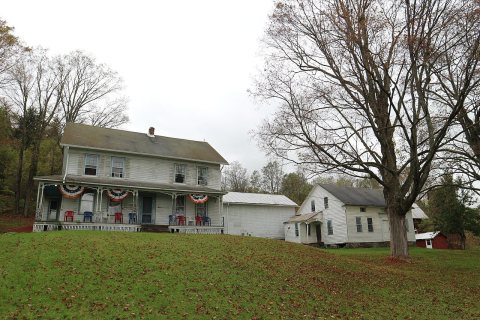
14 listings: 13 buildings, among them the Belcher Family Homestead and Farm (listed 1984, the first), and 1 historic district, the Berkshire Village Historic District, with 25 contributing buildings. 54 historic buildings in all.
How old are the homes in Berkshire?
33% of Berkshire’s homes were built before 1940 (Census estimate, ±7.8 points), against a typical 27% for a New York town; the median home was built in 1972.
Founding dates: Wikidata, Wikipedia, the U.S. post office records of Blevins & Helbock (CC0) and the Census. Homes by year built: Census ACS 2020–24. National Register of Historic Places: National Park Service (list of May 22, 2026). Old photos, postcards and papers: Wikimedia Commons, the Library of Congress and other public archives, credited on each item’s page. Maps: U.S. Geological Survey historical topographic maps (via Esri) and Sanborn fire-insurance maps (Library of Congress). History text and census tables: Wikipedia (CC BY-SA 4.0). Places that used to be: USGS Geographic Names Information System (2021).
From Wikimedia Commons (5), the National Register of Historic Places (14), Wikipedia, Wikidata and Wikipedia for famous people, U.S. Geological Survey historical maps, U.S. Census counts (via Wikipedia), the US Post Offices dataset (Blevins & Helbock), the USGS Geographic Names Information System and old county and town histories (Internet Archive). Archive images are copied here with their credits and licenses, shown on each photo’s page. Refreshed monthly.


 2017
 2017
 2017
 2017
 2017

