New Ulm dates to 1854, and 28% of its homes were built before 1940
More historic than 83% of U.S. towns · #15 of 273 in Minnesota. What drives it
22 places in town are on the National Register, among them four historic districts with 85 buildings between them. Below: 8 old photos and papers, maps from 1884 on, and the census since 1860.
New Ulm dates its founding to 1854 (Wikidata and Wikipedia’s history agree). The census first counted it in 1860.
First census: 635 in 18602020 census: 14,120172 years
How did New Ulm get its name?
New Ulm was named after the city of Ulm in the state of Baden-Württemberg in southern Germany.
More on the name
Ulm and Neu-Ulm (which may have inspired the name) are twin cities, with Ulm on the Baden-Württemberg side of the Danube River and Neu-Ulm on the Bavarian side.
How historic is New Ulm?
A−
More historic than 83% of U.S. towns, on its age, its old homes and the National Register.
Founding year: Wikidata; Wikipedia’s history section gives the same year. First post office: 1856. Name: Wikipedia, licensed CC BY-SA 4.0.The full story ↓
History grade
What drives New Ulm’s History grade
On its age, its old homes and the National Register, New Ulm is more historic than 83% of U.S. towns, #15 of 273 in Minnesota. Its National Register listings hold the grade up; its age pulls it down.
A−
HistoryA character grade: shown, never part of New Ulm’s overall grade.
Minnesota towns list about as much on the Register as the country (a typical Minnesota town has 2.1 per 10,000 residents, the U.S. 2.4), so New Ulm’s 72.6 sits above most of its state (96% of Minnesota towns have fewer) while its 102 historic buildings outnumber those of 90% of U.S. towns.
How sure. Graded on any two of the three inputs instead, the letter would range from B to A+. The pre-1940 share (±2.7 points) is firm at this size. Two sources give 1854.
Founding year: Wikidata (other dates in Quick answers). Homes: Census ACS 2020–24. National Register: National Park Service, May 2026 list; each listing counted once (boundary changes and added documentation belong to their listing), and a historic district counts its contributing buildings. How TownRatings grades history →
What stands out about New Ulm’s past
Read from the archive, the National Register and the record. The page puts what stands out first.
National Park Service, National Register of Historic Places. Photos from Wikimedia Commons, credited on each place’s page.
Every building
New Ulm, building by building, 1884–1922
Fire insurance maps drew every building, what it was made of and what it was used for, so insurers could price the risk of fire. Pick a year, then a sheet.
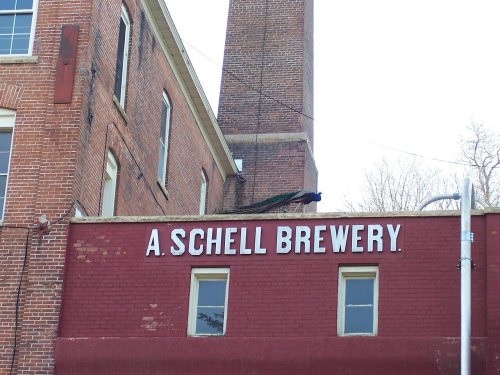
New Ulm was founded in 1854 by the German Land Company of Chicago. It was named after the city of Ulm in the state of Baden-Württemberg in southern Germany. Ulm and Neu-Ulm (which may have inspired the name) are twin cities, with Ulm on the Baden-Württemberg side of the Danube River and Neu-Ulm on the Bavarian side. In part due to the Minnesota city's German heritage, it became a center for brewing in the Upper Midwest. It is home to the August Schell Brewing Company. The Sioux called it Wakzupata, which roughly means "village on the cottonwood".
Passages that mention New Ulm, cut from the printed page as they were published.
History of brown county Minnesota1916 · page 285Read the page →
Read the text
On January 7, 1862, the board cut down the territory embraced in New Ulm civil township, leaving only the incorporated town of New Ulm within a township by itself, and attaching the old territory to adjoining townships, same as it is today. But this had to be ratified by an election by the voters of the township, which was done that fall. This brings the transcript of commissioners’ records up to the Civil War period, so far as any important enact-
Text read by machine from the scan; it may contain errors.
History of brown county Minnesota1916 · page 161Read the page →
Read the text
A “draft” was about this time being ordered all over the United States to replace the soldiers who had died on Southern battle-fields. The young settlement at New Ulm and vicinity sent her best men for the maintenance of the Union, never suspecting that a cruel and more formidable enemy than the rebel of the South was at her very doors.
Text read by machine from the scan; it may contain errors.
Scans and text from the Internet Archive. Books published in 1930 or earlier, which are in the public domain.
Timeline
New Ulm, 1854 to 1976
Woven from the archive, old maps, post office records, the National Register and the people born here.
Nothing in the archives for these yearsWeddings on Main Street, storms, parades, school pictures, the old store. If it’s in your family album, it belongs here.
In 1854, according to Wikidata and Wikipedia’s history of the town. New Ulm’s post office opened in 1856, and the census of 1860 counted 635 people here.
How does New Ulm rank for history?
New Ulm is more historic than 83% of U.S. towns, #15 of 273 in Minnesota. The History grade combines the town’s founding era, the share of homes built before 1940 and its National Register listings. It’s a character grade, so it isn’t part of the overall grade. How it works.
What is on the National Register in New Ulm?
22 listings: 16 buildings, among them the New Ulm Post Office (listed 1970, the first), 4 historic districts with 85 contributing buildings, 1 site, and 1 structure. 102 historic buildings in all.
How old are the homes in New Ulm?
28% of New Ulm’s homes were built before 1940 (Census estimate, ±2.7 points), against a typical 8.1% for a Minnesota town; the median home was built in 1966.
Founding dates: Wikidata, Wikipedia, the U.S. post office records of Blevins & Helbock (CC0) and the Census. Homes by year built: Census ACS 2020–24. National Register of Historic Places: National Park Service (list of May 22, 2026). Old photos, postcards and papers: Wikimedia Commons, the Library of Congress and other public archives, credited on each item’s page. Maps: U.S. Geological Survey historical topographic maps (via Esri) and Sanborn fire-insurance maps (Library of Congress). History text and census tables: Wikipedia (CC BY-SA 4.0). Places that used to be: USGS Geographic Names Information System (2021).
From Wikimedia Commons (3), the Library of Congress (5), Wikidata (2), the National Register of Historic Places (22), Wikipedia, Wikidata and Wikipedia for famous people, U.S. Geological Survey historical maps, U.S. Census counts (via Wikipedia), the US Post Offices dataset (Blevins & Helbock), the USGS Geographic Names Information System, Sanborn fire insurance maps (Library of Congress) and old county and town histories (Internet Archive). Archive images are copied here with their credits and licenses, shown on each photo’s page. Refreshed monthly.







 1880
 1880
 1880
 1880
 1881
 1884


