Its Register listings are the John T. Chyphers House, the Capt. John Oliver House and the Jackson, Mitchell, Farmhouse. Its Register listings are the John T. Chyphers House, the Capt. John Oliver House and the Jackson, Mitchell, Farmhouse. Below: 1 old photo or paper, maps from 1946 on, and the census since 1880.
Founding year: Wikipedia. First post office: 1854.The full story ↓
History grade
What drives Lakeland’s History grade
On its age, its old homes and the National Register, Lakeland is more historic than 81% of U.S. towns. All 3 inputs are above most U.S. towns; its age ranks highest and its share of homes from before 1940 lowest.
A−
HistoryA character grade: shown, never part of Lakeland’s overall grade.
Minnesota towns list about as much on the Register as the country (a typical Minnesota town has 2.1 per 10,000 residents, the U.S. 2.4), so Lakeland’s 20.1 sits above most of its state (84% of Minnesota towns have fewer) while its 3 listings outnumber those of 65% of U.S. towns.
How sure. Graded on any two of the three inputs instead, the letter would range from B+ to A−. The pre-1940 share is a Census survey estimate (±7.1 points). Two sources give 1849.
Founding year: Wikipedia (other dates in Quick answers). Homes: Census ACS 2020–24. National Register: National Park Service, May 2026 list; each listing counted once (boundary changes and added documentation belong to their listing), and a historic district counts its contributing buildings. How TownRatings grades history →
What stands out about Lakeland’s past
Read from the archive, the National Register and the record. The page puts what stands out first.
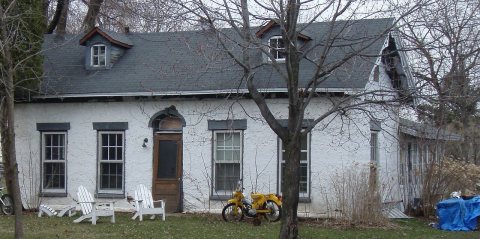
Lakeland was platted in 1849. The 1849 Captain John Oliver House, 1850 Mitchell Jackson Farmhouse, and 1858 John T. Cyphers House are listed on the National Register of Historic Places.
Passages that mention Lakeland, cut from the printed page as they were published.
History of Washington County and the St. Croix Valley Including the Explorers and Pioneers of Minnesota1881 · page 415Read the page →
Read the text
The town of Lakeland was organized October 20th, 1858. The election of officers for the gov¬ ernment of the same, was held at the school-house, in the village of Lakeland, on the same date, with the following result: R. H. Sanderson was chosen chairman of the meeting; Daniel T. Watson, moderator; A. L. Dallard, clerk. The judges of election were D. T. Watson and A. L. Ballard.
Text read by machine from the scan; it may contain errors.
History of Washington County and the St. Croix Valley Including the Explorers and Pioneers of Minnesota1881 · page 399Read the page →
Read the text
Croix river. In the spring of 1858, when the commissioners were appointed for the organizing and naming of the towns, were adjusting the boundaries, the township of Lakeland insisted on having Bolle's creek for the southern boundary of their town. To this proposition, Afton ob¬ jected; but at last a compromise was effected and the difficulty adjusted by setting off to Lakeland,
Text read by machine from the scan; it may contain errors.
History of Washington County and the St. Croix Valley1881 · page 416Read the page →
Read the text
A special meeting of the voters of the town of Lakeland was called August 31st, 1880, and the following resolution was adopted: "Eesolved, That, whereas the Stillwater and Hastings Railroad Company has complied with the requirements of the law in regard to their petition for the construction of said railroad; that the chairman of the board, and the town clerk,
Text read by machine from the scan; it may contain errors.
Scans and text from the Internet Archive. Books published in 1930 or earlier, which are in the public domain.
By decade
Lakeland, decade by decade
One decade in the archive so far: the 1880s. Scroll each row; tap a photo for its story.
Nothing in the archives for these yearsWeddings on Main Street, storms, parades, school pictures, the old store. If it’s in your family album, it belongs here.
In 1849, according to Wikipedia’s history of the town. Lakeland’s post office opened in 1854, and the census of 1880 counted 303 people here.
How does Lakeland rank for history?
Lakeland is more historic than 81% of U.S. towns. The History grade combines the town’s founding era, the share of homes built before 1940 and its National Register listings. It’s a character grade, so it isn’t part of the overall grade. How it works.
What is on the National Register in Lakeland?
Three places: the John T. Chyphers House (listed 1971), the Capt. John Oliver House (1977) and the Jackson, Mitchell, Farmhouse (1982).
How old are the homes in Lakeland?
15% of Lakeland’s homes were built before 1940 (Census estimate, ±7.1 points), against a typical 8.1% for a Minnesota town; the median home was built in 1976.
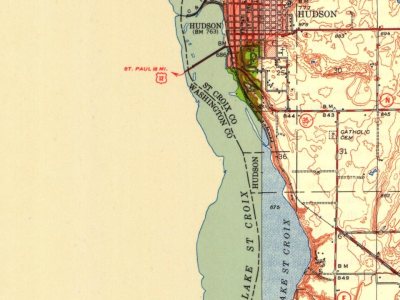
Founding dates: Wikidata, Wikipedia, the U.S. post office records of Blevins & Helbock (CC0) and the Census. Homes by year built: Census ACS 2020–24. National Register of Historic Places: National Park Service (list of May 22, 2026). Old photos, postcards and papers: Wikimedia Commons, the Library of Congress and other public archives, credited on each item’s page. Maps: U.S. Geological Survey historical topographic maps (via Esri) and Sanborn fire-insurance maps (Library of Congress). History text and census tables: Wikipedia (CC BY-SA 4.0). Places that used to be: USGS Geographic Names Information System (2021).
From Wikimedia Commons (6), Wikidata (3), the National Register of Historic Places (3), Wikipedia, U.S. Geological Survey historical maps, U.S. Census counts (via Wikipedia), the US Post Offices dataset (Blevins & Helbock), the USGS Geographic Names Information System and old county and town histories (Internet Archive). Archive images are copied here with their credits and licenses, shown on each photo’s page. Refreshed monthly.




 2013
 2012
 2008
 2008
 2008


