Afton dates to 1855, and 17% of its homes were built before 1940
More historic than 62% of U.S. towns · #69 of 273 in Minnesota. What drives it
Its Register listings are the Erastus Bolles House, the Newington Gilbert House and the Cushing Hotel. Below: 3 old photos and papers, maps from 1946 on, and the census since 1880.
Founding year: Wikidata; Wikipedia’s history section gives the same year. First post office: 1857.The full story ↓
History grade
What drives Afton’s History grade
On its age, its old homes and the National Register, Afton is more historic than 62% of U.S. towns, #69 of 273 in Minnesota. Its National Register listings hold the grade up; its age pulls it down.
B
HistoryA character grade: shown, never part of Afton’s overall grade.
Minnesota towns list about as much on the Register as the country (a typical Minnesota town has 2.1 per 10,000 residents, the U.S. 2.4), so Afton’s 10.1 sits above most of its state (76% of Minnesota towns have fewer) while its 3 listings outnumber those of 65% of U.S. towns.
How sure. Graded on any two of the three inputs instead, the letter would range from B− to B+. The pre-1940 share is a Census survey estimate (±6.6 points). Two sources give 1855.
Founding year: Wikidata (other dates in Quick answers). Homes: Census ACS 2020–24. National Register: National Park Service, May 2026 list; each listing counted once (boundary changes and added documentation belong to their listing), and a historic district counts its contributing buildings. How TownRatings grades history →
What stands out about Afton’s past
Read from the archive, the National Register and the record. The page puts what stands out first.
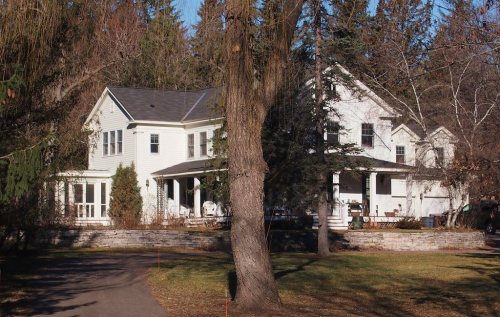
The first settlers in the area arrived in 1837. The settlement of Afton was platted in 1855, with the name chosen from a poem (Sweet Afton) by Robert Burns. A post office has been in operation at Afton since 1857. The city contains three properties listed on the National Register of Historic Places: the 1856 Erastus Bolles House, the 1864 Newington Gilbert House, and the 1867 Cushing Hotel.
Passages that mention Afton, cut from the printed page as they were published.
History of Washington County and the St. Croix Valley1881 · page 400Read the page →
Read the text
A meeting of the legal voters of the town of Afton was called at Paterson's hotel, in the vilage of Afton, October 20th, 1868, W, H. Getchell was chosen chairman, Joseph Haskell elected moderator, and Richard Buswell clerk. On motion, the meeting was adjourned to the schoolhouse, and elected Joseph Haskell, G. W. Cutler and H. L. Thomas, supervisors; M. H. Thomas,
Text read by machine from the scan; it may contain errors.
History of Washington County and the St. Croix Valley Including the Explorers and Pioneers of Minnesota1881 · page 400Read the page →
Read the text
A meeting of the legal voters of the town of Afton was called at Paterson’s hotel, in the vilage of Afton, October 20th, 1858, W, II. Getchell was chosen chairman, Joseph Haskell elected moderator, and Richard Buswell clerk. On mo¬ tion, the meeting was adjourned to the schoolhouse, and elected Joseph Haskell, G. W. Cutler and II. L. Thomas, supervisors; M. II. Thomas,
Text read by machine from the scan; it may contain errors.
History of Washington County and the St. Croix Valley1881 · page 402Read the page →
Read the text
The village of Afton is located on section 22, on the right bank of Lake St. Croix. It was laid out and platted by R. Haskell, Joseph Haskell, H. L. Thomas and C. S. Getchell, in May.
Text read by machine from the scan; it may contain errors.
History of Washington County and the St. Croix Valley Including the Explorers and Pioneers of Minnesota1881 · page 402Read the page →
Read the text
The village of Afton is located on section 22, on the right bank of Lake St. Croix. It was laid out and platted by It. Haskell, Joseph Has¬ kell, II. L. Thomas and C. S. Getchell, in May, 1855. It has a main street passing from north to south, with short streets extending up the sides of the bluffs. At the head of Main street stands the St. Croix Valley Academy, while in the cen¬
Text read by machine from the scan; it may contain errors.
Scans and text from the Internet Archive. Books published in 1930 or earlier, which are in the public domain.
Timeline
Afton, 1855 to 1946
Woven from the archive, old maps, post office records, the National Register and the people born here.
Nothing in the archives for these yearsWeddings on Main Street, storms, parades, school pictures, the old store. If it’s in your family album, it belongs here.
In 1855, according to Wikidata and Wikipedia’s history of the town. Afton’s post office opened in 1857, and the census of 1880 counted 130 people here.
How does Afton rank for history?
Afton is more historic than 62% of U.S. towns, #69 of 273 in Minnesota. The History grade combines the town’s founding era, the share of homes built before 1940 and its National Register listings. It’s a character grade, so it isn’t part of the overall grade. How it works.
What is on the National Register in Afton?
Three places: the Erastus Bolles House (listed 1982), the Newington Gilbert House (1982) and the Cushing Hotel (1985).
How old are the homes in Afton?
17% of Afton’s homes were built before 1940 (Census estimate, ±6.6 points), against a typical 8.1% for a Minnesota town; the median home was built in 1979.
Founding dates: Wikidata, Wikipedia, the U.S. post office records of Blevins & Helbock (CC0) and the Census. Homes by year built: Census ACS 2020–24. National Register of Historic Places: National Park Service (list of May 22, 2026). Old photos, postcards and papers: Wikimedia Commons, the Library of Congress and other public archives, credited on each item’s page. Maps: U.S. Geological Survey historical topographic maps (via Esri) and Sanborn fire-insurance maps (Library of Congress). History text and census tables: Wikipedia (CC BY-SA 4.0). Places that used to be: USGS Geographic Names Information System (2021).
From Wikimedia Commons (11), the Library of Congress (2), Wikidata (3), the National Register of Historic Places (3), Wikipedia, U.S. Geological Survey historical maps, U.S. Census counts (via Wikipedia), the US Post Offices dataset (Blevins & Helbock), the USGS Geographic Names Information System and old county and town histories (Internet Archive). Archive images are copied here with their credits and licenses, shown on each photo’s page. Refreshed monthly.




 Date?
 Date?
 2015
 2015
 2015
 2015
 2012
 2012
 2008
 2008
 2008
 2008

