Greenfield’s post office opened in 1833, and 6 of its places are on the National Register
More historic than 83% of U.S. towns · #199 of 593 in Indiana. What drives it
Most of Greenfield was built recently: 9% of its homes predate 1940 and the median home dates from 1995. 6 places in town are on the National Register, among them two historic districts with 595 buildings between them. Below: 12 old photos and papers, maps from 1886 on, and the census since 1850.
The Greenfield post office opened in 1833, the earliest record of the town by name. Another post office, Hancock (1829), opened inside today’s city and later closed.
First census: 420 in 18502020 census: 23,488193 years
How historic is Greenfield?
A−
More historic than 83% of U.S. towns, on its age, its old homes and the National Register.
Founding year: the first Greenfield post office (Blevins & Helbock, CC0).The full story ↓
History grade
What drives Greenfield’s History grade
On its age, its old homes and the National Register, Greenfield is more historic than 83% of U.S. towns, #199 of 593 in Indiana. Its National Register listings hold the grade up; its share of homes from before 1940 pulls it down.
A−
HistoryA character grade: shown, never part of Greenfield’s overall grade.
Indiana towns list more on the Register than most of the country (a typical Indiana town has 7.9 per 10,000 residents, the U.S. 2.4), so Greenfield’s 241 sits above most of its state (89% of Indiana towns have fewer) while its 602 historic buildings outnumber those of 98% of U.S. towns.
How sure. Graded on any two of the three inputs instead, the letter would range from B to A. The pre-1940 share (±2.9 points) is firm at this size. The founding year is the first post office, not a stated founding date.
Founding year: the first post office (other dates in Quick answers). Homes: Census ACS 2020–24. National Register: National Park Service, May 2026 list; each listing counted once (boundary changes and added documentation belong to their listing), and a historic district counts its contributing buildings. How TownRatings grades history →
What stands out about Greenfield’s past
Read from the archive, the National Register and the record. The page puts what stands out first.
National Park Service, National Register of Historic Places. Photos from Wikimedia Commons, credited on each place’s page.
Every building
Greenfield, building by building, 1886–1914
Fire insurance maps drew every building, what it was made of and what it was used for, so insurers could price the risk of fire. Pick a year, then a sheet.
Nothing in the archives for these yearsWeddings on Main Street, storms, parades, school pictures, the old store. If it’s in your family album, it belongs here.
Hancock County was created on March 1, 1828, and named for John Hancock, the first person to sign the Declaration of Independence. The town of Greenfield was chosen as the county seat on April 11, 1828. The Commissioners announced, "The seat of Justice of Hancock County shall be known and designated by the name and title of Greenfield." The population of the county at that time was 400.
Early settlers built along the two creeks which flow south through Center Township, which includes Greenfield. The first businesses were small gristmills for grinding corn and wheat for settlers.
Passages that mention Greenfield, cut from the printed page as they were published.
History of Hancock County, Indiana1916 · page 579Read the page →
Read the text
The first school houses in Center township were probably located within the present site of the city of Greenfield and are discussed in connection with the local history of Greenfield. The Independence school house has the honor of having been the meeting place for the organization of the first county teachers' association, on February 16, i860. The proceedings of that day, with the first constitution adopted by the teachers of the county, are fully set out in the chapter on education. In a notice that appeared in the local papers at that time the
Text read by machine from the scan; it may contain errors.
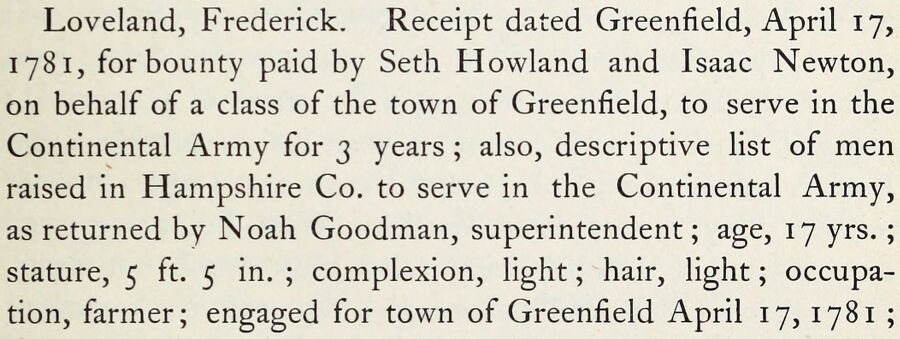
Loveland, Frederick. Receipt dated Greenfield, April 17, 1 78 1, for bounty paid by Seth Rowland and Isaac Newton, on behalf of a class of the town of Greenfield, to serve in the Continental Army for 3 years ; also, descriptive list of men raised in Hampshire Co. to serve in the Continental Army, as returned by Noah Goodman, superintendent ; age, 17 yrs. ; stature, 5 ft. 5 in. ; complexion, light ; hair, light ; occupation, farmer; engaged for town of Greenfield April 17, 1781 ;
Text read by machine from the scan; it may contain errors.
Willard's history of Greenfield1838 · page 24Read the page →
Read the text
Mill. — " The town of Greenfield doe hereby grant unto sd J ona. Wells and to his heirs ye stream aforesaid so long as they shall maintain a corn mill upon it to doe ye towns work, notwithstanding ye town doth reserve to themselves a liberty to set a saw mill upon ye same stream provided workmen of ye occupation together wt a committee chosen by the town for ye purpose doe judge yt a saw mill may bee built there without any con-
Text read by machine from the scan; it may contain errors.
of the town of Greenfield, to serve in the Continental Army for the term of 3 years ; also descriptive list of men raised in Hampshire Co. to serve in the Continental Army, as returned by Noah Goodman, superintendent ; age, 24 yrs. ; stature, 5 ft.
Text read by machine from the scan; it may contain errors.
Scans and text from the Internet Archive. Books published in 1930 or earlier, which are in the public domain.
Timeline
Greenfield, 1829 to 1956
Woven from the archive, old maps, post office records, the National Register and the people born here.
The Greenfield post office opened in 1833, the earliest record of the town by name (U.S. post office records).
How does Greenfield rank for history?
Greenfield is more historic than 83% of U.S. towns, #199 of 593 in Indiana. The History grade combines the town’s founding era, the share of homes built before 1940 and its National Register listings. It’s a character grade, so it isn’t part of the overall grade. How it works.
What is on the National Register in Greenfield?
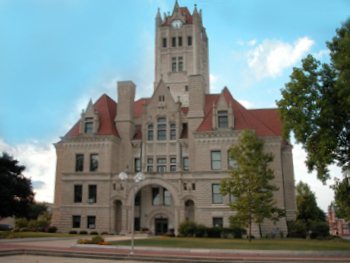
6 listings: 4 buildings, among them the James Whitcomb Riley House (listed 1977, the first), and 2 historic districts, the Greenfield Courthouse Square Historic District and the Greenfield Residential Historic District, with 595 contributing buildings. 602 historic buildings in all.
How old are the homes in Greenfield?
9% of Greenfield’s homes were built before 1940 (Census estimate, ±2.9 points), against a typical 14% for an Indiana town; the median home was built in 1995.
Founding dates: Wikidata, Wikipedia, the U.S. post office records of Blevins & Helbock (CC0) and the Census. Homes by year built: Census ACS 2020–24. National Register of Historic Places: National Park Service (list of May 22, 2026). Old photos, postcards and papers: Wikimedia Commons, the Library of Congress and other public archives, credited on each item’s page. Maps: U.S. Geological Survey historical topographic maps (via Esri) and Sanborn fire-insurance maps (Library of Congress). History text and census tables: Wikipedia (CC BY-SA 4.0). Places that used to be: USGS Geographic Names Information System (2021).
From Wikimedia Commons (14), the Library of Congress (3), Wikidata (1), the National Register of Historic Places (6), Wikipedia, Wikidata and Wikipedia for famous people, U.S. Geological Survey historical maps, U.S. Census counts (via Wikipedia), the US Post Offices dataset (Blevins & Helbock), the USGS Geographic Names Information System, Sanborn fire insurance maps (Library of Congress) and old county and town histories (Internet Archive). Archive images are copied here with their credits and licenses, shown on each photo’s page. Refreshed monthly.





 1905
 1918
 1925
 1925
 1925
 c. 1930
 c. 1930
 c. 1930
 c. 1930
 c. 1930
 c. 1930
 c. 1930
 2012
 2011
 2011
 2011
 2009