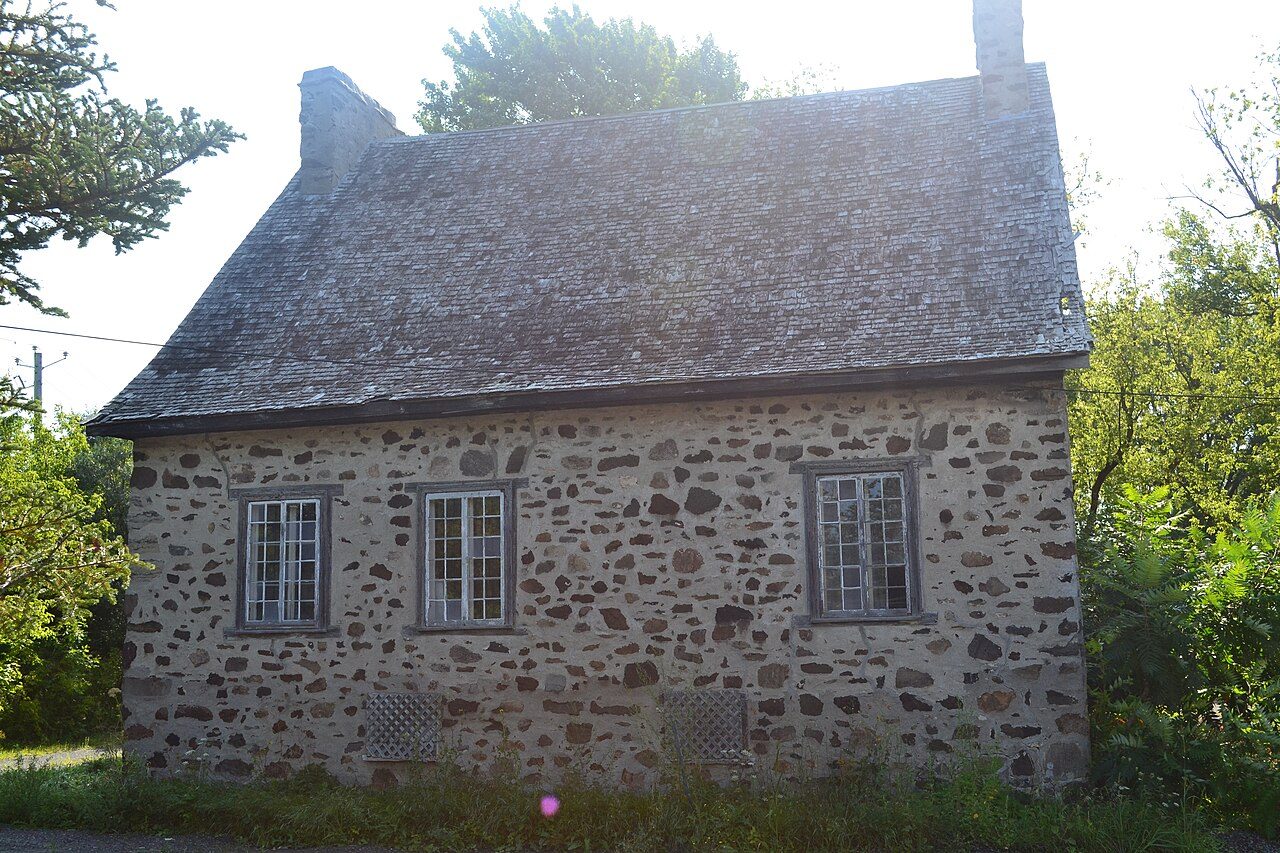
Maison de Saint-Hubert · Photo: Cantons-de-l'Est · CC BY-SA 4.0
4historic places on the registers
History of Carignan · Canada’s heritage registers
History in Carignan goes back to 1665: Fort Ste. Thérèse
On the registers Carignan counts 4 historic places, 3 at the top. Its 3.2 per 10,000 residents puts it ahead of 90% of Canadian towns. The list takes in a Recognized Federal Heritage Building. Homes from before 1961 are 9.8% of the stock, under the 18% of the typical town.
The set includes 2 of Carignan’s highest-designated places. Of the places on Carignan’s registers, 3 have a photo here. Two to begin with: Maison de Saint-Hubert and Maison Louis-Degneau.
Photos from Wikimedia Commons, each credited to its photographer with its licence; names open the place’s page. Tap a photo to step through them full screen.
How it began
Milestones of Carignan since 1855
A single date stands for Carignan as a municipality on Wikidata, July 1, 1855, and it may be an incorporation rather than a founding. The name Carignan comes from Carignano, italian comune. Saint-Joseph de Chambly was the name of Carignan until 1965.
Every place on the registers inside the town, by its designation.
Highest designationsOther federal designations
Each dot is a place: point at it for the name, tap it for its page.
The 4, by tier
3 Highest designations1 Other federal designations
In Québec the record is fuller than elsewhere: beside Parks Canada’s designations, the province’s register lists its classements and every municipal citation.
Points from Wikidata (Parks Canada’s files carry none) and from Québec’s register, as mapped there. One place, placed by its register’s municipality, has no point and isn’t on the map.
Highest designations
3 places in Carignan with the highest designation
They date from 1665 (Fort Ste. Thérèse) to 1790. By designation: 2 places classified by Québec and a National Historic Site. National Historic Sites and Classified Federal Heritage Buildings, Canada’s highest federal recognition. Each one opens its own page.
Carignan is still building: 22% of homes date from 2016 to 2021, against 4.1%
Homes built from 2001 to 2015 make up 33% of Carignan’s, against 15% in the typical town. Only 18% of Carignan’s homes were built from 1961 to 1980, less than the typical town’s 27%. Carignan built little from 1981 to 2000: 17% of its homes, where most towns have 23%.
9.8%
Before 1961
18%
1961–80
17%
1981–2000
33%
2001–15
22%
2016–21
CarignanTypical town
2021 Census, private dwellings by period of construction (Statistics Canada); the typical town is the middle Canadian town of 2,500 or more.
Towns its size
Carignan has the most of 16 towns its size
Towns of 12,500 to 12,700 residents, by places on the registers.
All told, Carignan has 4 historic places, 3 with the highest designation; Fort Ste. Thérèse heads the list. Among the 16 towns nearest its size, none has more historic places. Its housing is young: only 9.8% predates 1961, against 18% in the typical town. Everything else is close to the norm: its places were designated between 1923 and 1997.
How to read these numbers
What this data can and can’t tell you
•
The grade. This page gives no grade; history doesn’t count toward a Canadian town’s letter.
•
People and events. Parks Canada’s open file gives its national historic persons no place. A town’s page names one only when the person was born there (matched by name and both life years) or one of its own historic places carries the name and its record speaks of them; national historic events stay off.
•
Québec’s register. Québec is the one province whose register is open: classements, declarations and municipal citations, described by the ministry in French.
•
The federal register. Every federal designation is in Parks Canada’s directory, and the Canadian Register of Historic Places gives most of them a bilingual statement of significance.
•
The tiers. The highest designations are National Historic Sites, Classified Federal Heritage Buildings and Québec’s classements; then come the other federal designations; then provincial and local listings.
•
Map points. Where a federal place sits on the map is Wikidata’s placing; the directory itself has no coordinates.
•
Protection. A place classified or cited under Québec’s law is protected; National Historic Site status alone protects only what the federal government owns.
Questions about Carignan’s history
What is the oldest building in Carignan?
Fort Ste. Thérèse (National Historic Site): the first construction date on its record is 1665.
Which places in Carignan have the highest designation?
Fort Ste. Thérèse, Maison de Saint-Hubert and Maison Louis-Degneau.
How old are the homes in Carignan?
9.8% of its homes were built before 1961, against 18% in the typical Canadian town.
Contains information licensed under the Open Government Licence – Canada (Parks Canada). Québec register data: Ministère de la Culture et des Communications du Québec, CC BY 4.0.
Sources: Parks Canada, Directory of Federal Heritage Designations · Canadian Register of Historic Places (federal extract) · Répertoire du patrimoine culturel du Québec (MCC, Données Québec) · Wikidata (CC0) for map points, other names and articles · Statistics Canada, 2021 Census (homes by period of construction). Under the Statistics Canada Open Licence.


 Top
 Top
 Fed