 Top
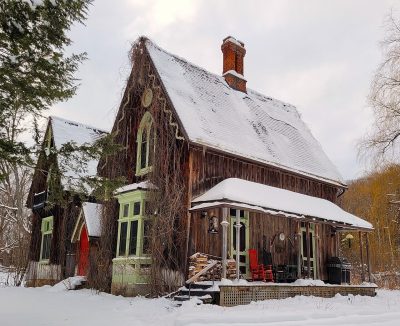
National Historic Site · 1871–1872Claverleigh8242 Regional Road #9Photo: Mhsheikholeslami · CC BY-SA 4.0 · Commons file
 Claverleigh · Photo: Mhsheikholeslami · CC BY-SA 4.0
1historic place on the registers
History of Stayner · Canada’s heritage registers
Stayner’s 1 historic place is a top designation
In Stayner that place is Claverleigh, a national historic site, from 1871. Stayner has 0.6 for every 10,000 people, a higher rate than 75% of Canadian towns.
Historic places
1
0.6 per 10,000 residents
Highest designations
1
National Historic Sites and Classified Federal Heritage Buildings
Oldest building
1871
the first construction date on its record
Homes built before 1961
27%
typical town: 18%
The map
Where Stayner’s history is
Every place on the registers inside the town, by its designation.
Highest designations
Dots open their places’ pages; hover first to read the name.
The 1, by tier
1 Highest designations
What the map shows is the open record: the federal directory in full, and from provincial or municipal lists only the places Wikidata ties to an encyclopedia article.
Points from Wikidata (Parks Canada’s files carry none) and from Québec’s register, as mapped there.
Highest designations
One place in Stayner with the highest designation
National Historic Sites and Classified Federal Heritage Buildings, Canada’s highest federal recognition. Each one opens its own page.
Around the town
5 designated places lie within 25 km of Stayner
They stand in 3 towns, Collingwood, Springwater and Angus among them. Collingwood Downtown Heritage Conservation District in Collingwood is the nearest, 13 km away. The record reaches back to 1814 with Glengarry Landing, 16 km away.
The 5 nearest, within 25 km
| Collingwood Downtown Heritage Conservation DistrictHeritage conservation district · 13 km away, in Collingwood |
| Federal BuildingClassified Federal Heritage Building · 1913–1916 · 13 km away, in Collingwood |
| Glengarry LandingNational Historic Site · 1814 · 16 km away, in Springwater |
| LighttowerClassified Federal Heritage Building · 1857–1859 · 18 km away, in Collingwood |
| Royal Flying Corps HangarsNational Historic Site · 1917–1918 · 24 km away, in Angus |
Homes by age
Stayner keeps more old homes than most towns: 27% from before 1961, against 18%
From 2016 on, Stayner built 6.6% of its homes; the typical town built 4.1%. More of Stayner’s homes were built from 1981 to 2000 than in any other period: 29%. Half of the homes standing in Stayner today were built before 1981.
27%
Before 1961
24%
1961–80
29%
1981–2000
14%
2001–15
6.6%
2016–21
StaynerTypical town
2021 Census, private dwellings by period of construction (Statistics Canada); the typical town is the middle Canadian town of 2,500 or more.
Born here
6 lives that began in Stayner before 1914
Best known is William Herbert Burns, with articles in 7 Wikipedia languages. Vern Turner closes the list, born in 1895. It starts with John McEachern, born in 1872. Longest lived was Angus Daniel Campbell, 92 years in all (1976).
John McEachern
William Herbert Burns
Archibald M. Carmichael
Angus Daniel Campbell
Merrill Samuel Taylor
Vern Turner
18501875190019251950
WB
William Herbert Burns1878–1964 · Canadian politician and curler

Angus Daniel Campbell1884–1976 · Canadian ice hockey player
MT
Merrill Samuel Taylor1893–1918 · Canadian aviator
AC
Archibald M. Carmichael1882–1959 · Canadian politician
JM
John McEachern1872–1947 · Canadian surgeon

Vern Turner1895–1960 · American ice hockey coach and player
Everyone born in Stayner → Born before 1914 (the page’s periods: Confederation to the First World War). Birthplaces from Wikidata, each checked against the person’s Wikipedia article.
Towns its size
Stayner has the 4th most of 16 towns its size
Towns of 16,400 to 16,800 residents, by places on the registers.
Stayner1
Just these have more: Leduc County, Côte-Saint-Paul and Parc-Lafontaine. The typical town its size has 0. For 10, the registers list nothing.
Neighbours
Stayner and its neighbours
| Town | People | Places | Highest | Oldest |
|---|---|---|---|---|
| Stayner | 16,571 | 1 | 1 | 1871 |
| Wasaga Beach | 28,736 | 0 | 0 | — |
| Collingwood | 28,366 | 3 | 2 | 1857 |
In brief
Stayner in brief
Of the homes standing in Stayner, 27% went up before 1961, against 18% in the typical town. The lists come to 1 historic place, one with the highest designation, including Claverleigh. Of the 16 towns closest in size, just 3 have more historic places. William Herbert Burns (1878), Angus Daniel Campbell (1884) and Merrill Samuel Taylor (1893) are the best known of its historic lives. For the rest, its designation dates from 1990.
How to read these numbers
What this data can and can’t tell you
- The tiers. Three tiers: the top for National Historic Sites, classified federal buildings and Québec’s classements, a second for the other federal designations, a third for provincial and municipal listings.
- The grade. History is described, not graded, for every Canadian town.
- Map points. Parks Canada publishes no coordinates, so federal places are pinned where Wikidata puts them.
- People and events. Persons of national historic significance come with no location; a town gets one only by birthplace (name and both life years agreeing) or by one of its own places that bears the name and whose record tells the story. Events, which can’t be tied, are left out.
- Protection. A National Historic Site designation recognises significance; it doesn’t by itself protect a building the federal government doesn’t own. Legal protection comes from provincial and municipal designations, whose own registers aren’t open data outside Québec.
- The federal register. Federal places come from Parks Canada’s directory, which counts National Historic Sites, federal heritage buildings, stations and lighthouses; their statements are the register’s own.
- Provincial and municipal lists. Only Wikidata gives open access to listings on provincial and municipal registers outside Québec; without an article such a place is counted but not paged.
Questions about Stayner’s history
Which places in Stayner have the highest designation?
Claverleigh.
What is the oldest building in Stayner?
By its record, Claverleigh, from 1871 (National Historic Site).
How old are the homes in Stayner?
The 2021 Census dates 27% of its homes before 1961 (18% in the typical town).
Contains information licensed under the Open Government Licence – Canada (Parks Canada).
Sources: Parks Canada, Directory of Federal Heritage Designations · Canadian Register of Historic Places (federal extract) · Wikidata (CC0) for map points, other names and articles · Statistics Canada, 2021 Census (homes by period of construction). Under the Statistics Canada Open Licence.
Adapted from Statistics Canada (Census of Population 2021, population estimates 2025, 2021 census boundaries) under the Statistics Canada Open Licence; this does not constitute an endorsement by Statistics Canada. Neighbourhood names in some cities © OpenStreetMap contributors (ODbL).