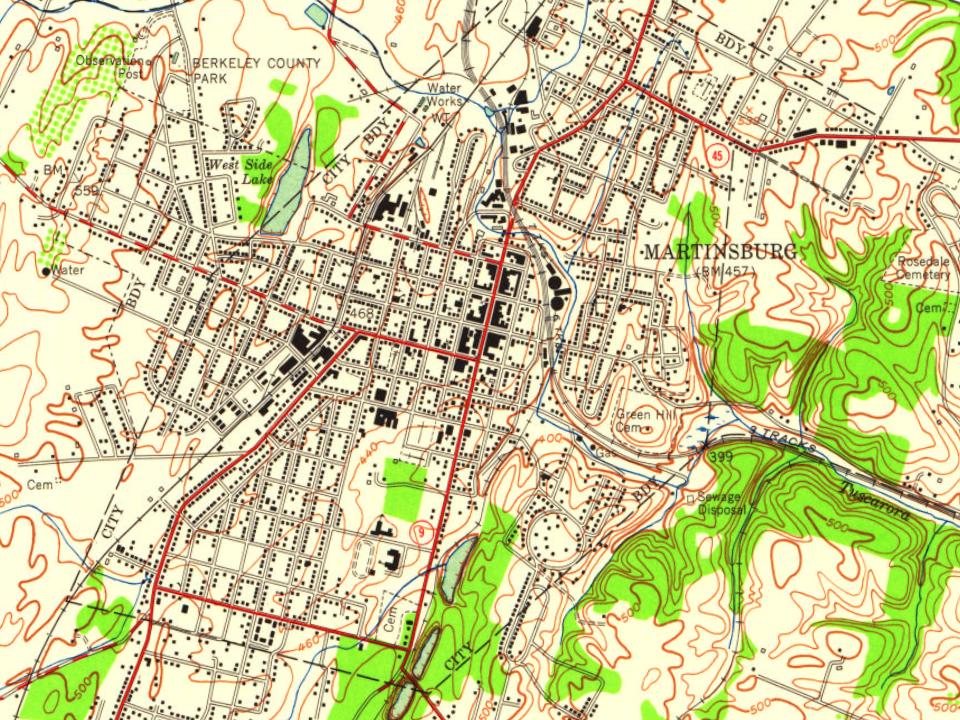
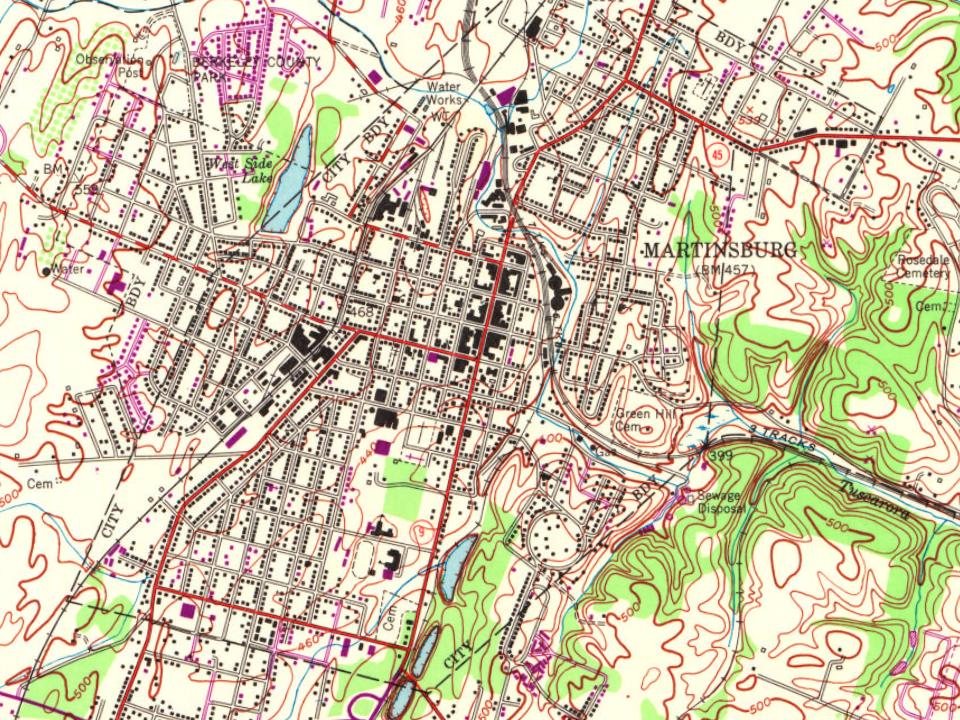
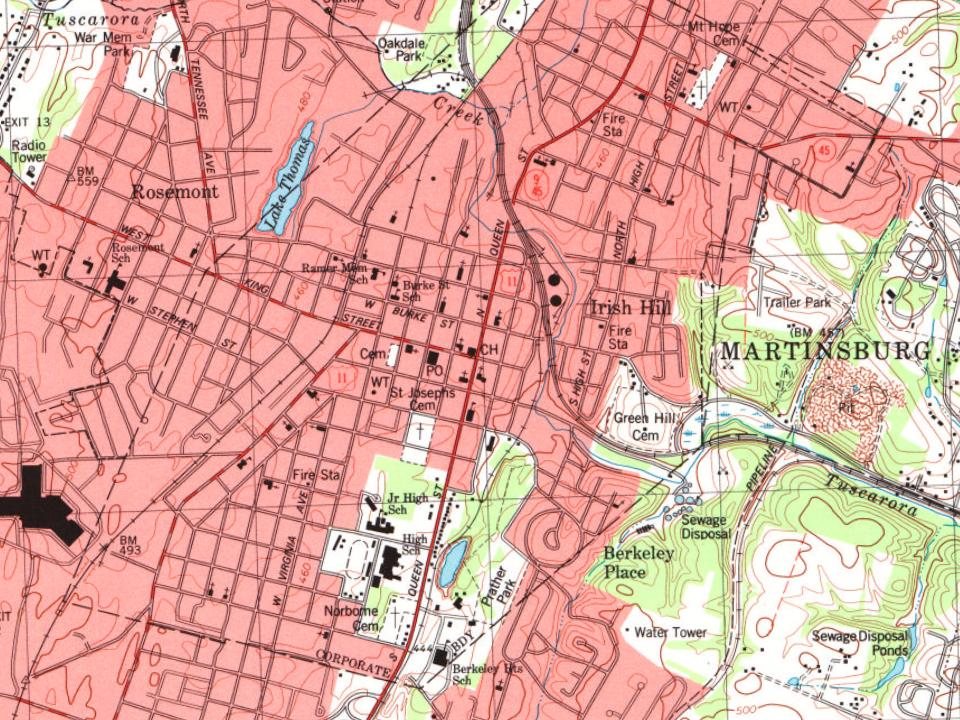
Martinsburg dates to 1778, and 23% of its homes were built before 1940
More historic than 93% of U.S. towns · #10 of 61 in West Virginia. What drives it
29 places in town are on the National Register, among them the Baltimore and Ohio Railroad Martinsburg Shops, a National Historic Landmark, and ten historic districts with 1,426 buildings between them. Below: 13 old photos and papers, maps from 1885 on, and the census since 1850.
Founding year: Wikidata; Wikipedia’s history section gives the same year. First post office: 1792.The full story ↓
History grade
What drives Martinsburg’s History grade
On its age, its old homes and the National Register, Martinsburg is more historic than 93% of U.S. towns, #10 of 61 in West Virginia. All 3 inputs are above most U.S. towns; its National Register listings ranks highest and its share of homes from before 1940 lowest.
A
HistoryA character grade: shown, never part of Martinsburg’s overall grade.
West Virginia towns list more on the Register than most of the country (a typical West Virginia town has 29.6 per 10,000 residents, the U.S. 2.4), so Martinsburg’s 772 sits above most of its state (89% of West Virginia towns have fewer) while its 1,459 historic buildings outnumber those of 99% of U.S. towns.
How sure. Graded on any two of the three inputs instead, the letter would range from A− to A. The pre-1940 share is a Census survey estimate (±4.8 points). Two sources give 1778.
Founding year: Wikidata (other dates in Quick answers). Homes: Census ACS 2020–24. National Register: National Park Service, May 2026 list; each listing counted once (boundary changes and added documentation belong to their listing), and a historic district counts its contributing buildings. How TownRatings grades history →
What stands out about Martinsburg’s past
Read from the archive, the National Register and the record. The page puts what stands out first.
The country’s official list of buildings and places worth saving. One is a National Historic Landmark, the highest tier. Boundary changes and added documentation are counted with their listing.
National Park Service, National Register of Historic Places. Photos from Wikimedia Commons, credited on each place’s page.
Every building
Martinsburg, building by building, 1885–1922
Fire insurance maps drew every building, what it was made of and what it was used for, so insurers could price the risk of fire. Pick a year, then a sheet.
Martinsburg was established by an act of the Virginia General Assembly that was adopted in December 1778 during the American Revolutionary War. Founder Major General Adam Stephen named the gateway town to the Shenandoah Valley along Tuscarora Creek in honor of Colonel Thomas Bryan Martin, a nephew of Thomas Fairfax, 6th Lord Fairfax of Cameron.
Passages that mention Martinsburg, cut from the printed page as they were published.
Aler's history of Martinsburg and Berkeley County, West Virginia1888 · page 377Read the page →
Read the text
The town of Martinsburg is contained within the following boundaries, to wit : Beginning on the middle of the county bridge crossing the Baltimore and Ohio Railroad, south of Green Hill Cemetery and corner to Martinsburg, Arden and Opequou districts ; thence with the line of Opequon north 11^ degrees east, 66 poles to a stake at the angle of the fence and in an original line between the land of Ezra Herring and the lot of C. Henry;
Text read by machine from the scan; it may contain errors.
Aler's history of Martinsburg and Berkeley County, West Virginia1888 · page 242Read the page →
Read the text
This company was organized in October, 1861, at Martinsburg, princix)ally of* Berkeley County men, with a number from the surrounding counties. It was first stationed at Martinsburg, and acted on x)icket duty along the border, where it remained until about February 24th, 1862. From here they proceeded to and around Winchester, and afterward fell back up the valley. They next went to Strausburg and Woodstock, afterwards
Text read by machine from the scan; it may contain errors.
Scans and text from the Internet Archive. Books published in 1930 or earlier, which are in the public domain.
Timeline
Martinsburg, 1778 to 2003
Woven from the archive, old maps, post office records, the National Register and the people born here.
Nothing in the archives for these yearsWeddings on Main Street, storms, parades, school pictures, the old store. If it’s in your family album, it belongs here.
Martinsburg’s post office has been open since 1792.
Hamlets and corners on the map
Adam Stephen HomesBerkeley PlaceBoydvilleIrish HillRosemont
Gone or out of use
Adam Stephen MilllocaleBerkeley County JailbuildingHigh Street Public SchoolschoolHooge Street Public SchoolschoolJohn Street Public SchoolschoolKings Daughters HospitalhospitalMartinsburg AcademyschoolRamer Center SchoolschoolRamer Memorial Schoolschool
6cemeteries and burying grounds inside Martinsburg
German Lutheran ReformedGreen HillMount HopeNorborneOld NorbourneSaint Josephs
US Post Offices dataset (Blevins & Helbock, CC0). Places and cemeteries from the USGS Geographic Names Information System (2021).
Help out
Finish Martinsburg’s story
Most archives stop around 1920. The photos from after that are in family albums, not libraries.
Decades since 1900 with photos
00s10s20s30s40s50s60s70s80s90s
3 of 10 decades. The empty ones are waiting for someone’s album.
In 1778, according to Wikidata and Wikipedia’s history of the town. Martinsburg’s post office opened in 1792, and the census of 1850 counted 2,190 people here.
How does Martinsburg rank for history?
Martinsburg is more historic than 93% of U.S. towns, #10 of 61 in West Virginia. The History grade combines the town’s founding era, the share of homes built before 1940 and its National Register listings. It’s a character grade, so it isn’t part of the overall grade. How it works.
What is on the National Register in Martinsburg?
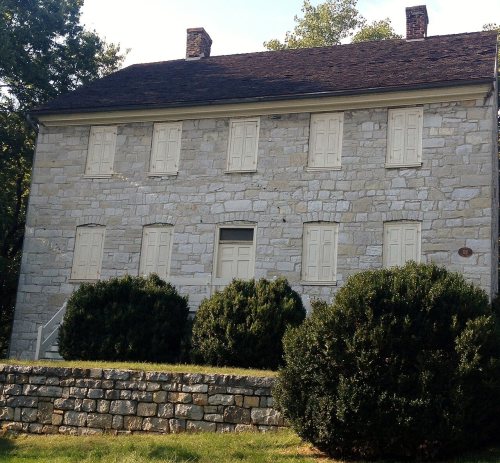
29 listings: 15 buildings, among them the Baltimore and Ohio Railroad Martinsburg Shops (a National Historic Landmark since 2003) and the Adam Stephen House (listed 1970, the first), 13 historic districts with 1,426 contributing buildings, and 1 structure. 1,459 historic buildings in all.
How old are the homes in Martinsburg?
23% of Martinsburg’s homes were built before 1940 (Census estimate, ±4.8 points), against a typical 13% for a West Virginia town; the median home was built in 1969.
Founding dates: Wikidata, Wikipedia, the U.S. post office records of Blevins & Helbock (CC0) and the Census. Homes by year built: Census ACS 2020–24. National Register of Historic Places: National Park Service (list of May 22, 2026). Old photos, postcards and papers: Wikimedia Commons, the Library of Congress and other public archives, credited on each item’s page. Maps: U.S. Geological Survey historical topographic maps (via Esri) and Sanborn fire-insurance maps (Library of Congress). History text and census tables: Wikipedia (CC BY-SA 4.0). Places that used to be: USGS Geographic Names Information System (2021).
From Wikimedia Commons (18), the Library of Congress (3), Wikidata (2), the National Register of Historic Places (29), Wikipedia, Wikidata and Wikipedia for famous people, U.S. Geological Survey historical maps, U.S. Census counts (via Wikipedia), the US Post Offices dataset (Blevins & Helbock), the USGS Geographic Names Information System, Sanborn fire insurance maps (Library of Congress) and old county and town histories (Internet Archive). Archive images are copied here with their credits and licenses, shown on each photo’s page. Refreshed monthly.




 1864
 1892
 1902
 1902
 1902
 1917
 1930–1945
 2011
 2011
 2011
 2009
 2009
 2007
 2004
 2004