Founding year: Wikidata. First post office: 1847.The full story ↓
History grade
What drives Oconomowoc’s History grade
On its age, its old homes and the National Register, Oconomowoc is more historic than 78% of U.S. towns, #95 of 362 in Wisconsin. All 3 inputs are above most U.S. towns; its age ranks highest and its share of homes from before 1940 lowest.
A−
HistoryA character grade: shown, never part of Oconomowoc’s overall grade.
Wisconsin towns list more on the Register than most of the country (a typical Wisconsin town has 3.0 per 10,000 residents, the U.S. 2.4), so Oconomowoc’s 3.7 sits near the middle of its state (63% of Wisconsin towns have fewer) while its 7 historic buildings outnumber those of 73% of U.S. towns.
How sure. Graded on any two of the three inputs instead, the letter would range from B+ to A−. The pre-1940 share (±2.4 points) is firm at this size. Two sources give 1837.
Founding year: Wikidata (other dates in Quick answers). Homes: Census ACS 2020–24. National Register: National Park Service, May 2026 list; each listing counted once (boundary changes and added documentation belong to their listing), and a historic district counts its contributing buildings. How TownRatings grades history →
What stands out about Oconomowoc’s past
Read from the archive, the National Register and the record. The page puts what stands out first.
Fire insurance maps drew every building, what it was made of and what it was used for, so insurers could price the risk of fire. Pick a year, then a sheet.
Nothing in the archives for these yearsWeddings on Main Street, storms, parades, school pictures, the old store. If it’s in your family album, it belongs here.
Before 1700, this region was inhabited by Potawatomi peoples descended from Woodland Indians known as "mound builders". There are reports that the Sauk Indian chief Black Hawk had a campsite on Oconomowoc Lake.
The first white person recorded in the area was Amable (sometimes spelled "Aumable") Vieau, brother-in-law of Solomon Juneau, one of the founders of Milwaukee. Vieau established a trading post in 1827. White settlers began to follow in 1830.
Passages that mention Oconomowoc, cut from the printed page as they were published.
The History of Waukesha County, Wisconsin. Containing an account of its settlement, growth, development and resources1880 · page 868Read the page →
Read the text
at that time as Richland Co., Ohio, where he was employed by a Mr. I. Clark ; traveled with Mr. Clark as a rider of race-horses, and in that business traveled with Mr. Clark over many of the States. In February, 1844, he landed in the town of Summit, Waukesha Co., Wis., and in May following, began work for Mr. George Ferry in the town of Oconomowoc at $8 per month. He soon after made a claim to forty acres of canal land on Sec. 17, town of Oconomowoc, which he partially improved, built a log house thereon, and, with a Mr. Whitney, made that his home for nearly a year ; he was employed as miller for Cotton & Rockwell, from the fall of 1844, till the autumn of 1847, and during a part of 1848-49, he was employed by them to haul flour from Oconomowoc to Milwaukee, after which he was in the employ of Mr. Rock-
Text read by machine from the scan; it may contain errors.
The History of Waukesha County, Wisconsin. Containing an account of its settlement, growth, development and resources1880 · page 772Read the page →
Read the text
The first town meeting was held for the town of Oconomowoc in April, 1844, in the Village of Oconomowoc, at Rockwell & Cotton's Mill. Prior to this time the town had been attached to the town of Summit. Out of this town meeting a strong local feeling was engendered between the two towns, which lasted for a number of years. On the morning of the town meeting day, Curtis Reed, who then lived at what is now known as Okauchee, had a caucus on his own account. This caucus was held in the hollow under the hill, as yoa enter the Brown street valley on the north Okauchee road, and was long after known as Caucus
Text read by machine from the scan; it may contain errors.
Scans and text from the Internet Archive. Books published in 1930 or earlier, which are in the public domain.
Timeline
Oconomowoc, 1837 to 1984
Woven from the archive, old maps, post office records, the National Register and the people born here.
In 1837, according to Wikidata. Oconomowoc’s post office opened in 1847, and the census of 1860 counted 699 people here.
How does Oconomowoc rank for history?
Oconomowoc is more historic than 78% of U.S. towns, #95 of 362 in Wisconsin. The History grade combines the town’s founding era, the share of homes built before 1940 and its National Register listings. It’s a character grade, so it isn’t part of the overall grade. How it works.
What is on the National Register in Oconomowoc?
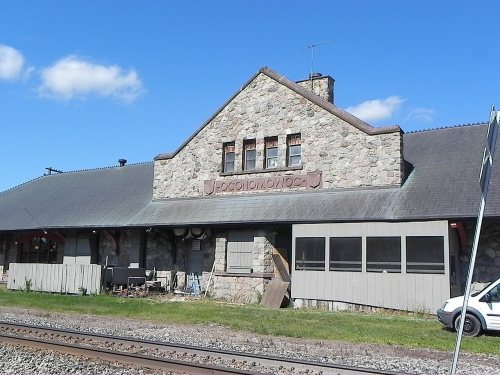
6 listings: 6 buildings, among them the Oconomowoc Depot (listed 1980, the first). 7 historic buildings in all.
How old are the homes in Oconomowoc?
14% of Oconomowoc’s homes were built before 1940 (Census estimate, ±2.4 points), against a typical 12% for a Wisconsin town; the median home was built in 1982.
Founding dates: Wikidata, Wikipedia, the U.S. post office records of Blevins & Helbock (CC0) and the Census. Homes by year built: Census ACS 2020–24. National Register of Historic Places: National Park Service (list of May 22, 2026). Old photos, postcards and papers: Wikimedia Commons, the Library of Congress and other public archives, credited on each item’s page. Maps: U.S. Geological Survey historical topographic maps (via Esri) and Sanborn fire-insurance maps (Library of Congress). History text and census tables: Wikipedia (CC BY-SA 4.0). Places that used to be: USGS Geographic Names Information System (2021).
From Wikimedia Commons (9), the Library of Congress (5), Wikidata (4), the National Register of Historic Places (6), Wikipedia, Wikidata and Wikipedia for famous people, U.S. Geological Survey historical maps, U.S. Census counts (via Wikipedia), the US Post Offices dataset (Blevins & Helbock), the USGS Geographic Names Information System, Sanborn fire insurance maps (Library of Congress) and old county and town histories (Internet Archive). Archive images are copied here with their credits and licenses, shown on each photo’s page. Refreshed monthly.


 1872
 1885
 1890
 1895
 1906
 c. 1910
 1936
 1941
 1941
 1941
 1941
 1941
 2009
 2008