Founding year: the first Greenwood post office (Blevins & Helbock, CC0).The full story ↓
History grade
What drives Greenwood’s History grade
On its age, its old homes and the National Register, Greenwood is more historic than 64% of U.S. towns. Its National Register listings hold the grade up; its age pulls it down.
B
HistoryA character grade: shown, never part of Greenwood’s overall grade.
Wisconsin towns list more on the Register than most of the country (a typical Wisconsin town has 3.0 per 10,000 residents, the U.S. 2.4), so Greenwood’s 18.2 sits above most of its state (82% of Wisconsin towns have fewer) while its 2 historic buildings outnumber those of 60% of U.S. towns.
How sure. Graded on any two of the three inputs instead, the letter would range from B− to A−. The pre-1940 share is a Census survey estimate (±7.0 points). The founding year is the first post office, not a stated founding date.
Founding year: the first post office (other dates in Quick answers). Homes: Census ACS 2020–24. National Register: National Park Service, May 2026 list; each listing counted once (boundary changes and added documentation belong to their listing), and a historic district counts its contributing buildings. How TownRatings grades history →
What stands out about Greenwood’s past
Read from the archive, the National Register and the record. The page puts what stands out first.
Fire insurance maps drew every building, what it was made of and what it was used for, so insurers could price the risk of fire. Pick a year, then a sheet.
1894Sheet 1 of 1
Edition
Sheets
BrickWoodStone
Sanborn Map Company, via the Library of Congress. Editions published in 1930 or earlier, which are in the public domain.
In the years just before settlement, the future site of Greenwood was a hunting ground shared by Ojibwe, Menominee and Ho-Chunk people. The Black River ran quietly through immense forests until Mormon loggers came upstream in 1844, working out of a camp downstream from Greenwood's site, cutting white pine logs and floating them down the rivers to be used in their temple in Nauvoo, Illinois.
In 1847 or 1848 Van Dusen and Waterman built a mill on the west side of the Black River across from where Greenwood would grow. Albert Lambert built another mill nearby. Elijah and Frederick Eaton bought Van Dusen's mill in 1854. A little mill town began to take shape, called Eatonville for a while.
The Greenwood post office opened in 1872, the earliest record of the town by name (U.S. post office records).
How does Greenwood rank for history?
Greenwood is more historic than 64% of U.S. towns. The History grade combines the town’s founding era, the share of homes built before 1940 and its National Register listings. It’s a character grade, so it isn’t part of the overall grade. How it works.
What is on the National Register in Greenwood?
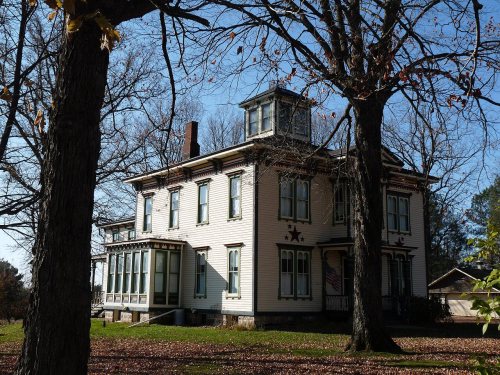
One place: the Robert Schofield House (listed 1982).
How old are the homes in Greenwood?
19% of Greenwood’s homes were built before 1940 (Census estimate, ±7.0 points), against a typical 12% for a Wisconsin town; the median home was built in 1973.
Founding dates: Wikidata, Wikipedia, the U.S. post office records of Blevins & Helbock (CC0) and the Census. Homes by year built: Census ACS 2020–24. National Register of Historic Places: National Park Service (list of May 22, 2026). Old photos, postcards and papers: Wikimedia Commons, the Library of Congress and other public archives, credited on each item’s page. Maps: U.S. Geological Survey historical topographic maps (via Esri) and Sanborn fire-insurance maps (Library of Congress). History text and census tables: Wikipedia (CC BY-SA 4.0). Places that used to be: USGS Geographic Names Information System (2021).
From Wikimedia Commons (6), the Library of Congress (1), Wikidata (1), the National Register of Historic Places (1), Wikipedia, Wikidata and Wikipedia for famous people, U.S. Geological Survey historical maps, U.S. Census counts (via Wikipedia), the US Post Offices dataset (Blevins & Helbock), the USGS Geographic Names Information System and Sanborn fire insurance maps (Library of Congress). Archive images are copied here with their credits and licenses, shown on each photo’s page. Refreshed monthly.


 Date?
 2024
 2024
 2015
 2015
 2015
 2011