Founding year: the first Albion post office (Blevins & Helbock, CC0).The full story ↓
History grade
What drives Albion’s History grade
On its age, its old homes and the National Register, Albion is more historic than 85% of U.S. towns. All 3 inputs are above most U.S. towns; its age ranks highest and its National Register listings lowest.
A−
HistoryA character grade: shown, never part of Albion’s overall grade.
Wisconsin towns list more on the Register than most of the country (a typical Wisconsin town has 3.0 per 10,000 residents, the U.S. 2.4), so Albion’s 10.1 sits above most of its state (76% of Wisconsin towns have fewer) while its 2 historic buildings outnumber those of 60% of U.S. towns.
How sure. Graded on any two of the three inputs instead, the letter would still be A−. The pre-1940 share is a Census survey estimate (±5.7 points). The founding year is the first post office, not a stated founding date.
Founding year: the first post office (other dates in Quick answers). Homes: Census ACS 2020–24. National Register: National Park Service, May 2026 list; each listing counted once (boundary changes and added documentation belong to their listing), and a historic district counts its contributing buildings. How TownRatings grades history →
What stands out about Albion’s past
Read from the archive, the National Register and the record. The page puts what stands out first.
The Town of Christiana was created from the Town of Albion on May 6, 1847.
Freeborn Sweet was the first settler of the Town of Albion, migrating from Oneida County, New York in August 1841. Other settlers began arriving that fall. In 1842, the first inhabitants in what would become the hamlet of Albion arrived, and the following year they organized a Seventh Day Baptist Church, which became a prominent institution in the community.
Passages that mention Albion, cut from the printed page as they were published.
History of Dane County, Wisconsin ... preceded by a history of Wisconsin, statistics of the state, and an abstract of its laws and constitution and of the Constitution of the United States1880 · page 513Read the page →
Read the text
Albion Academy located in the village of Albion, was founded in 1854, with C. R. Head, as President ; J. H. Potter, as Secretary, and J. A. Potter as Treasurer. The first building was completed in September, 1854, and the school began its work under the direction of T. R. Williams, A. M., D. D. His very able administration continued until 1860, when he resigned in order to engage in the ministry, and A. R. Cornwall, A. M., was appointed to supply the vacancy.
Text read by machine from the scan; it may contain errors.
History of Dane County, Wisconsin ... preceded by a history of Wisconsin, statistics of the state, and an abstract of its laws and constitution and of the Constitution of the United States1880 · page 828Read the page →
Read the text
The town of Sun Prairie, all the present towns of Bristol, Sun Prairie, Medina and Yorii, and ' the village of Sun Prairie ; the town ot Rome, all of what now constitutes Oregon, Fitchburg and Dunn ; the town of Albion, so much as is now Albion and Christiana ; Rutland is as first -constituted ; and so also is Dun-kirk, and the village of Stoughton. These six towns are usually designated as "the original towns of the county."
Text read by machine from the scan; it may contain errors.
A history of Madison, the capital of Wisconsin1874Read the page →
Read the text
The village of Albion lies in the central part of the town, and is a small settlement. The township lies in the southeast corner of Dane county. It is well watered, and the lands generally are of an excellent quality. Rice lake is about six miles long, north and south, and takes a part of sections 12 and 13 ; and the western part of Lake Koshkonong covers a part of sec¬ tions 25 and 36.
Text read by machine from the scan; it may contain errors.
Scans and text from the Internet Archive. Books published in 1930 or earlier, which are in the public domain.
Timeline
Albion, 1846 to 1953
Woven from the archive, old maps, post office records, the National Register and the people born here.
The Albion post office opened in 1847, the earliest record of the town by name (U.S. post office records).
How does Albion rank for history?
Albion is more historic than 85% of U.S. towns. The History grade combines the town’s founding era, the share of homes built before 1940 and its National Register listings. It’s a character grade, so it isn’t part of the overall grade. How it works.
What is on the National Register in Albion?
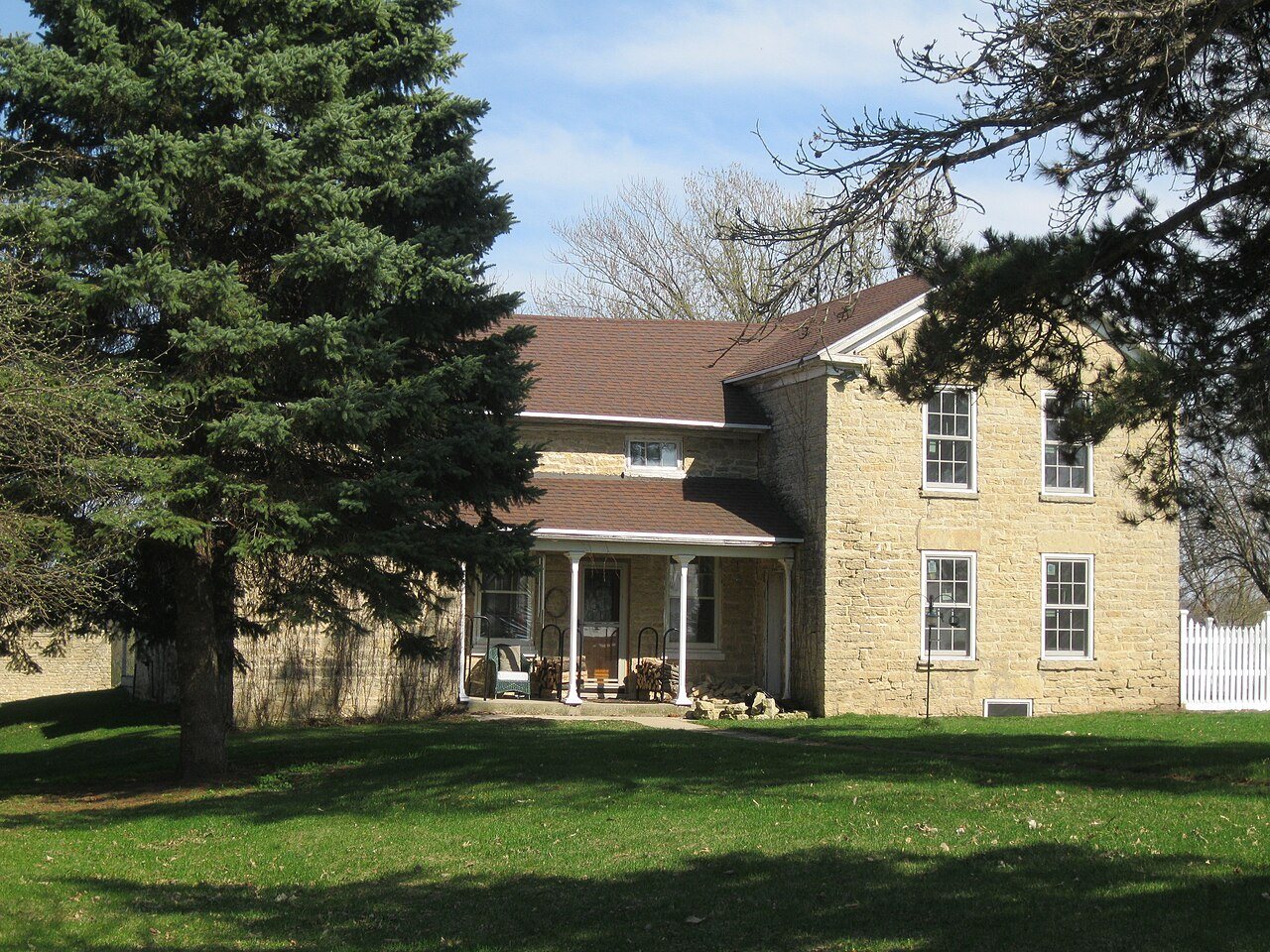
One place: the Samuel Hall House (listed 1993).
How old are the homes in Albion?
22% of Albion’s homes were built before 1940 (Census estimate, ±5.7 points), against a typical 12% for a Wisconsin town; the median home was built in 1972.
Founding dates: Wikidata, Wikipedia, the U.S. post office records of Blevins & Helbock (CC0) and the Census. Homes by year built: Census ACS 2020–24. National Register of Historic Places: National Park Service (list of May 22, 2026). Old photos, postcards and papers: Wikimedia Commons, the Library of Congress and other public archives, credited on each item’s page. Maps: U.S. Geological Survey historical topographic maps (via Esri) and Sanborn fire-insurance maps (Library of Congress). History text and census tables: Wikipedia (CC BY-SA 4.0). Places that used to be: USGS Geographic Names Information System (2021).
From Wikidata (1), the National Register of Historic Places (1), Wikipedia, Wikidata and Wikipedia for famous people, U.S. Geological Survey historical maps, the US Post Offices dataset (Blevins & Helbock), the USGS Geographic Names Information System and old county and town histories (Internet Archive). Archive images are copied here with their credits and licenses, shown on each photo’s page. Refreshed monthly.