7 places in town are on the National Register, among them three historic districts with 149 buildings between them. Below: 17 old photos and papers, maps from 1919 on, and the census since 1800.
Founding year: the first Waitsfield post office (Blevins & Helbock, CC0).
History grade
What drives Waitsfield’s History grade
On its age, its old homes and the National Register, Waitsfield is more historic than 90% of U.S. towns. All 3 inputs are above most U.S. towns; its National Register listings ranks highest and its share of homes from before 1940 lowest.
A
HistoryA character grade: shown, never part of Waitsfield’s overall grade.
Vermont towns list more on the Register than most of the country (a typical Vermont town has 147 per 10,000 residents, the U.S. 2.4), so Waitsfield’s 819 sits above most of its state (95% of Vermont towns have fewer) while its 157 historic buildings outnumber those of 92% of U.S. towns.
How sure. Graded on any two of the three inputs instead, the letter would range from A− to A. The pre-1940 share is a Census survey estimate (±6.4 points). The founding year is the first post office, not a stated founding date.
Founding year: the first post office (other dates in Quick answers). Homes: Census ACS 2020–24. National Register: National Park Service, May 2026 list; each listing counted once (boundary changes and added documentation belong to their listing), and a historic district counts its contributing buildings. How TownRatings grades history →
What stands out about Waitsfield’s past
Read from the archive, the National Register and the record. The page puts what stands out first.
Nothing in the archives for these yearsWeddings on Main Street, storms, parades, school pictures, the old store. If it’s in your family album, it belongs here.
Wikipedia doesn’t have a history of Waitsfield yet. The photos, dates and memories neighbors add here are how it gets written.
Waitsfield is a town in Washington County, Vermont, United States. The population was 1,844 as of the 2020 census. It was created by a Vermont charter on February 25, 1782, and was granted to militia Generals Benjamin Wait, Roger Enos and others. The town was named after Wait.
Its first post office opened in 1819. Between the 2010 and 2020 censuses its population grew from 1,719 to 1,844 (+7%).
Intro from Wikipedia. Population: U.S. Census Bureau.
From the old history books
What they wrote about Waitsfield, 1892–1909
Passages that mention Waitsfield, cut from the printed page as they were published.
Historical address delivered August 7, 1889, at the centennial celebration1892 · page 14Read the page →
Read the text
oars, and the idea of connecting islands with each other and with mainland by bridges built with the aid of state appropriations was then too remote to be practicable. The grant of the township of Waitsfield was made by the governor and council at Bennington Feb.. 25, 1782, with the following special stipulations : "Resolved, That the proprietors of the township of Waitsfield granted to Gen. Roger Enos, Col. Benjamin
Text read by machine from the scan; it may contain errors.
History of the town of Waitsfield, Vermont, 1782-1908, with family genealogies1909 · page 130Read the page →
Read the text
work was undertaken in 1833, when a plan of a house to be 36 X 46 feet in size was prepared and the following agreement indorsed thereon for signature: "In consideration that Rufus Barret of Waitsfield, Builder, causes to be Built A Meeting House on the spot of ground Lying between the Parsonage lot and Joel Foster's Line (it being in Waitsfield) For the use and accommodation of the Methodist Episcopal Church in Waitsfield and Fayston as a House of
Text read by machine from the scan; it may contain errors.
History of the town of Waitsfield, Vermont, 1782-1908, with family genealogies1909 · page 111Read the page →
Read the text
Waitsfield, February 6, 1810. Pursuant to letters missive from the Congregational Church of Christ in Waitsfield, an Eclesiastical Council convened at said Waitsfield on the 6th day of February, 1810, at the house of Gen. Benjamin Wait, for the purpose of affording their assistance in the ordiiiation of Mr. Amariah Chandler to the pastoral care of said Church. Present from the Church in Brookfield, Rev. Elijah Lyman, Pastor, Brother Phinehas Kellogg, delegate;
Text read by machine from the scan; it may contain errors.
Scans and text from the Internet Archive. Books published in 1930 or earlier, which are in the public domain.
Timeline
Waitsfield, 1816 to 2020
Woven from the archive, old maps, post office records, the National Register and the people born here.
The Waitsfield post office opened in 1819, the earliest record of the town by name (U.S. post office records).
How does Waitsfield rank for history?
Waitsfield is more historic than 90% of U.S. towns. The History grade combines the town’s founding era, the share of homes built before 1940 and its National Register listings. It’s a character grade, so it isn’t part of the overall grade. How it works.
What is on the National Register in Waitsfield?
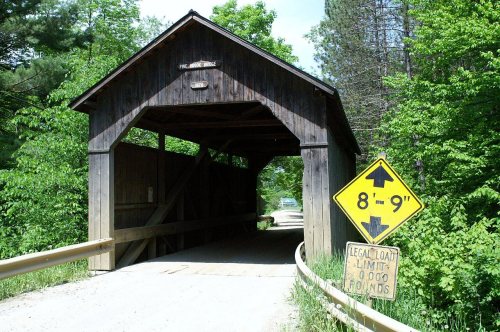
7 listings: 2 buildings, 3 historic districts, the Waitsfield Village Historic District, the Mad River Valley Rural Historic District and the Waitsfield Common Historic District, with 149 contributing buildings, and 2 structures. 157 historic buildings in all.
How old are the homes in Waitsfield?
16% of Waitsfield’s homes were built before 1940 (Census estimate, ±6.4 points), against a typical 22% for a Vermont town; the median home was built in 1980.
Founding dates: Wikidata, Wikipedia, the U.S. post office records of Blevins & Helbock (CC0) and the Census. Homes by year built: Census ACS 2020–24. National Register of Historic Places: National Park Service (list of May 22, 2026). Old photos, postcards and papers: Wikimedia Commons, the Library of Congress and other public archives, credited on each item’s page. Maps: U.S. Geological Survey historical topographic maps (via Esri) and Sanborn fire-insurance maps (Library of Congress). History text and census tables: Wikipedia (CC BY-SA 4.0). Places that used to be: USGS Geographic Names Information System (2021).
From the Library of Congress (17), Wikidata (1), the National Register of Historic Places (7), Wikidata and Wikipedia for famous people, U.S. Geological Survey historical maps, U.S. Census counts (via Wikipedia), the US Post Offices dataset (Blevins & Helbock), the USGS Geographic Names Information System and old county and town histories (Internet Archive). Archive images are copied here with their credits and licenses, shown on each photo’s page. Refreshed monthly.




 1940
 1940
 1940
 1940
 1940
 1940
 1940
 1940
 1940
 1940
 1940
 1940
 1940
 1940
 1940
 1940
 1940


