Richmond dates to 1794, and 15% of its homes were built before 1940
More historic than 77% of U.S. towns · #51 of 71 in Vermont. What drives it
8 places in town are on the National Register, among them the Round Church, a National Historic Landmark, and three historic districts with 14 buildings between them. Below: maps from 1894 on and the census since 1800.
Founding year: Wikidata; Wikipedia’s history section gives the same year. First post office: 1808.The full story ↓
History grade
What drives Richmond’s History grade
On its age, its old homes and the National Register, Richmond is more historic than 77% of U.S. towns, #51 of 71 in Vermont. All 3 inputs are above most U.S. towns; its age ranks highest and its share of homes from before 1940 lowest.
A−
HistoryA character grade: shown, never part of Richmond’s overall grade.
Vermont towns list more on the Register than most of the country (a typical Vermont town has 147 per 10,000 residents, the U.S. 2.4), so Richmond’s 43.3 sits near the middle of its state (46% of Vermont towns have fewer) while its 18 historic buildings outnumber those of 79% of U.S. towns.
How sure. Graded on any two of the three inputs instead, the letter would range from B+ to A−. The pre-1940 share is a Census survey estimate (±5.3 points). Two sources give 1794.
Founding year: Wikidata (other dates in Quick answers). Homes: Census ACS 2020–24. National Register: National Park Service, May 2026 list; each listing counted once (boundary changes and added documentation belong to their listing), and a historic district counts its contributing buildings. How TownRatings grades history →
What stands out about Richmond’s past
Read from the archive, the National Register and the record. The page puts what stands out first.
National Park Service, National Register of Historic Places. Photos from Wikimedia Commons, credited on each place’s page.
Every building
Richmond, building by building, 1894–1910
Fire insurance maps drew every building, what it was made of and what it was used for, so insurers could price the risk of fire. Pick a year, then a sheet.
1894Sheet 1 of 1
Edition
Sheets
BrickWoodStone
Sanborn Map Company, via the Library of Congress. Editions published in 1930 or earlier, which are in the public domain.
In 1775, Amos Brownson and John Chamberlain made the first settlement attempt. They abandoned their efforts in the fall of that year, but returned in the spring of 1784, at the close of the Revolutionary War. Richmond was incorporated by the General Assembly on October 27, 1794, then organized in 1795. The Winooski and Huntington rivers both offered locations for water mills. Industries began to manufacture wagons, harnesses, tinware, brass, cabinet work and woodenware. By 1859, the population was 1,453.
Richmond is noted for the Round Church, a rare 16-sided meetinghouse that was erected in 1812–1813. Originally designed to be a town meeting place and a Protestant church, today it is open to the public and a popular tourist destination.
Passages that mention Richmond, cut from the printed page as they were published.
History of Chittenden County, Vermont, with illustrations and biographical sketches of some of its prominent men and pioneers1886 · page 750Read the page →
Read the text
GILLETT, HENRY, was born in Richmond on the 13th of January, 1818. He was educated at the Hinesburg and Montpelier Academies, after which he returned to his father's farm in Richmond. His grandfather, Asa Gillett, sen., the first of the family to come to Vermont, left Pittsfield, Mass., before the town of Richmond was incorporated, and settled on the strip of land which then formed a part of Huntington, and was afterwards annexed to Richmond. His son, Asa, jr., father of the subject of this sketch, was born in July, 1790, on the farm called the Captain Russell place, about one-half mile north from Richmond village, and died in August, 1869, at his home in
Text read by machine from the scan; it may contain errors.
History of Chittenden County, Vermont, with illustrations and biographical sketches of some of its prominent men and pioneers1886 · page 368Read the page →
Read the text
The regiment was one of the first to enter Richmond after its evacuation and was stationed at that city until mustered out. On the 13th of June the original members of the regiment and the recruits whose terms of service were to expire before the ist of October, were mustered out. The remaining members of the regiment were consolidated into a battalion of four companies, which was stationed at Richmond for a time, and then moved to Portsmouth, Va., and mustered out December i, 1865.
Text read by machine from the scan; it may contain errors.
Scans and text from the Internet Archive. Books published in 1930 or earlier, which are in the public domain.
Timeline
Richmond, 1794 to 1996
Woven from the archive, old maps, post office records, the National Register and the people born here.
In 1794, according to Wikidata and Wikipedia’s history of the town. Richmond’s post office opened in 1808, and the census of 1800 counted 718 people here.
How does Richmond rank for history?
Richmond is more historic than 77% of U.S. towns, #51 of 71 in Vermont. The History grade combines the town’s founding era, the share of homes built before 1940 and its National Register listings. It’s a character grade, so it isn’t part of the overall grade. How it works.
What is on the National Register in Richmond?
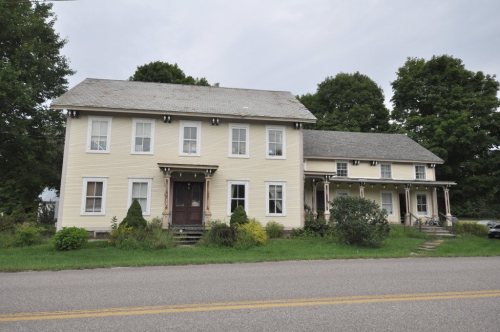
8 listings: 4 buildings, among them the Round Church (a National Historic Landmark since 1996), 3 historic districts, the Martin M. Bates Farmstead, the M. S. Whitcomb Farm and the Gray Rocks, with 14 contributing buildings, and 1 structure. 18 historic buildings in all.
How old are the homes in Richmond?
15% of Richmond’s homes were built before 1940 (Census estimate, ±5.3 points), against a typical 22% for a Vermont town; the median home was built in 1983.
Founding dates: Wikidata, Wikipedia, the U.S. post office records of Blevins & Helbock (CC0) and the Census. Homes by year built: Census ACS 2020–24. National Register of Historic Places: National Park Service (list of May 22, 2026). Old photos, postcards and papers: Wikimedia Commons, the Library of Congress and other public archives, credited on each item’s page. Maps: U.S. Geological Survey historical topographic maps (via Esri) and Sanborn fire-insurance maps (Library of Congress). History text and census tables: Wikipedia (CC BY-SA 4.0). Places that used to be: USGS Geographic Names Information System (2021).
From Wikimedia Commons (6), the National Register of Historic Places (8), Wikipedia, Wikidata and Wikipedia for famous people, U.S. Geological Survey historical maps, U.S. Census counts (via Wikipedia), the US Post Offices dataset (Blevins & Helbock), the USGS Geographic Names Information System, Sanborn fire insurance maps (Library of Congress) and old county and town histories (Internet Archive). Archive images are copied here with their credits and licenses, shown on each photo’s page. Refreshed monthly.


 ★ Landmark




 2009
 2009
 2008
 2006
 2006
 2004


