 I
Church · listed 1975Church of All SaintsOn the list as Leighton Buzzard Church of All SaintsPhoto: Nigel Cox · CC BY-SA 2.0
 Library at the Cedars School · Photo: Back ache · CC BY-SA 3.0
B−History Grade
History of Leighton Buzzard · Historic England
120 listed buildings, 1 of them Grade I
On the Historic England list, all of them stand inside Leighton Buzzard’s built-up area, 28 for every 10,000 residents. It also has 3 scheduled monuments. We have photos of 6 of its listed buildings and 4 old views of the town. 9.5% of its homes were built before 1919. Leighton Buzzard grades B− for history: #8 of 33 in Bedfordshire.
Listed buildings
120
28 per 10,000 residents
Grade I
1
exceptional interest
Grade II*
2
more than special interest
Scheduled monuments
3
nationally important sites
Homes built before 1919
9.5%
typical UK town 15%
In pictures
Leighton Buzzard in 10 photos and old views
Nearly every Grade I and II* building, photographed, and the town before 1950. Tap a photo to step through them full screen.
 Leighton Buzzard Church of All SaintsGrade I listed
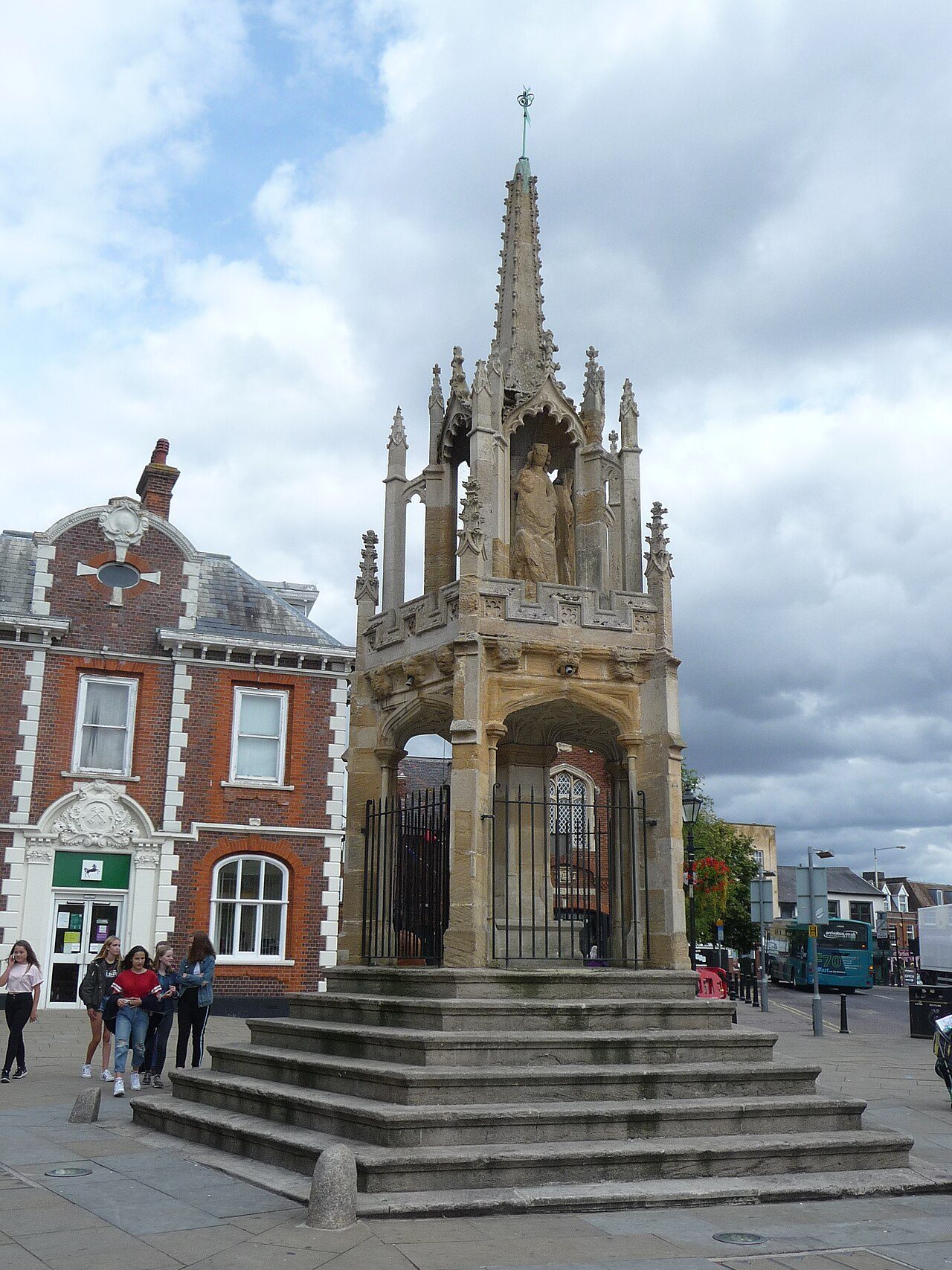 Market CrossGrade II* listed
 The Golden Bell Public HouseGrade II listed
 Canal House Grand Union HouseGrade II listed
 Barclays BankGrade II listed+5See all photos
Photos from Wikimedia Commons and Geograph, copied to our own server, each credited to its photographer with its licence; names open the building’s page or its official list entry.
Through time
Leighton Buzzard from 1903 to 1914
4 old photos and postcards, in date order. All public domain, made before 1950.
 1903
 1903
 1908
 1914
Public domain, from Wikimedia Commons, copied to our own server. Each credit opens the image’s page with its full description and history.
The map
Where Leighton Buzzard’s history is
Every Grade I and II* building, monument and historic park, over the age of each neighbourhood’s homes.
Grade IGrade II*Scheduled monument
Homes built before 1919, by neighbourhoodunder 10%10–25%25–50%50%+
1 of 29neighbourhoods have mostly pre-1919 homes; in the oldest, 55% were built before 1919.
Hover a dot for its name; tap one with a photo to open it.
120 listed buildings by grade
1 Grade I2 Grade II*117 Grade II
Historic England lists buildings in three grades: Grade I for buildings of exceptional interest (about 2.5% of all listed buildings), Grade II* for particularly important buildings of more than special interest (about 5.8%), and Grade II for buildings of special interest (about 91.7%). Listing protects the whole building, inside and out.
Every entry on the National Heritage List for England whose point lies inside the ONS 2022 built-up-area boundary. One list entry can cover a terrace or a group of buildings. Neighbourhood dots: the population-weighted centre of each Census 2021 output area, coloured by its neighbourhood’s (LSOA’s) share of homes built before 1919 (Valuation Office Agency, March 2025).
Grade I
The Grade I listed building in Leighton Buzzard
Buildings of exceptional interest, about 2.5% of all listed buildings. Every one is photographed. Each opens its own page, with the official list entry.
Grade II*
The 2 Grade II* listed buildings in Leighton Buzzard
Particularly important buildings of more than special interest. Every one is photographed.
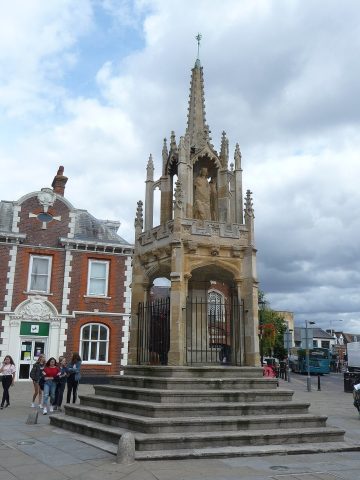 II*
Public · listed 1954Market CrossPhoto: Immanuel Giel · CC0
 II*
Public · listed 1954Library at the Cedars SchoolPhoto: Back ache · CC BY-SA 3.0
Historic streets
High Street has the most listed buildings
Streets by the listed entries with an address on them. One entry can be a whole terrace, so long rows count once.
High Street21 listed
Market Square13 listed
North Street11 listed
New Road5 listed
Church Road4 listed
Hockliffe Street4 listed
Lake Street4 listed
Southcott Village4 listed
Market Square (North Island Site)3 listed
Of the 120 entries, 74 are named by a street address; the rest are named buildings such as churches, halls and bridges.
What’s protected
Most of Leighton Buzzard’s listed buildings are homes
Every listed building sorted by what its list name says it is.
Houses, terraces & villas90
Inns, shops & warehouses14
Public & civic buildings8
Churches, chapels & priories3
Memorials, crosses & tombs3
Walls, gates & bridges2
90 entries (75%) are houses, terraces and villas. 3 are churches, chapels and priories, including 1 of the 1 Grade I buildings.
Buildings are sorted by words in each entry’s name (church, gate, inn, memorial…): the list’s open data has no building type. An entry named only by its address counts as a house.
Grade II
117 Grade II listed buildings
Most listed buildings are in this grade, which covers buildings of special interest. Open any building to read its official list entry.
All 117 Grade II listed buildings, A to Z
Assembly Hall at the Cedars SchoolBarclays BankBarn to West of Number 37Bedford Arms Public HouseBuxton HouseCanal House Grand Union HouseChelsea House Flats 1-7Church of St BarnabasFire StationGazebo at the LodgeHeath LodgeHoddesden VillasLeck HouseLeighton Buzzard Quaker Meeting HouseLeighton Buzzard War Memorial, including a pair of stone benchesLeighton Lock Cottage Grand Union CanalLinslade War MemorialMain Building of the Cedars SchoolNational Westminster BankNumbers 13 and 15 (Front Block Only)Old Bank HouseOutbuilding to the Black Horse Public HouseOxendon LodgePair of K6 Telephone Kiosks to East of Number 2Peacock Public HousePublic LibraryRavenstone ChambersShenley HouseStonhillThe Black Horse Public HouseThe Black Lion Public HouseThe Cross Keys InnThe Globe InnThe Golden Bell Public HouseThe Hunt LodgeThe KnollsThe Market TavernThe Red Lion Public HouseThe Roebuck Public HouseThe Round HouseThe Sun Public HouseThe Swan HotelUnicorn Club1, High Street1,2 and 3, Village Court1-5, Market Square1-5, Pulford Road10 and 12, High Street10, North Street10-14, Lammas Walk11 and 11A, Market Square12, Lake Street12, Market Square12, North Street13 Church Road13, High Street14, High Street15, Church Road15B, Market Square16 and 18, High Street16, Market Square17, Church Road17, High Street17, Hockliffe Street18 and 18A, Market Square19 and 21, Hockliffe Street19, High Street20 and 22, Lake Street21 Church Road21, High Street21A, Hockliffe Street22, Market Square24, Market Square25, Market Square (North Island Site)26, Lake Street26, Market Square27-31, North Street29, Market Square (North Island Site)3 and 5, North Street31, Market Square (North Island Site)33 and 35, North Street34 and 36, High Street35, High Street36, Southcott Village37, High Street37-51, North Street38 and 40, Stoke Road38, High Street39, High Street4, Hockliffe Street4, Market Square4, North Street4-14, Church Square40 and 42, New Road40, High Street41, High Street43 and 45, New Road43, High Street44 and 46, New Road44, High Street45 and 47, High Street46, High Street46, Southcott Village47, Southcott Village48 and 50, New Road48, Southcott Village51, High Street52 and 54, New Road52 and 54, North Street57 and 59, High Street5A and 7, North Street6 and 6A, Lake Street6 and 8, North Street6, Market Square7, Market Square9, Market Square9, North Street
Conservation areas
3 conservation areas cover 3.6% of Leighton Buzzard
Areas the council protects as a whole: demolition and changes to how buildings look need consent, and trees are protected.
Leighton Buzzard 197020 ha
Linslade 197412 ha
Southcott Village 19765 ha
37 hain conservation areas, of 1,048 ha inside the built-up area.
The first, Leighton Buzzard, was designated in 1970; the newest, Southcott Village, in 1976. 107 of the 120 listed buildings stand in one.
Historic England’s conservation areas layer, supplied by councils (incomplete in places, so a page fact, never graded). Hectares are the part of each area inside the built-up area.
How the list grew
More than half of Leighton Buzzard’s listed buildings were added in one year, 1975
The year each building now on the list was first listed.
1975 · 951954 · 14
19501960197019801990200020102020
The first 14 entries were listed in 1954. 95 came in 1975, in the national resurvey of the 1970s and 80s. Only 2 have been added in the last 15 years.
Monuments & landscapes
Monuments, parks and gardens
Designations that overlap the town by a tenth of their area or half a hectare.
3 scheduled monuments
Nationally important archaeological sites and monuments, protected by law; work on them needs consent from the Secretary of State, advised by Historic England.
History Grade
Leighton Buzzard grades B− for history
Protected heritage and the age of the town’s homes, against all UK towns.
Protected heritage, for its size and in all (130 points, 30 per 10,000 residents)More than 66% of UK towns
Homes built before 1919 (9.5%)More than 23% of UK towns
Two measures, each ranked against every UK town of 1,000 or more, with protected heritage counting twice as much as the age of homes. Protected heritage counts each listed building by its grade (Grade I three points, II* two, II one), each scheduled monument and battlefield two, and each registered park or garden by its grade; it is ranked both per 10,000 residents and as a total, so a village with one fine church doesn’t outrank a historic city. The second measure is the share of homes built before 1919, from the Valuation Office Agency’s council tax records. History is a character grade: it describes the town and isn’t part of the overall grade.
Homes by age
9.5% of Leighton Buzzard’s homes were built before 1919
Every home by when it was built, from council tax records, against England & Wales (the dark tick).
8.1%
Before 1900
1.4%
1900–18
0.9%
1919–29
3%
1930s
4%
1945–54
8.9%
1955–64
11%
1965–72
22%
1973–82
5.6%
1983–92
3.1%
1993–99
12%
2000–08
7.8%
2009–15
12%
2016–25
Leighton BuzzardEngland & Wales
8.1% of homes are Victorian or older, against 16% across England and Wales. The busiest period since was 1973–82, which added 22% of today’s homes.
Valuation Office Agency, council tax stock of properties by build period, 31 March 2025, for the neighbourhoods (LSOAs) that make up the town, split by where their residents live. Homes with no recorded build period (0 here) are left out; 1939–44 is not a period in the data.
Born here
8 notable people born in Leighton Buzzard before 1900
Their lives on one timeline, earliest first.
Matthew Mead
Francis Augustus Cox
Samuel Claridge
Harry Brown
Christian Tindall
J. E. M. Pritchard
Edgar Allison Peers
Harry Pantling
16001650170017501800185019001950

Francis Augustus Cox1783–1853 · English writer and Baptist minister
EP
Edgar Allison Peers1891–1952 · Scholar in Hispanic Studies and educationist (1891–1952)

Matthew Mead1629–1699 · English minister
HP
Harry Pantling1891–1952 · English footballer (1891-1952)

Samuel Claridge1828–1919 · Mormon leader
HB
Harry Brown1863–1925 · Western Australian politician
CT
Christian Tindall1878–1951 · British cricketer (1878-1951)

J. E. M. Pritchard1889–1921 · RAF officer and mining engineer (1889–1921)
Everyone born in Leighton Buzzard → Birthplaces from Wikidata; portraits from Wikimedia Commons.
Neighbours
Listed buildings in the places around Leighton Buzzard
| Town | People | Listed | Grade I | History |
|---|---|---|---|---|
| Leighton Buzzard | 42,736 | 120 | 1 | B− |
| Heath and Reach | 1,451 | 20 | 0 | B+ |
| Wing | 2,979 | 18 | 1 | B+ |
| Hockliffe | 1,068 | 16 | 0 | B+ |
| Stoke Hammond | 1,155 | 11 | 0 | B− |
| Eaton Bray and Edlesborough | 4,201 | 35 | 2 | B+ |
| Stewkley | 1,421 | 30 | 1 | A− |
| Totternhoe | 1,017 | 12 | 1 | B− |
In brief
Leighton Buzzard in brief
The official list counts 120 listed buildings in Leighton Buzzard, 1 of them Grade I, including Church of All Saints. High Street alone has 21 listed buildings. Its older streets lie in 3 conservation areas, the first designated in 1970. Of the whole list, 75% are houses, terraces and villas.
Francis Augustus Cox (1783), Edgar Allison Peers (1891) and Matthew Mead (1629) are among the 8 people born here before 1900. Its homes are mostly newer: 9.5% were built before 1919, against 15% in the typical UK town. More than half went on the list in a single year, 1975: 95 of 120. The rest is about typical: it has one Grade I building, about typical for a town its size (the middle one has 1); per resident it sits near the middle of UK towns; and it also has 3 scheduled monuments.
Questions about Leighton Buzzard’s history
How many listed buildings are there in Leighton Buzzard?
Historic England lists 120 buildings inside Leighton Buzzard’s built-up area: 1 Grade I, 2 Grade II* and 117 Grade II.
What are the Grade I listed buildings in Leighton Buzzard?
One: Leighton Buzzard Church of All Saints.
Which street in Leighton Buzzard has the most listed buildings?
High Street (21), Market Square (13) and North Street (11) have the most listed entries named by an address. One entry can be a whole terrace.
Are there scheduled monuments in Leighton Buzzard?
Yes, 3 scheduled monuments, including Bowl barrow east of the Knolls, Bowl barrow south of the Knolls and Leighton Buzzard market cross.
How many conservation areas are there in Leighton Buzzard?
3, covering about 37 hectares of the town. The largest are Leighton Buzzard and Linslade.
When were Leighton Buzzard’s buildings listed?
The first in 1954; the most, 95, in 1975.
Are there old photos of Leighton Buzzard?
Yes: 4 public-domain photos and postcards from 1903 to 1914, all on this page.
Who was born in Leighton Buzzard?
Among people born before 1900: Francis Augustus Cox (1783), Edgar Allison Peers (1891), Matthew Mead (1629), Harry Pantling (1891) and Samuel Claridge (1828).
How old are the homes in Leighton Buzzard?
9.5% of homes were built before 1919 and 13% before 1940, from the Valuation Office Agency’s council tax records (March 2025).
© Historic England 2026. Contains Ordnance Survey data © Crown copyright and database right 2026. The National Heritage List for England is the official, up-to-date register of all nationally protected historic buildings and sites in England; check an entry on Historic England’s website before relying on it.
Sources: Historic England, National Heritage List for England (listed buildings, scheduled monuments, registered parks and gardens, battlefields, World Heritage Sites), October 2026, inside the ONS 2022 built-up-area boundary · Valuation Office Agency, Council Tax: stock of properties by build period (31 March 2025) · TownRatings grades: our own summary of the data, ranked against UK towns only · Historic England conservation areas (supplied by local planning authorities; October 2026). All under the Open Government Licence v3.0.
Contains public sector information licensed under the Open Government Licence v3.0. Contains HM Land Registry data © Crown copyright and database right 2026. Contains OS data © Crown copyright and database right 2026 (ONS boundaries). Northern Ireland: Source: NISRA; contains Land & Property Services data and Ordnance Survey of Northern Ireland information, © Crown copyright, licensed under the Open Government Licence v3.0. Scotland: contains National Records of Scotland data, Registers of Scotland data and SEPA data, © Crown copyright / © SEPA 2025, licensed under the Open Government Licence v3.0.