Wilkinsburg dates to 1790, and 41% of its homes were built before 1940
More historic than 97% of U.S. towns · #82 of 1,035 in Pennsylvania. What drives it
5 places in town are on the National Register, among them two historic districts with 238 buildings between them. Below: 6 old photos and papers, maps from 1904 on, and the census since 1880.
Founding year: Wikidata. First post office: 1840.The full story ↓
History grade
What drives Wilkinsburg’s History grade
On its age, its old homes and the National Register, Wilkinsburg is more historic than 97% of U.S. towns, #82 of 1,035 in Pennsylvania. All 3 inputs are above most U.S. towns; its share of homes from before 1940 ranks highest and its age lowest.
A+
HistoryA character grade: shown, never part of Wilkinsburg’s overall grade.
Pennsylvania towns list about as much on the Register as the country (a typical Pennsylvania town has 2.1 per 10,000 residents, the U.S. 2.4), so Wilkinsburg’s 172 sits above most of its state (91% of Pennsylvania towns have fewer) while its 241 historic buildings outnumber those of 94% of U.S. towns.
NoteThe founding year comes from Wikidata alone; no second source gives 1790.
How sure. Graded on any two of the three inputs instead, the letter would range from A to A+. The pre-1940 share is a Census survey estimate (±4.3 points).
Founding year: Wikidata (other dates in Quick answers). Homes: Census ACS 2020–24. National Register: National Park Service, May 2026 list; each listing counted once (boundary changes and added documentation belong to their listing), and a historic district counts its contributing buildings. How TownRatings grades history →
What stands out about Wilkinsburg’s past
Read from the archive, the National Register and the record. The page puts what stands out first.
Wilkinsburg is located in an area of the Appalachian Plateau where various land and water transportation routes join, an area which Native Americans have inhabited for thousands of years. Geologically, Wilkinsburg centers on a valley going through the hills located east of the three rivers confluence: namely, the Allegheny River, the Monongahela River, and the Ohio River. The Wilkinsburg valley eased passage by land through the barrier of the Appalachian Mountains, for example travel to and from Philadelphia and other Atlantic coast areas, including travel through the Cumberland Gap. The nearby meeting of the three rivers facilitated passage by water and by land alongside the rivers, which eventually joining the south-flowing Mississippi River, meeting the Gulf of Mexico, and so linking with oceanic trade. This made Wilkinsburg a nexus for divergent routes, where travel from the east an…
Passages that mention Wilkinsburg, cut from the printed page as they were published.
History of Allegheny county, Pennsylvania1889 · page 419Read the page →
Read the text
township, Allegheny county, was James Mc- Kelvy, who emigrated to Western Pennsylvania from County Down, Ireland, and settled near the present town of Wilkinsburg, where he lived the rest of his days. He had seven children, of whom James, Jr., the eldest, born in 1800, came to Wilkinsburg with his father, and always lived there; followed
Text read by machine from the scan; it may contain errors.
History of Allegheny county, Pennsylvania1889 · page 120Read the page →
Read the text
At Wilkinsburg is located the Western Pennsylvania Institution for the Instruction of the Deaf and Dumb, an account of which will be found on page 416, Part I- The Women’s Christian Association of Pittsburgh has established two charitable institutions at Wilkinsburg, a “Home for Aged Protestant Women ” and a similar home for men. The former was organized June 10, 1869, and incorporated March 25, 1871. The latter was opened in 1872, as ‘ ‘ The Sheltering Arms. ’ ’ The buildings in both instances are brick, and live acres for each were donated by James Kelly.
Text read by machine from the scan; it may contain errors.
History of Allegheny county, Pennsylvania1889 · page 121Read the page →
Read the text
Wilkinsburg was incorporated December 2, 1887, by decree of court. Brushton, the first station on the Pennsylvania railroad beyond the city limits, is a small suburban town. The works of the PhcBnix Glass-Pot manufactory are located here.
Text read by machine from the scan; it may contain errors.
Scans and text from the Internet Archive. Books published in 1930 or earlier, which are in the public domain.
Timeline
Wilkinsburg, 1790 to 1958
Woven from the archive, old maps, post office records, the National Register and the people born here.
Nothing in the archives for these yearsWeddings on Main Street, storms, parades, school pictures, the old store. If it’s in your family album, it belongs here.
Nothing in the archives for these yearsWeddings on Main Street, storms, parades, school pictures, the old store. If it’s in your family album, it belongs here.
In 1790, according to Wikidata. Wilkinsburg’s post office opened in 1840, and the census of 1880 counted 1,529 people here.
How does Wilkinsburg rank for history?
Wilkinsburg is more historic than 97% of U.S. towns, #82 of 1,035 in Pennsylvania. The History grade combines the town’s founding era, the share of homes built before 1940 and its National Register listings. It’s a character grade, so it isn’t part of the overall grade. How it works.
What is on the National Register in Wilkinsburg?
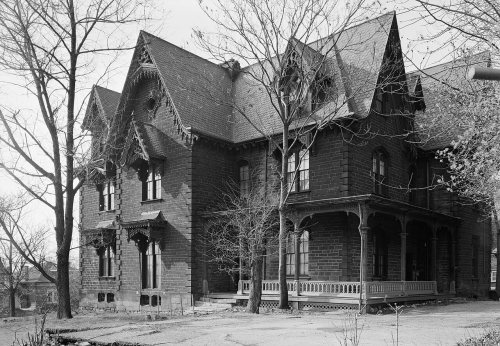
5 listings: 3 buildings, among them the John F. Singer House (listed 1974, the first), and 2 historic districts, the Hamnett Historic District and the Wilkinsburg Historic District, with 238 contributing buildings. 241 historic buildings in all.
How old are the homes in Wilkinsburg?
41% of Wilkinsburg’s homes were built before 1940 (Census estimate, ±4.3 points), against a typical 18% for a Pennsylvania town; the median home was built in 1947.
Founding dates: Wikidata, Wikipedia, the U.S. post office records of Blevins & Helbock (CC0) and the Census. Homes by year built: Census ACS 2020–24. National Register of Historic Places: National Park Service (list of May 22, 2026). Old photos, postcards and papers: Wikimedia Commons, the Library of Congress and other public archives, credited on each item’s page. Maps: U.S. Geological Survey historical topographic maps (via Esri) and Sanborn fire-insurance maps (Library of Congress). History text and census tables: Wikipedia (CC BY-SA 4.0). Places that used to be: USGS Geographic Names Information System (2021).
From Wikimedia Commons (6), the National Register of Historic Places (5), Wikipedia, Wikidata and Wikipedia for famous people, U.S. Geological Survey historical maps, U.S. Census counts (via Wikipedia), the US Post Offices dataset (Blevins & Helbock), the USGS Geographic Names Information System and old county and town histories (Internet Archive). Archive images are copied here with their credits and licenses, shown on each photo’s page. Refreshed monthly.






 1925
 c. 1930
